


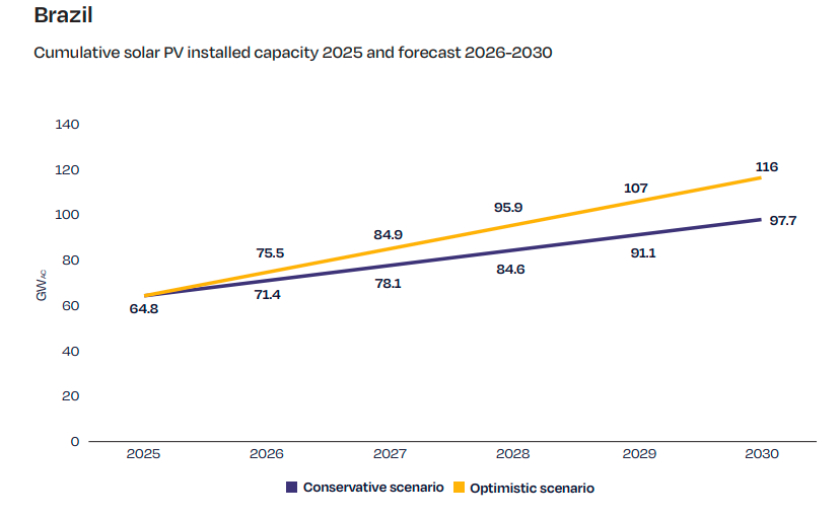
Brazil’s solar energy sector is navigating a complex mix of regulatory, economic, and infrastructure challenges while remaining one of the world’s most promising photovoltaic (PV) markets. According to ABSOLAR, the country is expected to install more than 10 GW of new solar capacity in 2026 and could reach between 97.7 GWAC and 115.6 GWAC of total solar PV capacity by 2030.
A major achievement for the industry came in 2025 when ABSOLAR secured government quotas that reduced import tariffs on PV modules from 25 percent to 9.6 percent for projects larger than 5 MW. Valid until July 2027, the measure is expected to generate tax exemptions worth $717.4 million (€621.8 million) between July 2025 and July 2026, followed by an additional $403.2 million (€349.5 million) from July 2026 to July 2027.
Despite policy support, distributed solar generation continues to face grid connection challenges due to alleged reverse power flow issues. Even with these constraints, distributed solar installations exceeded ABSOLAR forecasts by 6 percent in 2025, adding 8.8 GWAC of new capacity. Although this represented a 7.3 percent decline from 2024 levels, rising electricity prices and a resilient rooftop solar market helped sustain growth, SolarPower Europe report said.
Large-scale solar projects experienced a more difficult year. Brazil added only 2.8 GWAC of utility-scale solar capacity in 2025, significantly lower than the 5.6 GWAC commissioned in 2024. Increasing curtailment of operating solar plants led to financial losses, forcing developers to delay or postpone projects under development.
The regulatory environment remains a critical factor for future growth. In 2026, Brazil increased import tariffs on PV inverters from 12.6 percent to 20 percent, while China’s gradual withdrawal of export incentives on PV modules and batteries is expected to increase technology costs. Political uncertainty linked to Brazil’s 2026 presidential, congressional, and state elections may also slow investment decisions and legislative progress affecting the renewable energy sector.
Looking ahead, distributed generation is projected to remain the dominant growth segment. ABSOLAR forecasts annual distributed solar additions of 3.9 GWAC to 6.6 GWAC through 2030, resulting in cumulative capacity of 64.4 GWAC to 77.8 GWAC. Centralized solar generation is expected to contribute an additional 2.6 GWAC to 3.5 GWAC annually, reaching between 33.4 GWAC and 37.8 GWAC by 2030. Overall, Brazil is expected to add between 6.6 GWAC and 10.2 GWAC of solar capacity every year from 2026 to 2030.
Energy storage is emerging as a key enabler for the next phase of solar expansion. Brazil is expected to conduct its first Battery Energy Storage System (BESS) capacity auction in 2026, with regulations and auction rules anticipated during the first half of the year. The move is expected to stimulate local demand, improve grid flexibility, reduce curtailment risks, and accelerate both distributed and utility-scale solar deployment.
Long-term electricity demand growth is expected to create significant opportunities for solar investors. According to Brazil’s Ten-Year Energy Expansion Plan (PDE 2035), 54.2 GWAC of new large-scale electricity demand will connect to the National Interconnected System by 2038. This includes 26.3 GWAC from data centers and 27.9 GWAC from green hydrogen projects. BloombergNEF also ranks Brazil among the most competitive green hydrogen producers globally, projecting a production cost of just $1.47 (€1.27) per kilogram by 2030.
ABSOLAR is focusing on regulatory reforms, fair compensation mechanisms for solar curtailment, expanded deployment of solar in social housing projects, carbon market development under Law No. 15,042/2024, and stronger integration of energy storage systems. These initiatives are aimed at improving project bankability, attracting international investment, and ensuring Brazil maintains its position as one of the fastest-growing solar markets worldwide.
BABURAJAN KIZHAKEDATH