


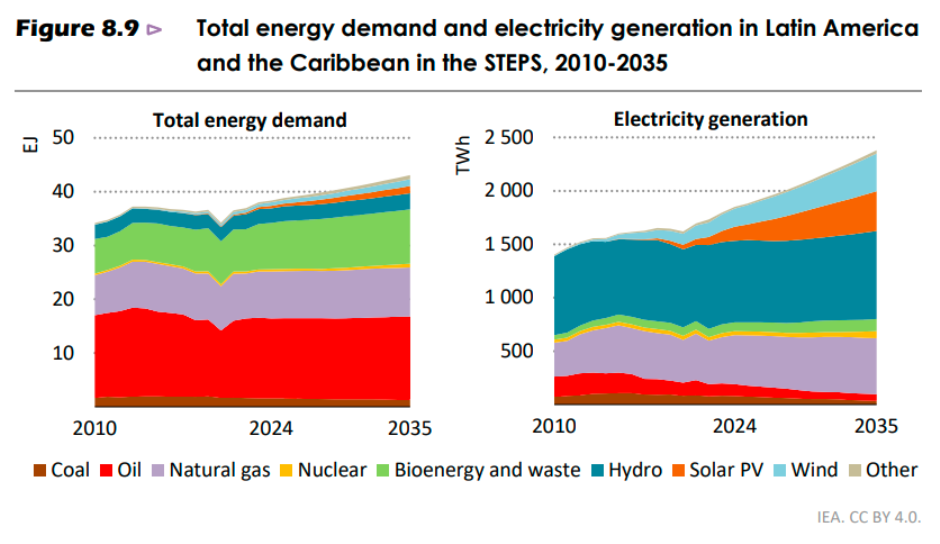
The World Energy Outlook 2025 highlights Latin America and the Caribbean (LAC) as a global frontrunner in renewable energy adoption and biofuel innovation. The region combines vast untapped resources, including solar, wind, oil, bioenergy, and critical minerals, with growing efforts to build climate resilience. As Brazil prepares to host COP30, the focus is firmly on accelerating sustainable energy transitions. Below are ten main takeaways from the IEA report on Latin America’s evolving energy landscape.
1. Latin America Leads the World in Renewable Electricity
Around 65 percent of electricity generation in Latin America and the Caribbean comes from renewables – the highest regional share globally. By 2035, this rises to about 70 percent, driven by growth in solar and wind power. Brazil already generates nearly 90 percent of its power from renewables, while Chile and Uruguay are world leaders in solar and wind integration.
2. Solar Energy Emerges as the Fastest-Growing Source
From 2025 to 2035, solar accounts for more than 45 percent of new power capacity additions in the region. Investment in grid infrastructure is now critical to manage intermittent supply and reduce curtailments, especially in Brazil and Chile, where renewable generation has exceeded grid capacity at times.
3. Electric Vehicles Gain Momentum Across the Region
Government incentives and affordable Chinese EV models have boosted electric vehicle sales, particularly in Brazil, Costa Rica, Uruguay, and Colombia. By 2035, nearly one in four new vehicles sold in the region will be electric. Electric bus fleets are expanding rapidly, with Chile and Colombia among global leaders.
4. Oil Remains a Major Energy Source
Despite renewable progress, oil continues to dominate the region’s overall energy mix due to transport reliance. Oil production grows in Brazil, Guyana, and Argentina but declines in Mexico, Venezuela, and Ecuador. Argentina is the only country expected to see a significant increase in natural gas output by 2035.
5. Critical Minerals Create New Economic Opportunities
Latin America holds around one-third of global critical mineral reserves. Chile leads in copper production, and Argentina, Bolivia, and Chile form the “Lithium Triangle.” Expanding local refining and processing could generate new jobs, strengthen economies, and diversify global supply chains.
6. Bioenergy Powers a Fifth of the Region’s Energy Use
Bioenergy meets about 20 percent of Latin America’s total energy demand, with 85 percent coming from modern sources. Solid bioenergy fuels industries such as food processing, while sustainable standards aim to curb land-use change and methane emissions.
7. Brazil Dominates Global Biofuels Market
Brazil’s long-standing Pró-Álcool program has built a robust bioethanol industry, making it the world’s second-largest producer of liquid biofuels. Flex-fuel vehicles, capable of running on high ethanol blends, make up about 85 percent of Brazil’s car fleet. Argentina and Colombia are emerging biofuel exporters.
8. Biogas Production Offers Major Growth Potential
Brazil has the world’s largest biogas potential but currently produces only 0.7 billion cubic meters per year. New policies, such as Brazil’s Fuel of the Future law, are expected to stimulate growth using sustainable feedstocks like crop residues and animal waste.
9. Biomethane Could Enhance Energy Security
Producing biomethane at about USD 23 per gigajoule could help reduce natural gas imports, support waste management, and create rural jobs. Infrastructure expansion and financial incentives will be key to scaling production and connecting biomethane to national grids.
10. Regional Energy Resilience and Climate Leadership Strengthen
Latin America’s renewable dominance, critical mineral wealth, and bioenergy innovation position it as a global leader in sustainable development. Hosting COP30 reinforces the region’s commitment to cleaner, more resilient energy systems that balance economic growth with climate goals.
Conclusion
The World Energy Outlook 2025 underscores Latin America’s role as a renewable energy powerhouse. With strong policies, rising EV adoption, and booming bioenergy, the region is set to advance its leadership in clean energy and sustainable growth while addressing climate risks and infrastructure needs.
Baburajan Kizhakedath