


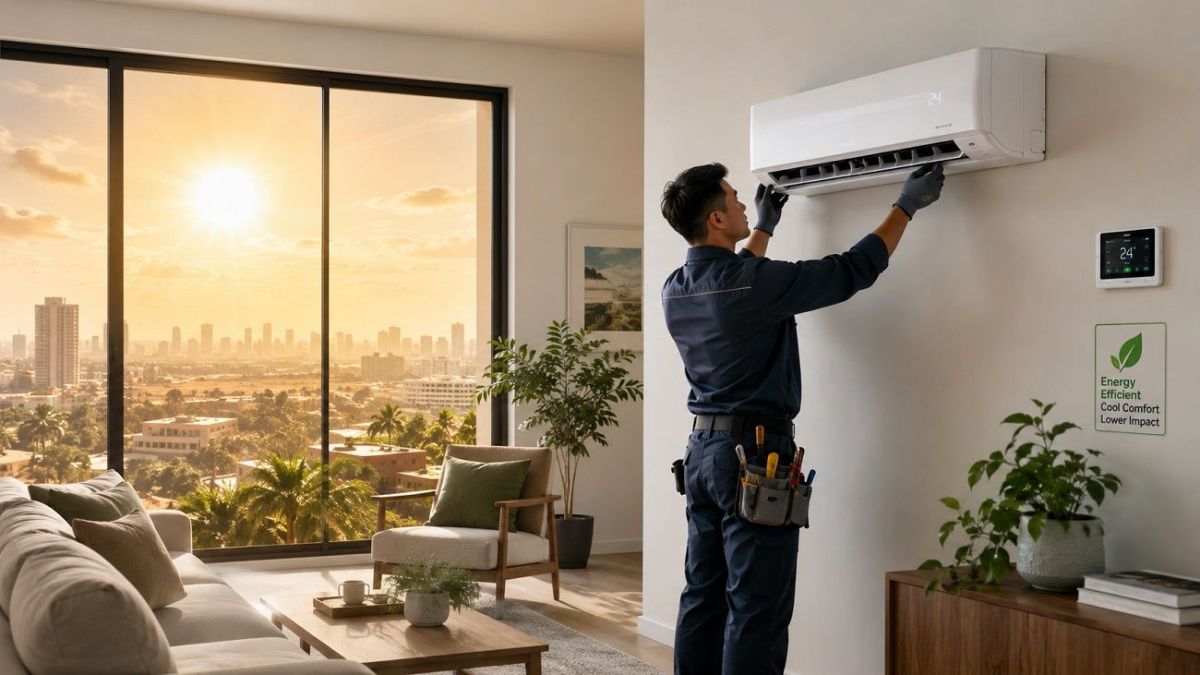
Cooling is no longer just a seasonal comfort issue. It is emerging as one of the defining energy challenges for homes, utilities and climate policy. As heatwaves become more frequent and households become more reliant on air conditioning, how cooling systems are selected, installed and maintained directly affects electricity demand, peak load pressure, household costs and emissions.
For many years, the conversation around air conditioning centred mainly on the efficiency of the equipment. Homeowners were encouraged to purchase units with higher efficiency ratings, and manufacturers competed based on their products’ performance labels. This still matters. However, equipment efficiency is only one part of the cooling equation. Even a high-efficiency air conditioner can underperform if it is installed in a poorly sized system, connected to leaky ducts or matched with weak airflow.
This is why energy-efficient cooling should be considered at system level, rather than as a simple appliance replacement..
Cooling demand is becoming an energy issue
Demand for air conditioning is rising for a number of reasons. More households are gaining access to cooling systems. Summers are becoming hotter in many regions. Homes are filled with more electronics that generate heat. In warmer states, people often expect to be able to enjoy indoor comfort for longer periods throughout the year, not just during a few extreme summer days.
This matters because the cooling load is not spread evenly throughout the day or across the grid. Air conditioners tend to work hardest during hot afternoons and early evenings, when lots of households are using electricity at the same time. This creates peak demand pressure. Even if a home’s annual energy usage appears to be within manageable limits, inefficient cooling can still contribute to grid stress during the hours when power systems are most vulnerable.
For homeowners, the issue is more personal, involving high bills, uneven temperatures, longer run times and equipment wearing out sooner than expected. An inefficient cooling system does not always malfunction suddenly. More often, it quietly wastes energy through oversizing, undersizing, restricted airflow, leaky ducts, poor refrigerant charging or weak commissioning.
Efficiency starts before the unit is installed
A common mistake in residential cooling systems is to treat replacement as simply a “box swap”. The old outdoor unit is removed and replaced with a new unit of similar capacity, and the job is considered complete. While this approach may be convenient, it can perpetuate the same comfort and energy issues that existed previously.
The correct starting point is a load calculation. The cooling requirements of a home depend on its square footage, insulation, window exposure, ceiling height, duct condition, air leakage, shading, orientation and local climate. Even two homes with the same floor area may require different system capacities if one has older windows, poor attic insulation or large west-facing glass areas.
Oversizing is particularly common. While a larger unit may sound safer, bigger is not necessarily better. Oversized systems can short-cycle, meaning they turn on and off too quickly to remove humidity properly. Short cycling also increases wear and tear, and can result in rooms feeling unevenly heated. Conversely, undersized systems create different problems, such as long run times, poor comfort on hot days and higher stress on equipment.
The best installations begin with an accurate understanding of the building, rather than an educated guess based on an old nameplate.
Ductwork can affect real-world performance
Ducts are often the hidden weak point in residential cooling systems. While a homeowner may invest in a high-efficiency condenser and air handler, if the duct system leaks conditioned air into an attic, crawl space or garage, some of this investment is lost before the air reaches the living space.
Duct problems can also reduce airflow. Restricted airflow forces the system to work harder and can result in reduced capacity and comfort issues such as hot bedrooms, weak vents, and temperature differences between floors. In some cases, the air conditioner is blamed for poor performance when the real issue lies with the distribution system.
A proper installation should include a review of the ductwork. This does not necessarily involve replacing every duct. Sometimes, improvements such as sealing, insulating, balancing or correcting a few restrictions can significantly enhance performance. In other cases, however, an older duct system may be unsuitable for the new equipment and should be upgraded as part of the project.
The key point is simple: efficiency ratings are measured in controlled conditions. Homes are not controlled laboratories. How well the equipment is connected to the building determines real-world performance.
SEER2 is useful, but it’s not the whole story
Efficiency ratings such as SEER2 help consumers to compare air conditioning systems. Higher-rated equipment can reduce electricity usage, particularly in regions with long cooling seasons. Variable-speed and inverter-driven systems can also enhance comfort by operating at lower speeds for extended periods rather than constantly switching on and off.
However, SEER2 should not be the only factor in your decision. Even a system with a strong rating can disappoint if it is poorly selected or installed. Homeowners should consider the full performance package, including system sizing, compressor technology, blower performance, thermostat controls, duct condition, humidity control, refrigerant practices and commissioning.
This is where the quality of the installation becomes a measurable energy issue. The correct refrigerant charge, proper airflow, sealed connections, safe electrical work and final system testing all affect performance. Rushing the installation process can reduce efficiency, shorten equipment life and lead to recurring service calls.
For households considering replacement, energy-efficient AC installation should mean more than choosing a high-SEER2 unit. It should mean designing a cooling system around the actual building, verifying airflow, reviewing ducts, and commissioning the system after installation.
Smart cooling also depends on controls and behaviour
Technology alone cannot meet the demand for cooling. The way in which energy is used is influenced by thermostats, zoning, shading, insulation and homeowner habits.
Smart thermostats can reduce unnecessary runtime, particularly when homes are unoccupied for part of the day. However, savings depend on the thermostat being set up properly and schedules being realistic. In very hot climates, setting the temperature too low can sometimes make the system work harder later on, particularly in poorly insulated homes. The most effective approach varies depending on the type of building, occupancy pattern and system design.
Measures such as ceiling fans, window coverings, attic insulation, air sealing and reflective roofing materials can also reduce the cooling load. While these measures do not replace air conditioning, they do reduce the amount of heat that the system must remove. In many homes, upgrading to a more efficient AC unit is not the only way to improve cooling efficiency. It is a combination of better equipment and reducing the amount of heat generated by the building itself.
Heat pumps are changing the way we think about cooling
The increasing popularity of heat pumps is also changing the way people make decisions about residential HVAC systems. In many regions, heat pumps can provide both cooling and heating from a single electric system. For homes looking to move away from gas heating or improve year-round efficiency, a heat pump can form part of a broader electrification strategy.
In cooling mode, a heat pump functions in a similar way to an air conditioner. Its main advantage is that it can provide efficient heating in milder winter climates. This makes heat pumps particularly relevant in areas where winter heating requirements are moderate, but the need for cooling in summer remains important.
Nevertheless, heat pumps require the same careful design considerations as conventional air conditioners. Critical factors such as sizing, ductwork, airflow, controls and installation quality must be considered. In practice, a heat pump is not necessarily efficient simply because it is efficient on paper.
The Role of Homeowners and Contractors
While homeowners do not need to become HVAC engineers, they should know which questions to ask when replacing a system.
A good contractor should be able to explain how the size of the system was selected, whether the ductwork was inspected, which efficiency level is appropriate for the home, how airflow will be verified and which commissioning steps will be completed after installation. If the recommendation is based solely on the size of the old unit, this should raise concerns.
Many people underestimate the role that contractors play in the energy transition. Every installation decision affects energy demand for the next 10 to 15 years. Poor installations can spread across neighbourhoods, increasing peak load and wasting electricity. Better installations reduce that waste, one home at a time.
Cooling efficiency is a system, not a label
The future of cooling will require better technology, stronger building regulations, smarter grids and better-informed consumers. However, practical work often happens at home: choosing the right system, installing it correctly, sealing ducts, improving airflow and reducing unnecessary heat gain.
As cooling demand increases, the distinction between an average and a high-quality installation will become more significant. While efficient equipment is important, it cannot deliver its full value in a poorly designed system. Homes that perform best are those where cooling is treated as an integrated energy system.
In a warmer world, air conditioning will remain essential for comfort, health and productivity. The challenge lies in making that comfort less wasteful. One of the most immediate and practical places to start is with proper installation.