


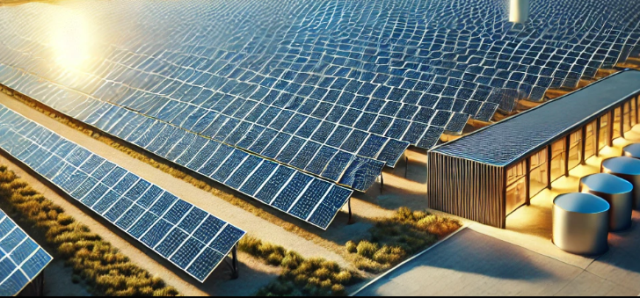
New data released by the U.S. Energy Information Administration (EIA) shows that renewable energy sources delivered nearly 26 percent of total U.S. electricity generation in 2025 and accounted for more than 36 percent of installed generating capacity.
The latest figures confirm that solar, wind and battery storage are reshaping the U.S. power mix, with projections indicating that these sources will add more than 60 percent more generating capacity in 2026 than in 2025. If forecasts hold, renewables and battery storage will provide virtually all net new generating capacity this year.
Solar Sets New Generation Records in 2025
According to EIA’s latest Electric Power Monthly report, with data through December 31, 2025, solar remains the fastest growing major source of U.S. electricity.
Utility-scale solar thermal and photovoltaic generation expanded by 34.5 percent in 2025 compared to 2024. Meanwhile, estimated small-scale solar systems such as rooftop installations grew by 11.0 percent.
Combined, utility-scale and small-scale solar generation rose by 28.0 percent and supplied just under 9.0 percent of total U.S. electricity in 2025. Utility-scale solar contributed 6.54 percent, while small-scale systems added 2.06 percent. That compares with a 6.9 percent total solar share in 2024.
Solar now represents 33.46 percent of all renewable electricity generation in the United States.
Wind Maintains Lead Among Renewables
Wind energy continued to hold the largest share among renewable resources. Wind turbines generated 10.3 percent of total U.S. electricity in 2025, reflecting a 2.8 percent increase from the previous year.
In December 2025 alone, wind generation was 19.0 percent higher than in December 2024, highlighting strong year-end performance.
Wind and Solar Surpass Coal and Nuclear
The combined contribution of wind and solar reached 18.9 percent of total U.S. electricity generation in 2025, up from 17.2 percent in 2024. Together, these two renewable sources produced 12.9 percent more electricity than the year before.
Notably, wind and solar generated 15.7 percent more electricity than coal and 8.7 percent more than nuclear power plants during the year, marking a significant shift in the U.S. energy landscape.
Renewables Reach Nearly 26 Percent of US Power Mix
When including wind, solar, hydropower, biomass and geothermal energy, total renewable generation increased by 9.6 percent in 2025 compared to 2024.
Renewables accounted for 25.7 percent of total U.S. electricity production in 2025, up from 24.1 percent a year earlier. Renewable energy is now second only to natural gas in electricity generation. In contrast, natural gas-fired generation declined by 3.3 percent in 2025.
Solar, Wind and Batteries Dominate Capacity Additions
Solar, wind and battery storage led capacity additions in 2025 and are expected to do so again in 2026.
In 2025:
Utility-scale solar capacity increased by 27,738.4 MW
Small-scale solar added 6,277.4 MW
Utility-scale battery storage surged by 58.4 percent, adding 15,775.1 MW
Wind capacity grew by 6,173.6 MW
EIA projects that 44,470.0 MW of new utility-scale solar capacity will be added by the end of 2026. Planned battery storage additions in 2026 total 24,268.5 MW, representing a further 56.7 percent increase.
Wind capacity additions in 2026 are forecast at 10,369.0 MW onshore and 1,515.0 MW offshore, nearly doubling 2025 levels.
By the end of 2025, renewables accounted for 33.2 percent of utility-scale generating capacity. Including estimated small-scale solar, renewables’ share reached 36.3 percent.
2026: All Net New Capacity from Renewables and Storage
Projections for 2026 suggest an even more dramatic shift. Utility-scale renewables and battery storage are expected to add 80,809.2 MW of new capacity. Additional small-scale solar installations are estimated to contribute at least 6,000 MW more.
At the same time, the net capacity of natural gas, coal and oil is forecast to decline by 4,211.6 MW. No new nuclear capacity is currently expected.
If these projections materialize, renewables and battery storage will account for all net new utility-scale capacity additions in 2026.
By the end of 2026, total renewable capacity, including small-scale solar, could reach 525,356.1 MW, surpassing natural gas capacity at 514,212.5 MW. Installed solar capacity, both utility-scale and small-scale, is projected to hit 261,166.0 MW, exceeding wind at 170,154.9 MW, coal at 163,425.8 MW, and more than doubling nuclear capacity at 98,451.5 MW.
Renewables’ share of total generating capacity could approach 40 percent by the end of 2026, excluding battery storage contributions.
Industry Reaction
Ken Bossong, executive director of the SUN DAY Campaign, said the key takeaway from EIA’s 2025 data is the dramatic growth in solar, wind and battery storage.
He added that if EIA’s projections for 2026 prove accurate, the expansion of renewable energy capacity will accelerate even further, signaling a historic transformation of the U.S. electricity sector.
BABURAJAN KIZHAKEDATH