


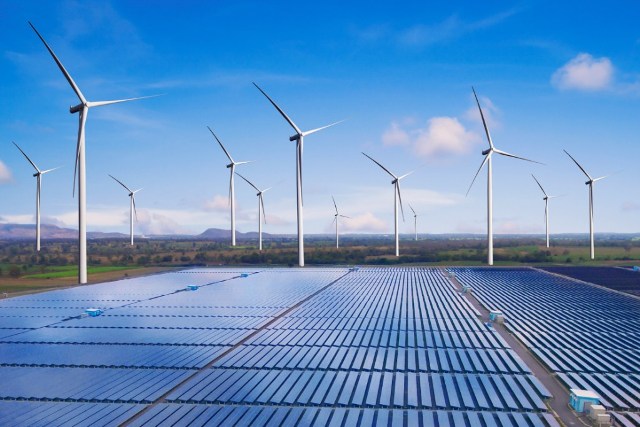
The United States is witnessing a rapid acceleration in renewable energy deployment, with electricity generation from renewable sources rising by more than 10 percent during the first four months of 2026. New data from the U.S. Energy Information Administration (EIA), indicates that utility-scale solar, wind and battery storage are set to add more than 78.5 GW of new clean energy capacity by April 2027, while fossil fuel and nuclear generating capacity will shrink by more than 5.2 GW.
Renewable Electricity Reaches 30 Percent of U.S. Power Generation
According to the EIA’s Electric Power Monthly report covering data through April 30, 2026, renewable electricity generation increased 10.03 percent compared with the same period in 2025.
Utility-scale solar delivered the strongest growth, with electricity generation rising 21.3 percent. Hydropower output climbed 15.7 percent, while small-scale solar expanded 11.9 percent and wind generation increased 3.4 percent, EIA report said.
During the same period, electricity generation from coal-fired power plants declined 11.6 percent. Nuclear power generation recorded only 0.5 percent growth, while natural gas-fired generation increased 2.8 percent.
Wind and solar, including small-scale installations, supplied 21.8 percent of total U.S. electricity generation during the first four months of 2026.
In April alone, both wind and solar individually generated more electricity than coal. Combined, solar and wind produced 57.0 percent more electricity than nuclear power.
Overall, renewable energy sources including hydropower, biomass and geothermal accounted for 30.0 percent of total U.S. electricity generation, up from 27.8 percent a year earlier.
Renewable Capacity Expands by Nearly 40 GW
Between May 1, 2025 and April 30, 2026, the United States added 39,884.2 MW of renewable generating capacity.
Utility-scale solar led capacity additions with 27,572.3 MW, followed by small-scale solar with 6,492.2 MW and wind with 5,976.4 MW.
A major milestone was achieved in April when utility-scale solar capacity reached 160,208.1 MW, overtaking wind capacity, which stood at 160,100.6 MW.
Battery energy storage also expanded rapidly, increasing by 17,703.5 MW, representing growth of 58.1 percent over the previous year.
By comparison, coal generating capacity declined by 3,511.4 MW, nuclear capacity increased by only 18.4 MW, while natural gas capacity grew by 7,754.2 MW.
More Than 55 GW of New Renewable Capacity Expected by 2027
As of May 1, 2026, renewable energy represented 33.8 percent of total U.S. utility-scale generating capacity. EIA projects this share will rise to 36.8 percent by April 30, 2027.
Utility-scale solar is forecast to add another 42,527.2 MW, increasing its share of total capacity from 13.1 percent to 15.9 percent.
Wind capacity is expected to grow by 13,154.4 MW, including 3,355.0 MW of offshore wind projects, raising its share from 13.1 percent to 13.6 percent.
Hydropower, biomass and geothermal combined are projected to contribute an additional 298.7 MW.
Overall, utility-scale renewable energy capacity is forecast to increase by 55,980.3 MW during the next 12 months, representing a 67.6 percent increase over the 33,392.0 MW added during the previous year.
Meanwhile, EIA expects no new nuclear generating capacity and forecasts a net decline of 5,200.5 MW in fossil fuel generating capacity.
Renewables Could Overtake Natural Gas Capacity
Small-scale solar continues to expand rapidly, adding 6,492.2 MW over the past year to reach a total installed capacity of 61,521.5 MW.
Assuming another 6,000 MW or more of small-scale solar is installed by May 2027, total renewable generating capacity would reach approximately 537,606.9 MW.
That would exceed projected natural gas generating capacity of 515,744.9 MW, making renewables the largest source of installed generating capacity in the United States.
Solar power alone would account for 20.1 percent of total U.S. generating capacity.
Battery Storage to Grow More Than 47 Percent
Battery energy storage is expected to remain one of the fastest-growing clean energy technologies.
EIA projects battery storage capacity will increase by another 22,828.9 MW by May 1, 2027, lifting total installed battery capacity to 71,007.4 MW. This represents growth of more than 47 percent.
Together, utility-scale renewable energy projects and battery storage are expected to contribute 78,809.2 MW of new clean energy capacity by mid-spring 2027.
When projected small-scale solar additions are included, total new clean energy capacity could approach 85,000 MW, reinforcing the rapid expansion of renewable energy across the U.S. power sector.