


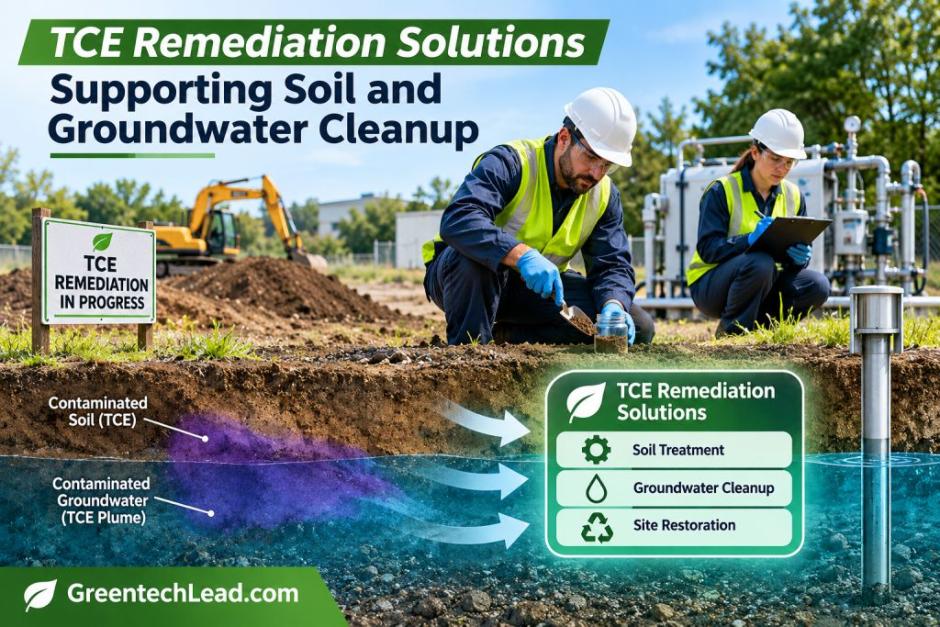
Long-term cleanup of trichloroethylene (TCE) depends on understanding how contamination affects the soil and groundwater. The liquid solvent can sink beneath the water table, following geological pathways that sustain dissolved groundwater plumes. Each remediation company approaches these conditions differently, so environmental officers need to connect site characterization with documented project experience when shortlisting a partner.
4 TCE Remediation Solutions Supporting Soil and Groundwater Cleanup
Companies should be evaluated for experience with chlorinated solvents, characterization support and a clearly defined treatment approach. Because remediation outcomes vary by geology, contaminant distribution and monitoring duration, environmental officers should compare each provider’s documented results against the conditions of the specific site.
1. Remediation Products Inc.
Remediation Products Inc. supports TCE remediation projects by providing specialized remediation products, technical design assistance and project-long analytical support for environmental consultants and approved installation partners. Remediation Products’ Trap & Treat® technologies are built around activated carbon, which adsorbs contaminants to help control exposure while treating contamination.
For TCE treatment support, Remediation Products also documents field experience in difficult subsurface conditions. In one case study involving a TCE plume in a challenging lithology, high-resolution sampling identified localized DNAPL pockets with TCE impacts as high as 5.4% by weight. After targeted BOS 100® slurry injections, groundwater TCE concentrations decreased by over 99%, and nearby monitoring wells remained below the applicable standard for more than a year.
Key Features
- Exposure control mechanism: Activated carbon adsorbs contaminants, keeping them from completing exposure pathways while treatment progresses.
- Reagents and technologies: Remediation Products’ products include carbon-based technologies such as BOS 100 and CAT 100, which support the degradation of chlorinated solvents.
2. REGENESIS
REGENESIS provides soil and groundwater remediation technologies, design support and application services for contaminated sites. Its team works with environmental consultants and site owners to select products and implementation approaches for chlorinated solvents, petroleum hydrocarbons and other contaminants.
For TCE remediation, REGENESIS has documented field experience using technologies such as S-MicroZVI and PlumeStop. In one Fullerton brownfield case, the company reported a 98.5% TCE reduction in groundwater within a month, with a sustained 99.7% reduction over 4.5 years of monitoring.
Key Features
- Exposure control mechanism: PlumeStop uses colloidal activated carbon to reduce contaminant mobility and limit dissolved-phase exposure pathways.
- Reagents and technologies: REGENESIS offers amendments such as S-MicroZVI, PlumeStop, PersulfOx and RegenOx for site-specific remediation programs.
3. Provectus Environmental Products
Provectus Environmental Products supplies remediation reagents and offers technical support for in-situ treatment programs. Its products are commonly used by consultants and contractors designing remedies for chlorinated volatile organic compounds, petroleum hydrocarbons and related groundwater impacts.
The company’s documented work includes a San Rafael case report involving Provect-IR and bioaugmentation at a former dry cleaner site. That project addressed a large chlorinated solvent plume, with reported reductions exceeding 99% in 11 of 14 target wells for perchloroethylene, a related chlorinated solvent.
Key Features
- Exposure control mechanism: Provectus’s technologies enable in situ reactions that reduce contaminant concentrations and limit plume persistence.
- Reagents and technologies: Options include Provect-IR, Provect-OX, ERD-CH4 and EZVI-CH4 for reduction, oxidation and bioremediation-based strategies.
4. VIYA Environmental
VIYA Environmental is a remediation contractor that designs, installs and operates thermal and biological treatment systems. Its work is relevant for complex sites where contamination exists in soil, groundwater or bedrock and where field execution requires contractor-led implementation.
VIYA reports experience with thermal TCE remediation in fractured bedrock. In one confidential Gimo site case study, the company reported a TCE reduction greater than 99.8% in groundwater while maintaining hydraulic control at an active metalworking facility in Sweden.
Key Features
- Exposure control mechanism: Thermal treatment can target contaminant mass in difficult subsurface conditions while hydraulic controls limit migration during implementation.
- Reagents and technologies: VIYA uses technologies such as ET-DSP, IT-DSP and Bioavailable Absorbent Media depending on the site conditions and treatment goals.
TCE Technology Providers at a Glance
Before comparing TCE remediation options, environmental officers should identify what each provider actually contributes to a project. Manufacturers, reagent suppliers, design partners and field contractors may all support cleanup, but their responsibilities differ across technology selection, installation, monitoring and technical support.
| Company | Provider Role | Primary Cleanup Approach | Media Treated | Documented Support |
| Remediation Products Inc. | Manufacturer with approved installers | Carbon adsorption and degradation | Soil and groundwater | Project-long laboratory support |
| REGENESIS | Supplier with application services | Carbon and chemical amendments | Soil and groundwater | Fullerton TCE groundwater case |
| Provectus | Reagent supplier and design partner | Reduction and oxidation reagents | Soil and groundwater | Related-solvent field report |
| VIYA Environmental | Remediation contractor | Thermal, chemical and biological methods | Soil, bedrock and groundwater | Fractured-bedrock TCE groundwater case |
How These TCE Remediation Providers Were Selected
The selected providers all met the criteria that environmental officers can use to compare TCE remediation options.
Selection considered:
- Relevant TCE or chlorinated-solvent experience: Each provider documents support for TCE or closely related chlorinated solvent treatment in soil, groundwater or bedrock.
- Defined provider role: The list distinguishes manufacturers, reagent suppliers, design partners and contractors so decision-makers can match each provider to the needed scope.
- Site-specific treatment capability: Each provider offers technologies or services that can be adapted to subsurface conditions, contaminant behavior and treatment boundaries.
- Exposure control or plume-management strategy: Each provider offers an approach intended to reduce exposure risk, control contaminant movement or degrade contaminant mass.
- Documented technical support: The providers offer supporting resources such as design assistance, laboratory analysis, application services, field implementation or case history documentation.
Frequently Asked Questions
A technology manufacturer, an injection contractor and a full-service remediation company offer different scopes of work. Establishing the intended role helps environmental officers direct questions to the responsible organization.
What makes TCE harder to remediate than other contaminants?
TCE can be difficult to remediate because its separate liquid phase may sink below the water table and continue feeding dissolved plumes into groundwater. Site geology, contaminant mass distribution and groundwater movement can all affect how easily the source area can be treated.
What should environmental officers look for in a TCE remediation company?
Environmental officers should compare provider role, documented chlorinated-solvent experience, treatment mechanism, characterization support, installation responsibilities and monitoring duration. Case histories are most useful when they identify site conditions, treatment boundaries, amendment quantities and follow-up data.
Selecting a Partner for Long-Term TCE Cleanup Success
TCE cleanup often involves several providers with different responsibilities. Before approving a scope, environmental officers should confirm who handles characterization, technology selection, installation, monitoring and data review. A strong proposal should connect each role to site-specific evidence, treatment boundaries, amendment placement and follow-up expectations.