


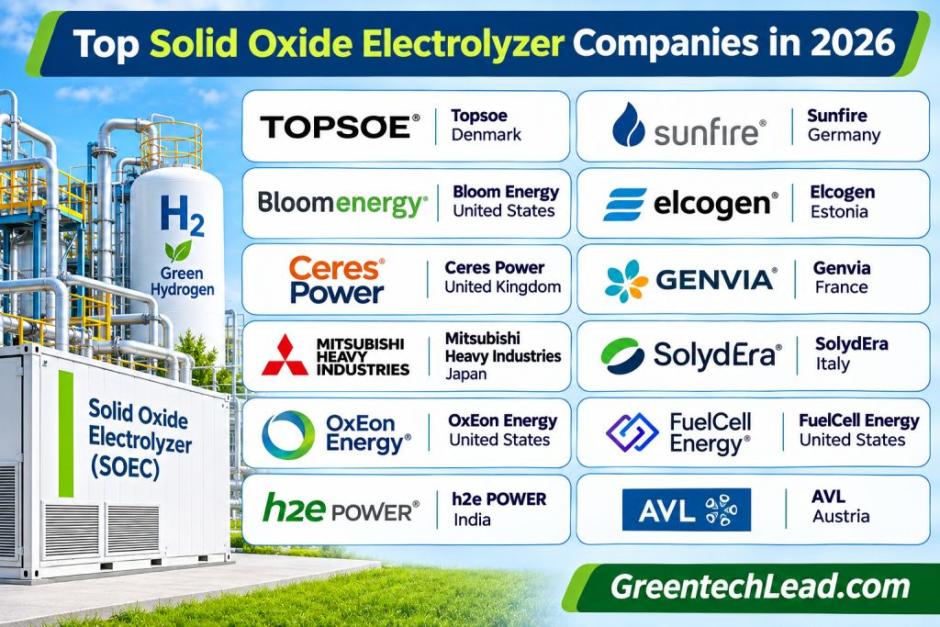
The global solid oxide electrolyzer cell (SOEC) market is attracting investment from energy companies, steel manufacturers, petroleum refiners, fertilizer producers and sustainable aviation fuel developers seeking to reduce industrial hydrogen production costs.
Topsoe, Sunfire, Bloom Energy, Elcogen, Ceres Power, Genvia and Mitsubishi Heavy Industries are among the companies developing high-temperature electrolysis technologies, manufacturing facilities and industrial hydrogen projects.
Unlike conventional alkaline and proton exchange membrane (PEM) electrolyzers, SOEC systems utilize high-temperature steam, typically operating at 600–850°C, to reduce electricity requirements. Access to industrial waste heat, however, is critical to achieving competitive hydrogen production costs.
According to the World Bank’s research on electrolyzer technology and economics, installed SOEC capital costs exceed $3,000/kW, compared with $500–1,500/kW for alkaline and $1,000–2,000/kW for PEM electrolyzers.
Top 12 solid oxide electrolyzer technology companies
1. Topsoe – Denmark
Topsoe has invested in industrial-scale SOEC manufacturing through its Herning factory in Denmark, designed to produce 500 MW of electrolyzer stacks annually. The project received €94 million from the EU Innovation Fund.
Its major customer projects include Forestal’s planned Triskelion green methanol facility in Spain, for which Topsoe has disclosed a 50 MW supply commitment.
However, Topsoe’s revised SOEC commercialization strategy announced in May 2026 involves demonstrating manufacturing reliability before placing the Herning factory into hibernation until market demand improves.
2. Sunfire – Germany
Sunfire has established an industrial hydrogen reference through its 2.6 MW SOEC installation at Neste’s Rotterdam refinery in the Netherlands.
The EU-supported MultiPLHY renewable hydrogen project utilizes industrial waste heat to support hydrogen production exceeding 60 kg per hour at rated capacity. Project participants include Neste, Sunfire, ENGIE, CEA and Paul Wurth.
Sunfire has also developed high-temperature co-electrolysis technology for producing synthesis gas, targeting synthetic aviation fuels and renewable chemicals through projects such as LOCALHY and SynLink-related technology development.
3. Bloom Energy – United States
Bloom Energy is targeting industrial hydrogen production, nuclear-powered electrolysis and renewable fuels.
Its 4 MW SOEC demonstration at NASA Ames Research Center has a reported hydrogen production capability exceeding 2.4 tonnes per day.
Bloom Energy has also collaborated with Idaho National Laboratory to evaluate nuclear-generated electricity and steam for high-temperature hydrogen production. Its collaboration with South Korea’s SK ecoplant addresses commercialization opportunities for hydrogen technologies.
Bloom claims its high-temperature electrolyzers can generate 20–25 percent more hydrogen per megawatt than conventional low-temperature alternatives under specified conditions.
4. Elcogen – Estonia
Elcogen supplies solid oxide cells and stacks to electrolyzer and fuel-cell system developers.
Its approximately €60 million ELCO I manufacturing facility in Tallinn, supported by approximately €25 million in EU funding, has initial annual production capacity of 90 MW of cells and 60 MW of stacks.
Elcogen’s industrial partners include AVL and Baker Hughes. Its European research project portfolio includes PilotSOEL, PRESSHYOUS and OUTFOX, which target manufacturing automation, pressurized electrolysis and industrial systems reaching 100 MW.
The company targets annual manufacturing capacities of 360 MW of cells and 230 MW of stacks by 2030, covering both electrolysis and fuel-cell applications.
5. Ceres Power – United Kingdom
Ceres Power operates a technology licensing business rather than manufacturing complete electrolyzer systems at industrial scale.
Its major industrial customer is Shell. The Shell-Ceres 1 MW electrolyzer project in Bengaluru began producing hydrogen in May 2025. The system targets output of 600 kg daily, with reported module-level electricity consumption of 37 kWh/kg.
Shell and Ceres also have a development agreement covering a 10 MW pressurized electrolyzer module.
Ceres Power Holdings
Ceres has established broader solid oxide technology partnerships with companies including Doosan, Delta Electronics and Denso, although not every licensing agreement covers electrolyzers.
6. Genvia – France
Genvia is developing high-temperature electrolysis systems through collaboration with SLB, the French Alternative Energies and Atomic Energy Commission (CEA), VINCI Construction and other industrial partners.
Its major customer projects include ArcelorMittal’s electrical steel manufacturing facility at Saint-Chély-d’Apcher, France.
The ArcelorMittal-Genvia industrial hydrogen demonstrator targets production of 200 kg of hydrogen daily by recovering residual heat from steel annealing operations. The project remains under construction.
Genvia also operates a 200 kg-per-day validation platform at Beziers.
7. Mitsubishi Heavy Industries – Japan
Mitsubishi Heavy Industries (MHI) is developing SOEC technology for industrial hydrogen production, renewable chemicals and synthetic fuels.
Its Takasago Hydrogen Park has a 400 kW-class SOEC testing module. MHI reports electricity consumption of approximately 3.5 kWh per normal cubic metre of hydrogen, equivalent to about 39 kWh/kg.
The company is also developing co-electrolysis technology that converts steam and carbon dioxide into synthesis gas for synthetic fuel manufacturing. Its existing test infrastructure represents technology validation rather than widespread customer deployment.
8. SolydEra – Italy
SolydEra develops solid oxide cells and stacks for hydrogen production, energy storage and industrial applications.
Its G8X stacks are deployed in Dynelectro’s 250 kW Dynamic Electrolyser Unit at Syntholene Energy’s Husavik project in Iceland.
By October 2026, the demonstration reportedly exceeded 1,000 operating hours and produced six tonnes of hydrogen.
Reported system electricity consumption reached 38.6 kWh/kg, alongside approximately 8 kWh/kg of thermal energy consumption. Separate durability testing demonstrated 25,000 operating hours for a 70-cell stack.
9. OxEon Energy – United States
OxEon Energy develops solid oxide electrolysis and co-electrolysis systems for hydrogen, synthetic fuels and aerospace applications.
Its technology portfolio includes work associated with NASA’s Mars Oxygen In-Situ Resource Utilization Experiment (MOXIE), which demonstrated oxygen production from atmospheric carbon dioxide.
The US Department of Energy awarded approximately $36 million to support OxEon’s manufacturing automation and expansion towards 25 MW of annual electrolyzer capacity. This remains a manufacturing target.
10. FuelCell Energy – United States
FuelCell Energy is developing high-temperature electrolyzers for hydrogen production using nuclear energy and other industrial heat sources.
Its major development partners include Idaho National Laboratory and Versa Power Systems.
A US Department of Energy technology evaluation details a 250 kW steam electrolysis demonstration designed to assess integration with nuclear power plants and address system efficiency and capital costs.
The company’s SOEC business remains at the technology validation and commercialization development stage.
11. h2e POWER – India
h2e POWER is developing domestic solid oxide manufacturing capabilities to support India’s National Green Hydrogen Mission.
The company demonstrated a 20 kW SOEC system with more than 6,000 hours of reported stable operation.
India’s National Green Hydrogen Mission lists a planned 1,000 MW solid oxide manufacturing facility in Maharashtra under construction.
India’s emerging SOEC ecosystem also includes Hindustan Petroleum Corporation’s 20 kW research-scale electrolyzer in Bengaluru, which has demonstrated hydrogen purity of 99.99 percent.
12. AVL – Austria
AVL provides engineering, system integration, simulation and technology validation services for solid oxide electrolyzers.
Its collaboration with Elcogen focuses on developing megawatt-scale solid oxide stack modules for industrial applications.
AVL is positioned as an engineering and commercialization partner rather than an independent electrolyzer manufacturer with established production capacity.
SOEC customer complaints, project cancellations and technology challenges
The termination of Topsoe’s 100 MW electrolyzer supply agreement with First Ammonia in March 2026 highlights commercialization challenges facing the SOEC industry.
Topsoe attributed the contract termination to missed contractual milestones despite granting multiple extensions for First Ammonia’s green ammonia project in Victoria, Texas.
However, First Ammonia disputed the supplier’s characterization, stating that Topsoe’s commercialization review would not materially affect its investment schedule and that it would select alternative hydrogen production technology. The companies subsequently announced a separate ammonia synthesis technology agreement in August 2026.
SOEC versus alkaline and PEM electrolyzer economics
| Technology indicator | Alkaline | PEM | SOEC |
| Installed CAPEX per kW | $500–1,500 | $1,000–2,000 | Above $3,000 |
| Annual non-electricity OPEX as share of CAPEX | 2–3% | 3.5–5% | Above 3% |
| Commercial maturity | High | Established | Emerging |
Source: World Bank electrolyzer technology benchmarks.
At $50/MWh, reducing electricity consumption from 50 kWh/kg to 38 kWh/kg delivers potential electricity savings of $600 per tonne of hydrogen, before accounting for thermal energy, equipment and maintenance costs.
SOEC manufacturers will need to demonstrate reliable industrial operation, competitive lifetime hydrogen production costs, repeat customer orders and manufacturing utilization to compete with established alkaline and PEM electrolyzer suppliers.
SHAFANA FAZAL