


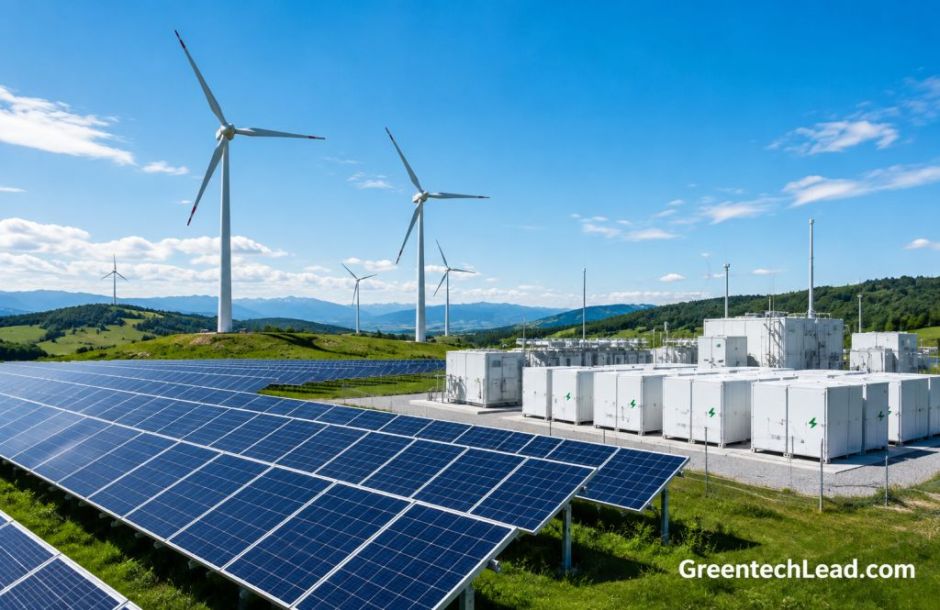
Middle East renewable energy investment is shifting from standalone solar farms toward gigawatt-scale solar, wind, battery storage and green hydrogen projects. MENA attracted a record $22 billion of renewable investment in 2025, while its project pipeline has reached 202 GW. Saudi Arabia’s $8.2 billion portfolio, the UAE’s $6.1 billion solar-plus-storage project and Oman’s $4.2 billion green hydrogen development show where capital is moving in 2026.
The region installed 16 GW of solar and wind during 2025, and BloombergNEF expects another 18 GW of solar additions in 2026. Battery deployment is forecast to reach 4 GW/16 GWh, twice the previous year’s capacity.
The longer-term opportunity is much larger. Solar and wind capacity across MENA could reach 404 GW by 2035, compared with about 49 GW currently. Regional investors already accounted for 85 percent of renewable financing activity in 2025.
Middle East Renewable Pipeline Reaches 202 GW
Dii Desert Energy’s MENA Energy Outlook 2026 identifies a 202 GW renewable project pipeline, comprising approximately:
130 GW solar PV
65 GW onshore wind
4 GW concentrated solar
3 GW offshore wind
Of this total, 43.7 GW is operational and another 38 GW is officially under construction. Approximately 120 GW remains in development or at the announced/MoU stage.
That distinction matters to investors. Announced GW cannot be treated as committed investment. Financial close, PPAs, construction starts and grid connections provide stronger indicators of which projects are actually moving forward.
Saudi Arabia Secures $8.2 Billion for 15 GW Renewables
Saudi Arabia is emerging as one of the largest renewable investment markets in the region.
ACWA Power, PIF-owned Badeel and Saudi Aramco subsidiary SAPCO achieved financial close on seven projects representing 15 GW and $8.2 billion of investment.
The portfolio includes five solar projects totaling 12 GW and two wind projects totaling 3 GW:
Bisha solar — 3 GW
Humaij solar — 3 GW
Khulis solar — 2 GW
Afif 1 and Afif 2 solar — 2 GW each
Starah wind — 2 GW
Shaqra wind — 1 GW
The developments secured approximately $5.9 billion of senior debt from local, regional and international lenders. Commercial operation is expected between the second half of 2027 and first half of 2028.
The Saudi Arabia $8.2 billion renewable investment program demonstrates how long-term offtake and sovereign-backed investment can mobilize enormous amounts of project finance.
PIF’s Badeel and its partners now sponsor renewable projects totaling 28.6 GW and more than $17 billion of investment, while ACWA Power’s Saudi solar and wind portfolio exceeds 34 GW across 21 projects.
Saudi Renewable Tariffs Show Cost Advantage
Saudi Arabia’s enormous project scale is helping produce some of the world’s most competitive renewable tariffs.
Selected project awards include approximately $10.96/MWh for the 1.4 GW Najran solar project and $13.38/MWh for the 1.5 GW Dawadmi wind project.
Large project sizes, high solar irradiation, competitive tenders, relatively inexpensive capital and long-term PPAs help support these economics.
Saudi Arabia is now extending the model into battery storage as its solar and wind fleet expands. Storage represents another investment opportunity spanning battery cells, power conversion, control systems and grid infrastructure.
UAE Invests $6.1 Billion in 24/7 Clean Power
The UAE is taking renewable investment in a different direction: making solar power dispatchable.
Masdar and Emirates Water and Electricity Company reached financial close in July 2026 on a $6.1 billion project combining 5.2 GW of solar PV with 19 GWh of battery storage.
The system is designed to deliver 1 GW of continuous clean electricity.
The financing structure includes approximately $1 billion of Masdar equity and $5.1 billion of financing from 13 local and international banks.
The UAE’s $6.1 billion solar and battery storage project could become an important model for renewable markets worldwide.
Instead of selling electricity primarily when the sun shines, the project combines enormous solar capacity with batteries to deliver power continuously.
That has particular relevance for AI data centers, industrial plants, desalination facilities and other 24/7 electricity consumers.
Dubai Adds 1.8 GW of Solar
The UAE is simultaneously continuing conventional utility-scale solar development.
Phase VI of Dubai’s Mohammed bin Rashid Al Maktoum Solar Park adds 1.8 GW of photovoltaic capacity with approximately AED5.51 billion of investment.
DEWA and Masdar are developing the project through an independent power producer structure.
The UAE therefore has two complementary investment models: very large low-cost solar projects and increasingly sophisticated solar-plus-storage infrastructure capable of delivering more reliable electricity.
Oman Links Renewable Power to $4.2 Billion Hydrogen Project
Oman’s renewable strategy increasingly connects clean electricity with industrial development.
OQ has expanded its renewable portfolio by more than 2 GW and secured PPAs covering more than 740 MW of additional solar and wind.
Ibri III combines 500 MW of solar with 100 MWh of battery storage, while new wind developments provide greater diversity to the country’s renewable generation mix.
The bigger investment opportunity is emerging at Duqm.
Oman announced agreements and memoranda worth approximately OMR2.9 billion, or $7.5 billion, for projects in the Special Economic Zone at Duqm. ACME’s green hydrogen and ammonia project represents $4.2 billion of this investment.
The Oman $4.2 billion green hydrogen and ammonia development includes two additional phases, each designed to produce 400,000 tonnes of green ammonia and 71,000 tonnes of green hydrogen annually.
This creates an investment ecosystem extending from renewable generation into electrolyzers, desalination and water treatment, hydrogen storage, pipelines, ammonia production and export infrastructure.
Qatar Targets 4 GW of Renewable Capacity
Qatar is building a large solar portfolio around its industrial economy.
QatarEnergy is targeting 4 GW of renewable capacity by 2030.
Existing and planned projects include the 800 MW Al Kharsaah solar project, 417 MW at Mesaieed Industrial City and 458 MW at Ras Laffan Industrial City.
Together, these assets provide approximately 1.675 GW, while the proposed 2 GW Dukhan solar project could make a major contribution toward the 2030 target.
Qatar’s investment case is particularly linked to industrial decarbonization. Large solar developments can supply electricity to energy-intensive industrial operations while reducing their power-related emissions.
Battery Storage Becomes a Major Middle East Investment Theme
Battery storage could be one of the fastest-growing clean-energy markets in the region.
BloombergNEF expects 4 GW/16 GWh of BESS additions across MENA during 2026, twice the capacity deployed during 2025.
The UAE’s 19 GWh project demonstrates one model: integrating enormous storage capacity directly with solar generation.
Saudi Arabia is developing another approach through standalone battery projects supported by storage-service agreements.
Both models address the same challenge. As solar penetration increases, batteries allow electricity generated during daylight hours to be shifted into evening and peak-demand periods.
Investment therefore extends beyond cells into battery management systems, power conversion, thermal management, grid controls, software and transmission upgrades.
Project Finance Is Unlocking Gigawatt-Scale Projects
One of the strongest signals from the Middle East market is the amount of debt being committed to renewable infrastructure.
Saudi Arabia’s $8.2 billion portfolio includes $5.9 billion of senior debt, while the UAE’s $6.1 billion solar-storage development has secured $5.1 billion of financing from 13 banks.
Long-term PPAs are crucial because predictable electricity revenues make multi-billion-dollar projects more bankable.
Government procurement, sovereign capital and established utilities further reduce some of the risks faced by lenders.
This financing structure is helping the region move from renewable targets to projects that have secured capital and are entering construction.
AI and Industry Could Accelerate Clean-Power Investment
Another important investment driver is emerging: large new electricity consumers.
AI data centers, desalination, industrial manufacturing and green hydrogen production require reliable electricity at enormous scale.
This increases the value of renewable projects capable of delivering firm power rather than intermittent generation alone.
The UAE’s 5.2 GW solar + 19 GWh battery project is perhaps the clearest example. Its objective is not merely to produce renewable electricity cheaply, but to transform solar into a continuous 1 GW clean-power supply.
Oman’s hydrogen developments represent another model in which renewable electricity becomes an industrial feedstock.
Middle East Renewable Investment Outlook
The numbers illustrate the scale of the opportunity: $22 billion of MENA renewable investment in 2025, a 202 GW development pipeline, 18 GW of expected solar additions in 2026 and potentially 404 GW of solar and wind capacity by 2035.
Saudi Arabia is using giga-scale procurement and PPAs to mobilize billions of dollars. The UAE is pioneering massive solar-plus-storage projects. Oman is connecting renewables with hydrogen and industrial exports, while Qatar is building toward a 4 GW solar portfolio.
The next phase will increasingly be judged not by announced capacity but by financial close, construction progress, PPAs, grid connectivity and commissioning.
For renewable-energy investors, the Middle East opportunity is consequently expanding far beyond solar panels. The investment race now encompasses wind, BESS, 24/7 clean power, project finance, grid infrastructure, green hydrogen and energy-intensive industries — creating one of the world’s fastest-evolving clean-energy infrastructure markets.
SHAFANA FAZAL