


The global hydrogen storage market is attracting investment as energy companies, industrial manufacturers, transportation operators and governments develop infrastructure for green hydrogen production, distribution and consumption. Efficient hydrogen storage is critical for decarbonizing steel manufacturing, fertilizer production, oil refining, heavy-duty transportation and power generation.
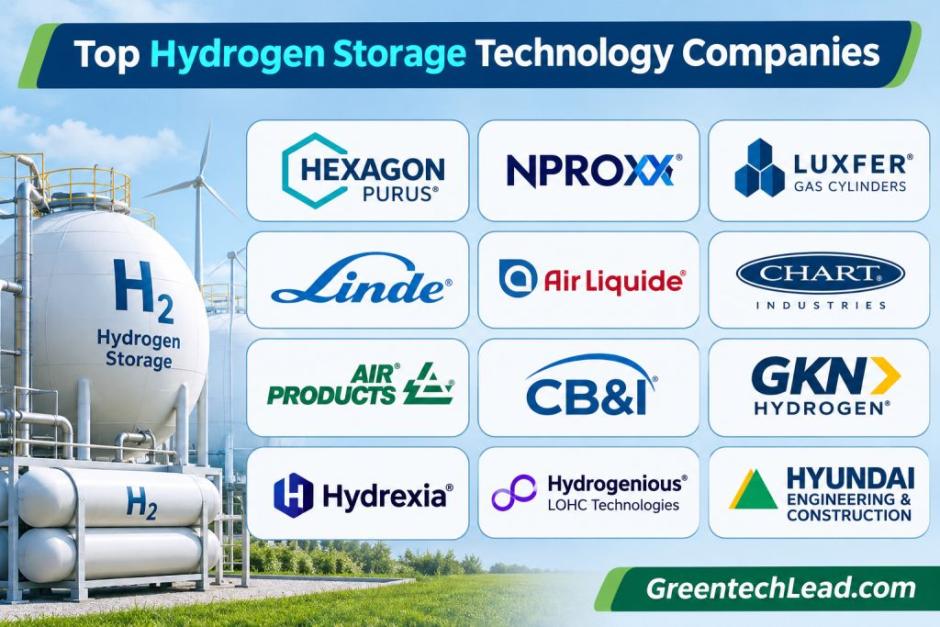
Leading hydrogen storage technology companies, including Hexagon Purus, NPROXX, Linde, Air Liquide, Chart Industries, Hydrexia and Hydrogenious, are developing compressed hydrogen cylinders, cryogenic tanks, metal-hydride systems and liquid organic hydrogen carriers (LOHCs).
According to the IEA’s Global Hydrogen Review 2026, announced underground hydrogen storage projects could deliver 11 TWh of storage capacity, equivalent to approximately 335,000 tonnes of hydrogen, by 2035.
Announced hydrogen pipeline projects exceed 40,000 km by 2035, but only 9 percent are operational or have secured investment commitments. However, just over 7 percent of this capacity had reached final investment decision or construction, highlighting the challenges facing commercial deployment.
Leading hydrogen storage technologies
| Technology | Major applications | Key challenges |
| Compressed hydrogen | Transportation, refueling and industrial storage | Compression costs and pressure management |
| Liquid hydrogen | Industrial supply, aviation and maritime transportation | Liquefaction costs and boil-off losses |
| Metal hydrides | Stationary storage and distributed energy | Weight and thermal management |
| Liquid organic hydrogen carriers | Long-distance transportation and exports | Hydrogen release costs |
| Underground storage | Large-scale and seasonal energy storage | Geological limitations and infrastructure investment |
Top 12 hydrogen storage technology companies
1. Hexagon Purus
Norway-based Hexagon Purus specializes in Type IV composite hydrogen cylinders, transportation modules and high-pressure storage systems for commercial vehicles and industrial applications.
Its customers include Air Liquide, Linde, Lhyfe, Plug Power and ZE PAK. Hydrogen infrastructure solutions generated NOK 1.058 billion in revenue in 2024, according to its annual report.
Hexagon Purus secured €6.2 million in hydrogen distribution equipment orders in March 2026. Its 45-foot HyCarrier system can transport 1,304 kg of hydrogen at 380 bar. More than 650 earlier distribution modules have been deployed.
Financial restructuring and negative equity remain potential procurement risks for customers requiring long-term maintenance and warranty support.
2. NPROXX
NPROXX develops high-pressure composite hydrogen storage vessels for trucks, trains, industrial facilities and hydrogen transportation infrastructure.
Its AH710-70 storage vessel offers 553 litres of internal volume and approximately 22.2 kg of usable hydrogen capacity at 700 bar.
The company’s lightweight composite technology supports commercial vehicle manufacturers seeking to increase hydrogen payload without compromising vehicle carrying capacity. Customers should evaluate cylinder replacement costs, pressure-cycle durability and inspection requirements.
3. Luxfer Gas Cylinders
Luxfer Gas Cylinders manufactures lightweight composite cylinders and multiple-element gas containers for hydrogen transportation, commercial vehicles and refueling infrastructure.
Reynolds Logistics announced an initial investment of approximately £3 million in four 40-foot Luxfer hydrogen transportation containers supporting the UK’s HyHaul project.
Luxfer’s mobile storage technology enables hydrogen suppliers to reach industrial customers and refueling stations in locations without dedicated hydrogen pipelines.
4. Linde
Linde’s hydrogen infrastructure portfolio includes approximately 1,000 km of hydrogen pipelines, cryogenic tanks with capacities ranging from 3,000 to more than 100,000 litres, transportation trailers and underground storage facilities.
Linde operates a commercial high-purity hydrogen storage cavern in Texas. Its 40-foot liquid hydrogen transportation container can accommodate up to 3,040 kg of hydrogen.
NASA awarded Linde a liquid hydrogen supply contract worth up to $29.1 million in 2022, covering facilities including Kennedy Space Center and Glenn Research Center, according to NASA’s contract announcement.
5. Air Liquide
Air Liquide operates an underground hydrogen storage cavern in Beaumont, Texas, with more than 4.5 billion cubic feet of storage capacity, supporting refinery and petrochemical customers along the US Gulf Coast.
The company has installed more than 260 hydrogen refueling stations globally. Its customers and project partners include HysetCo, Toyota and operators supporting Hyundai hydrogen trucks through California’s NorCAL ZERO project.
Air Liquide’s hydrogen business generates approximately €2 billion in annual revenue and sells around 1.2 million tonnes of hydrogen annually.
Its 200 MW Normand’Hy and 200 MW ELYgator hydrogen production projects create additional requirements for integrated storage and distribution infrastructure.
6. Chart Industries
Chart Industries supplies hydrogen liquefaction systems, cryogenic storage tanks, heat exchangers and hydrogen transfer equipment.
Its hydrogen liquefaction technology covers production capacities ranging from five tonnes to more than 150 tonnes per day.
Chart targets industrial gas suppliers, hydrogen project developers, transportation companies and refueling network operators. Its integrated equipment portfolio supports hydrogen production facilities seeking to develop commercial liquid hydrogen distribution networks.
Electricity consumption, cryogenic equipment maintenance and evaporation losses remain important considerations for customers.
7. Air Products
Air Products supplies liquid hydrogen to industrial manufacturers, aerospace organizations and commercial transportation operators.
In November 2025, NASA awarded Air Products liquid hydrogen supply contracts worth up to $144.4 million, covering approximately 36.5 million pounds of hydrogen for space agency facilities.
Air Products’ liquid hydrogen facility in Rotterdam was more than 65 percent complete in April 2026, with operations expected in 2027.
The Port of Rotterdam expects the project to become Europe’s largest facility of its kind.
8. CB&I
CB&I specializes in large-scale cryogenic storage tanks for industrial hydrogen projects and international energy transportation.
CB&I, Shell, NASA, GenH2 and the University of Houston are collaborating on affordable liquid hydrogen storage technology targeting tank capacities of up to 100,000 cubic metres.
In August 2026, CB&I completed the first liquid hydrogen fill of a 20-cubic-metre demonstration tank at NASA’s Marshall Space Flight Center.
The project evaluates non-vacuum insulation technology designed to reduce capital expenditure associated with large cryogenic storage infrastructure.
9. GKN Hydrogen
GKN Hydrogen develops solid-state hydrogen storage systems using metal hydrides, which absorb hydrogen and release it through controlled heating.
Its HY2MEGA technology targets industrial facilities, microgrids and distributed energy storage applications.
GKN Hydrogen collaborated with the National Renewable Energy Laboratory and SoCalGas on a demonstration project designed to provide 500 kg of hydrogen storage capacity.
The project received $1.7 million from the US Department of Energy and $400,000 from SoCalGas. Access to industrial waste heat can strengthen the economics of metal-hydride storage.
10. Hydrexia
Hydrexia develops magnesium-based solid-state hydrogen storage containers, transportation systems and mobile hydrogen refueling infrastructure.
In April 2026, Hydrexia announced its first commercial contract in Vietnam with KPT Chemical Group for hydrogen storage containers and mobile refueling stations.
The agreement is linked to hydrogen supply from Malaysia’s Darul Hana project. Contract valuation and storage capacity were not disclosed.
Hydrexia’s technology targets industrial companies seeking alternatives to conventional high-pressure hydrogen transportation.
11. Hydrogenious LOHC Technologies
Hydrogenious LOHC Technologies develops technology that chemically binds hydrogen to liquid organic carriers, enabling transportation using conventional liquid-fuel logistics infrastructure.
Its One Reactor project at Forschungszentrum Jülich targets hydrogen release capacity of 300 kg per day.
The Blue Danube project targets annual hydrogen release capacity of up to 1,800 tonnes. These projects represent opportunities for chemical manufacturers, industrial hydrogen consumers and international energy suppliers.
Hydrogen recovery costs and thermal energy requirements remain commercialization challenges.
12. Hyundai Engineering & Construction
Hyundai E&C is developing large-scale liquid hydrogen storage tanks for industrial facilities, import terminals and hydrogen distribution hubs.
In April 2026, Hyundai E&C was selected for a South Korean national research project targeting liquid hydrogen tanks with capacities of 4,000 and 50,000 cubic metres.
The development program involves 14 participating organizations, approximately KRW 29 billion in government support and a completion target of December 2029.
Hydrogen storage customer complaints and operational challenges
Customer dissatisfaction remains a significant challenge for hydrogen infrastructure operators.
The California Energy Commission’s hydrogen refueling network assessment identified equipment failures, maintenance requirements and hydrogen supply disruptions as major causes of station downtime.
Average availability of operating retail hydrogen stations reached 73 percent during the second quarter of 2025, while typical downtime incidents lasted approximately 42 hours.
California awarded $9.4 million to FirstElement Fuel and Iwatani to improve reliability across 45 refueling stations, targeting 95 percent uptime.
The California Air Resources Board also documented incomplete refueling and unsuccessful dispensing attempts.
Research published by the American Chemical Society identified storage and compression technology, equipment reliability, warranties and spare-parts availability among customer concerns.
India’s hydrogen storage market opportunity
India’s National Green Hydrogen Mission targets annual green hydrogen production of at least five million tonnes by 2030, supported by an initial government allocation of ₹19,744 crore.
Refineries, fertilizer manufacturers, steelmakers, ports and commercial transportation companies represent major potential customers for hydrogen storage technology suppliers.
A comparative techno-economic study covering industrial locations, including Hajira in India, estimated that increasing storage pressure from 200 bar to 350–700 bar could increase modeled hydrogen costs by 4–8 percent.
Hydrogen storage companies offering competitive lifecycle costs, reliable equipment, local manufacturing, safety certification and after-sales support will be better positioned to capitalize on India’s emerging hydrogen economy.
SHAFANA FAZAL