


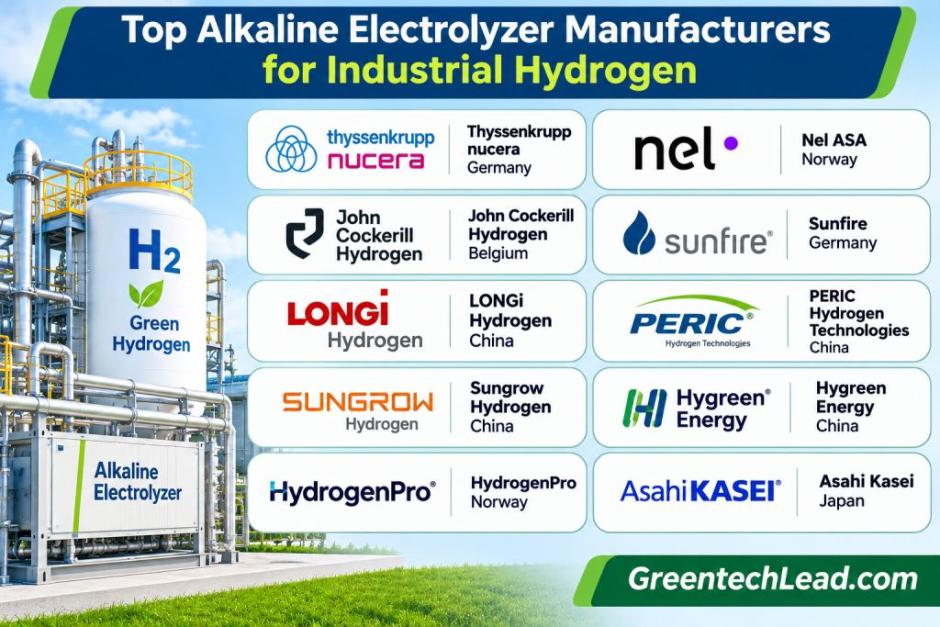
The global alkaline electrolyzer market is expanding as energy companies, steel manufacturers, petroleum refiners, fertilizer producers and chemical companies invest in low-emissions hydrogen production. Thyssenkrupp nucera, LONGi Hydrogen, John Cockerill, Nel, Sunfire, PERIC, Sungrow Hydrogen, Hygreen Energy, HydrogenPro and Asahi Kasei are among the prominent technology suppliers competing for industrial hydrogen contracts.
Manufacturing capacity, electricity consumption, equipment reliability, project execution, maintenance costs and after-sales support are becoming important differentiators as industrial customers seek to reduce green hydrogen production costs.
According to the International Energy Agency’s analysis of electrolyzer manufacturing costs, alkaline electrolyzer capital costs in 2025 were estimated at $500–1,100/kW in China, compared with $1,900–2,500/kW elsewhere. Balance-of-plant equipment, engineering, construction, installation and contingency costs significantly influence the final investment.
Leading alkaline electrolyzer manufacturers and project portfolios
1. Thyssenkrupp nucera – Germany
Thyssenkrupp nucera has secured some of the world’s largest industrial alkaline electrolyzer contracts, targeting green ammonia, sustainable steel and refinery decarbonization.
Its major customers and projects include Air Products’ NEOM green hydrogen project in Saudi Arabia with more than 2 GW of electrolysis capacity, Stegra’s green steel plant in Sweden with over 700 MW, and Shell’s 200 MW Holland Hydrogen I project in Rotterdam, according to a company presentation published through the Asian Development Bank’s knowledge platform.
Moeve’s 300 MW Onuba green hydrogen project in Spain will utilize fifteen 20 MW electrolyzer units, targeting annual hydrogen production of approximately 45,000 tonnes.
2. Nel ASA – Norway
Nel specializes in alkaline and PEM electrolyzers, serving fertilizer manufacturers, renewable hydrogen developers and industrial gas producers.
Its notable alkaline electrolyzer references include Yara’s 24 MW renewable hydrogen facility at Herøya in Norway.
Nel’s next-generation pressurized alkaline electrolyzer platform, introduced in May 2026, operates at 15 bar and supports outdoor installation.
Nel estimates turnkey costs below $1,450/kW for a specified 25 MW configuration. The company is developing a 1 GW annual production line at Herøya, with an estimated investment of NOK 300 million.
3. John Cockerill Hydrogen – Belgium
John Cockerill is strengthening its position in industrial hydrogen through manufacturing investments and large contracts in Europe and India.
AM Green awarded John Cockerill a 640 MW electrolyzer order for the first phase of its green ammonia development in Kakinada, Andhra Pradesh. The wider project envisages approximately 1.3 GW of electrolysis capacity.
Other customers and projects include Virya Energy’s 25 MW HyOffWind development in Belgium, Power2X’s 20 MW Djewels project in the Netherlands and the 2.5 MW H₂ Metz hydrogen refueling project in France.
John Cockerill began manufacturing equipment for another 40 MW Dutch project in 2026 and raised €116 million in capital during 2025.
4. Sunfire – Germany
Sunfire is targeting refinery decarbonization, green steel manufacturing and renewable fuel production with pressurized alkaline electrolyzers.
Its portfolio includes two 100 MW electrolyzer contracts associated with Repsol’s Cartagena and Petronor’s Muskiz facilities in Spain. Each project targets annual hydrogen production of up to 15,000 tonnes from 2029.
Repsol disclosed investments exceeding €300 million for Cartagena and €292 million for Muskiz.
The Sunfire HyLink Alkaline 23 technical specifications indicate electricity consumption of 46.5–52.3 kWh/kg and operating pressure of 30 bar(g).
5. LONGi Hydrogen – China
LONGi Hydrogen has established commercial relationships with major Chinese industrial companies, including Sinopec.
LONGi supplied sixteen alkaline electrolyzers, each capable of producing 1,000 Nm³ of hydrogen per hour, for Sinopec’s Kuqa renewable hydrogen project. The facility has a design capacity of 20,000 tonnes annually.
LONGi subsequently secured an order for 24 electrolyzer units for Sinopec’s Uxin Banner development in Inner Mongolia, targeting 30,000 tonnes of annual hydrogen production. LONGi has also supplied equipment for the Da’an green ammonia project.
The World Bank’s research on electrolyzer costs identifies LONGi, SANY and Huadian Engineering as successful suppliers in Sinopec’s major 2025 Ordos procurement.
6. PERIC Hydrogen Technologies – China
PERIC is a major Chinese alkaline electrolyzer manufacturer with industrial applications spanning ammonia, refining and chemical manufacturing.
Its project references include Sinopec’s Kuqa hydrogen development. Sweden’s Metacon is among PERIC’s international technology partners.
PERIC’s reported annual manufacturing capacity reached 6.5 GW in 2026. Its portfolio includes 5 MW, 10 MW and 15 MW stack technologies.
Metacon reported improvements of up to 17 percent in current density and a 13 percent reduction in cell-plate weight for a new pressurized stack design.
7. Sungrow Hydrogen – China
Sungrow Hydrogen is leveraging its renewable energy equipment expertise to expand into hydrogen production and green ammonia infrastructure.
Sungrow shipped 160 MW of alkaline electrolyzer equipment in March 2026 for ACME’s renewable ammonia project in Oman.
The company was also selected to supply sixteen electrolyzer units, each rated at 1,000 Nm³/hour, for a geothermal-powered ammonia development in Kenya.
The Kenyan project represents an estimated $800 million investment and targets annual ammonia production of 200,000 tonnes. These figures represent the overall project, rather than Sungrow’s contract revenue.
8. Hygreen Energy – China
Hygreen Energy manufactures alkaline, PEM and AEM electrolyzers for renewable hydrogen developers and industrial customers.
Its alkaline product portfolio includes stacks with capacities of up to 15 MW, an advertised operating load range of 30–110 percent and hydrogen purity reaching 99.999 percent under specified configurations.
Hygreen signed a memorandum of understanding with Hyundai Engineering & Construction in June 2026, combining electrolyzer manufacturing with engineering and project integration capabilities.
The partnership represents a commercial development opportunity rather than confirmed equipment orders.
9. HydrogenPro – Norway
HydrogenPro specializes in large-scale, high-pressure alkaline electrolysis for power generation and industrial decarbonization.
The company reported commissioning 40 electrolyzers representing 220 MW for the first stage of the Advanced Clean Energy Storage project in Utah, United States, in early 2026.
HydrogenPro is also supplying eighteen electrolyzer stacks totaling 100 MW through ANDRITZ for Salzgitter’s SALCOS green steel project in Germany.
The Salzgitter installation targets annual hydrogen production of 9,000 tonnes and potential CO₂ emission reductions of 200,000 tonnes.
10. Asahi Kasei – Japan
Asahi Kasei is targeting industrial hydrogen production through alkaline electrolyzer systems, membranes and electrochemical materials.
Its 10 MW-class Fukushima installation has provided an operating reference since 2020. JGC began a green ammonia demonstration using hydrogen from the facility in January 2026.
Asahi Kasei’s manufacturing expansion strategy includes approximately ¥35 billion in investment, supported by subsidies of up to ¥11.4 billion.
The company targets annual production capacity of at least 2 GW each for electrolyzer cell frames and membranes by 2028.
Alkaline electrolyzer customer complaints and operational challenges
Sinopec’s 260 MW Kuqa project provides an important example of industrial electrolyzer performance challenges. The project sourced equipment from John Cockerill Jingli (120 MW), LONGi Hydrogen (80 MW) and PERIC (60 MW).
According to Wood Mackenzie’s Sinopec hydrogen project case study, the facility produced 2,010 tonnes of hydrogen during 2023, operating at approximately 20 percent of rated capacity. Operational constraints could increase hydrogen production costs by up to 20 percent.
A California Energy Commission report identified insufficient electricity supply, safety challenges and difficulties operating electrolyzers at low loads.
LONGi defended its technology, explaining that selectively shutting down electrolyzers during periods of insufficient renewable electricity enables remaining units to operate more reliably, according to S&P Global.
Other industrial customer concerns include:
Higher-than-anticipated electricity consumption.
Stack degradation and replacement costs.
Hydrogen purity and gas crossover risks.
Commissioning delays and inadequate spare-parts availability.
Limited operational flexibility during renewable power fluctuations.
Differences between equipment quotations and final installation costs.
Alkaline electrolyzer costs and supplier selection
Electricity consumption remains critical to industrial hydrogen economics. An electrolyzer consuming 50 kWh/kg requires 50 MWh to produce one tonne of hydrogen. At $50/MWh, electricity alone costs $2,500 per tonne.
A 2 kWh/kg improvement in efficiency reduces electricity expenditure by $100 per tonne under the same pricing assumptions.
Industrial buyers should compare guaranteed system efficiency, operating pressure, hydrogen purity, equipment availability, stack durability, warranty coverage, maintenance expenditure and total installed capital costs.
The competitive position of alkaline electrolyzer manufacturers will increasingly depend on independently demonstrated operating performance, successful project execution and long-term customer support rather than announced manufacturing capacity or aggressive equipment pricing.
SHAFANA FAZAL