


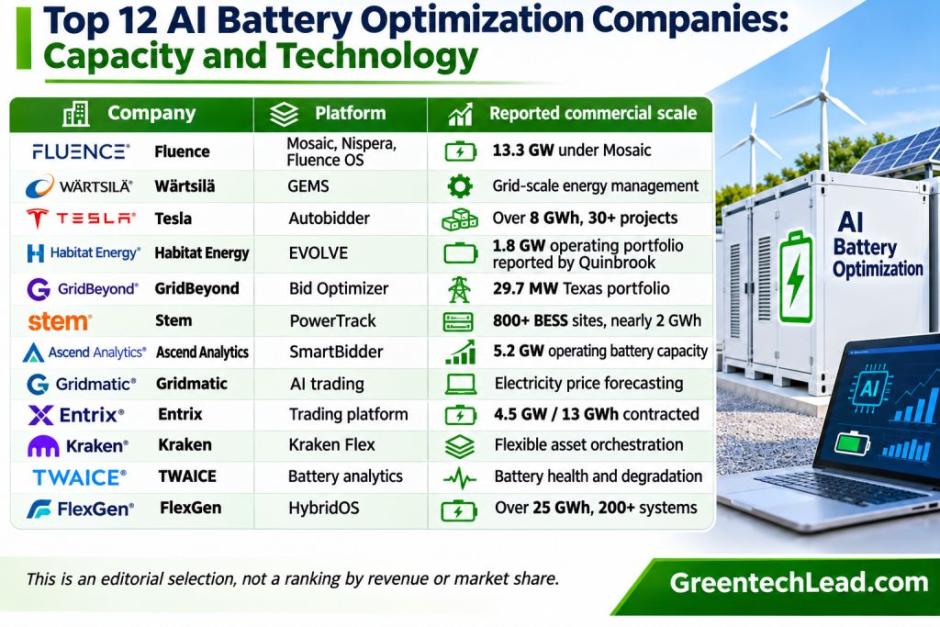
AI-powered battery energy storage optimization platforms are becoming important for utility-scale BESS profitability as electricity price volatility, renewable generation and grid services create new trading opportunities. Fluence, Wärtsilä, Tesla, Habitat Energy, GridBeyond, Stem, Ascend Analytics, Gridmatic, Entrix, Kraken, TWAICE and FlexGen are competing in battery dispatch, electricity trading, energy management and predictive analytics.
Battery energy storage system (BESS) operators increasingly use artificial intelligence to forecast electricity prices, automate bidding, manage charging and discharging, and reduce battery degradation.
However, installed capacity does not guarantee profitable operations. Revenue depends on electricity price spreads, ancillary services, charging costs, software fees, operating expenses and battery life.
The 12 companies provide different services. Some specialize in trading, while others focus on plant control, portfolio management or battery-health monitoring.
1. Fluence: Mosaic Manages Over 13.3 GW
Fluence combines AI-based electricity trading, battery analytics and plant controls through its digital platforms.
Its Fluence IQ platform includes Mosaic for wholesale market bidding, Nispera for asset performance analytics and Fluence OS for energy storage controls.
Fluence reports more than 13.3 GW managed through Mosaic and over 15.5 GW across Nispera’s wider renewable energy and storage portfolio.
These figures include different asset categories and should not be interpreted as exclusively operational battery capacity.
Investors should evaluate battery-specific software revenue, customer retention, trading performance and recurring contracts.
2. Wärtsilä: GEMS Optimizes Battery Operations
Wärtsilä’s GEMS Digital Energy Platform manages battery storage, hybrid power plants and other energy assets.
GEMS Pulse provides analytics covering state of charge, state of health, cell imbalance, temperature and available battery capacity.
The platform supports dispatch control, equipment monitoring and integration with external systems.
However, GEMS is primarily an energy management and plant-control platform rather than a standalone merchant electricity trading service.
Customers should assess compatibility with battery management systems, inverters and external trading software.
3. Tesla: Autobidder Manages Over 8 GWh
Tesla’s Autobidder platform uses market forecasts, battery availability and operating constraints to automate electricity trading decisions.
The company reports managing more than 8 GWh across over 30 projects in four countries.
Autobidder integrates with Tesla Megapack systems and supports automated bidding, charging and discharging.
Eligible contracts may include minimum-revenue arrangements and shared upside.
However, customers should examine software fees, revenue guarantees, warranty exclusions and dependence on Tesla hardware.
4. Habitat Energy: EVOLVE Targets Wholesale Trading Revenue
Habitat Energy’s EVOLVE platform combines algorithmic forecasting, automated trading and human oversight.
It targets wholesale electricity and ancillary-service markets.
Quinbrook has reported 1.8 GW of operating assets and a contracted pipeline exceeding 3.9 GW across the UK, Ireland, United States and Australia.
Operating and contracted capacity should be assessed separately.
For investors, the important metrics are settled trading revenue, software fees, battery degradation costs and risk-adjusted customer returns.
5. GridBeyond: 29.7 MW Texas Battery Optimization
GridBeyond combines electricity forecasting, bidding and dispatch optimization.
In August 2026, the company reported commercial optimization of three SmartestEnergy battery installations in South Texas totaling 29.7 MW.
The batteries participate in ERCOT day-ahead and real-time electricity markets.
However, the announcement did not disclose independently verified revenue improvement.
Customers should request settlement records, forecast accuracy and clarification of Qualified Scheduling Entity responsibilities.
6. Stem: PowerTrack Covers More Than 800 BESS Sites
Stem’s PowerTrack platform combines battery monitoring, energy management and operational optimization.
The company reports more than 800 battery storage sites and nearly 2 GWh under management.
These figures demonstrate reported software coverage but do not establish electricity trading profitability.
Project developers should distinguish equipment monitoring, plant control and automated market bidding.
The platform’s financial value depends on measurable operating savings, improved availability and additional revenue.
7. Ascend Analytics: SmartBidder Optimizes 5.2 GW
Ascend Analytics provides electricity market forecasting, project valuation and automated bidding software.
PowerVAL supports project financial analysis, while SmartBidder manages market bidding and scheduling.
In September 2026, Ascend reported 5.2 GW of operating battery capacity optimized through SmartBidder in US wholesale electricity markets.
The company combines market forecasting with battery operating constraints.
Investors should compare forecast results against actual settlements, including charging costs, degradation and market-price volatility.
8. Gridmatic: Machine Learning for Electricity Trading
Gridmatic uses machine learning to forecast electricity prices and identify trading opportunities.
Its models consider electricity demand, weather, renewable generation and market conditions.
The platform targets flexible electricity assets, including battery storage.
Commercial evaluation should focus on forecast errors, net trading revenue, dispatch reliability and downside protection.
Customers should also identify whether Gridmatic supplies plant controls or requires integration with another energy management system.
9. Entrix: 13 GWh Battery Portfolio Under Contract
Entrix provides algorithmic battery optimization and electricity trading services across European markets.
The company reports 103 projects representing approximately 4.5 GW and 13 GWh under contract.
These figures include contracted assets and should not automatically be described as operating capacity.
Entrix combines market forecasting with battery operating limits and ancillary-service opportunities.
The main commercial indicators are net revenue after trading fees, customer retention, asset availability and degradation-aware dispatch.
10. Kraken: Kraken Flex Coordinates Distributed Energy Assets
Kraken Flex connects batteries, renewable generation and other flexible electricity assets through a digital orchestration platform.
Its agreement with Vattenfall illustrates the division between technology services and electricity trading.
Under that arrangement, Vattenfall retains trading responsibilities while Kraken provides the technology infrastructure.
Customers should determine who controls bids, dispatch, settlement and imbalance exposure.
Kraken should not automatically be classified as a merchant trading optimizer for every deployment.
11. TWAICE: AI Analytics for Battery Degradation
TWAICE specializes in battery performance analytics rather than wholesale electricity trading.
Its software evaluates battery management system data to identify anomalies, estimate degradation and support maintenance decisions.
The platform can help operators assess battery state of health, warranty compliance and augmentation requirements.
Its value depends on data accuracy, chemistry compatibility and demonstrated reductions in lifecycle operating costs.
TWAICE can complement trading platforms rather than replace them.
12. FlexGen: HybridOS Supports Over 25 GWh
FlexGen provides HybridOS, an energy management platform for battery storage and hybrid power projects.
The company reports supporting more than 25 GWh across over 200 energy storage systems.
HybridOS provides monitoring, plant control and integration capabilities.
However, the reported capacity does not establish a measurable improvement in electricity trading revenue.
Customers should examine inverter compatibility, cybersecurity, data ownership and integration with external market optimizers.
BESS Customer Complaints: Revenue Shortfalls, Software Failures and Battery Degradation
Utility-scale battery optimization customers are primarily utilities, project developers and energy investors. There is no verified public database comparing customer complaint rates across these 12 platforms.
Potential customer disputes include lower-than-promised trading revenue, inaccurate price forecasts, failed dispatch instructions, unexpected software fees, battery degradation and disagreements over performance guarantees.
These are industry procurement risks, not verified complaints against individual providers.
| Customer concern | Financial or operational impact |
| Inaccurate electricity forecasts | Lower trading revenue |
| Failed dispatch instructions | Missed market opportunities |
| Excessive battery cycling | Faster battery degradation |
| Software downtime | Reduced market participation |
| Unexpected revenue-sharing fees | Lower project profitability |
| Data access restrictions | Difficulty switching vendors |
| Warranty conflicts | Higher replacement costs |
Project owners should require transparent settlement reporting, software availability guarantees, cybersecurity safeguards and clearly defined responsibilities for market participation.
AI Battery Optimization: Revenue Improvement Calculation
Consider a hypothetical 100 MW / 400 MWh battery installation.
If an optimization platform increases annual net operating revenue from $12 million to $13.2 million, the improvement is $1.2 million, or 10 percent.
With annual software fees of $300,000 and additional degradation-related costs of $200,000, the incremental annual benefit falls to $700,000.
| Financial indicator | Illustrative amount |
| Baseline annual net revenue | $12 million |
| Optimized annual net revenue | $13.2 million |
| Gross improvement | $1.2 million |
| Additional software fees | $300,000 |
| Additional degradation costs | $200,000 |
| Incremental annual benefit | $700,000 |
The figures are hypothetical, not actual results from any vendor.
A 2026 academic study cited in the supplied research reported modeled net-revenue improvements of 11.2–17.5 percent from degradation-aware revenue stacking. Those results are scenario-specific and do not constitute guaranteed performance.
Investment Outlook: Which AI Battery Platforms Offer Stronger Opportunities?
AI battery optimization creates opportunities in electricity trading, software subscriptions, energy management, predictive maintenance and battery lifecycle analytics.
Fluence, Tesla, Ascend Analytics, Habitat Energy, GridBeyond, Gridmatic and Entrix focus on market optimization to varying degrees.
Wärtsilä, Stem, Kraken and FlexGen provide control and management capabilities, while TWAICE specializes in battery-health analytics.
Project developers should compare software providers using the same battery capacity, electricity market, operating period, charging costs and degradation assumptions.
The leading AI-powered BESS optimization platforms in 2027 will be determined by verified incremental net revenue, reliable dispatch, lower battery degradation, transparent fees and long-term customer retention — not installed capacity or AI marketing claims alone.
SHAFANA FAZAL