


Green hydrogen investment is moving from ambitious announcements toward construction, financing and long-term supply contracts in 2026. Global committed clean-hydrogen investment has surpassed $130 billion across more than 570 projects, representing about 6.9 million tonnes per year (Mtpa) of committed production capacity. Around 90 percent of these projects are already operational or under construction, according to the Hydrogen Council’s Global Hydrogen Compass 2026.
Demand is becoming the industry’s biggest test. Current policies could support around 6 million tonnes of clean-hydrogen demand annually by 2030, potentially rising to 11 million tonnes with stronger policy implementation.
Against this backdrop, the top green hydrogen projects in 2026 are increasingly differentiated not simply by electrolyzer capacity, but by investment, renewable-energy supply, construction progress, financing and credible buyers.
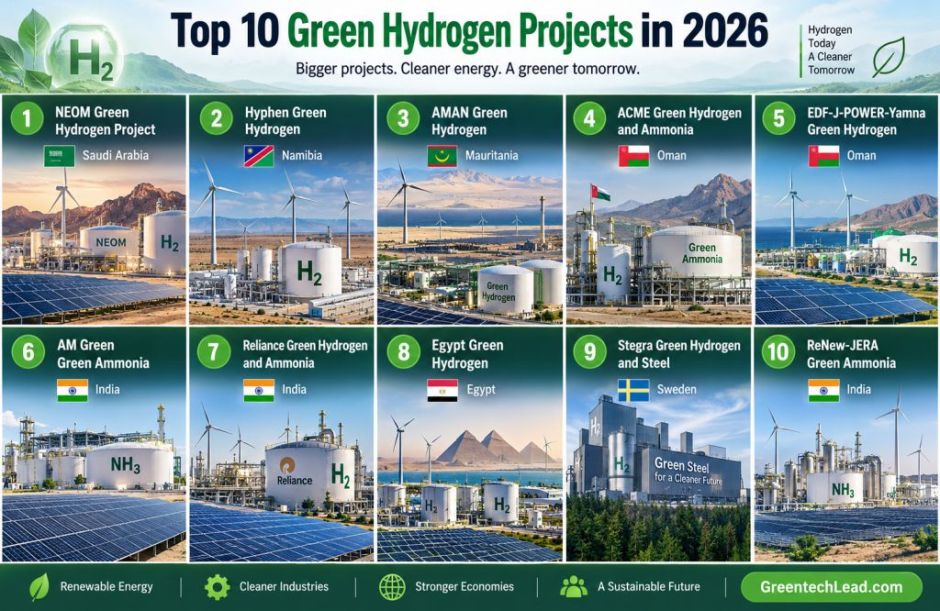
1. NEOM Green Hydrogen Project — Saudi Arabia
The $8.4 billion NEOM Green Hydrogen project is one of the world’s most advanced large-scale green-hydrogen developments.
NEOM Green Hydrogen Company — a joint venture between ACWA Power, Air Products and NEOM — is integrating up to 4 GW of solar and wind power to produce as much as 600 tonnes of carbon-free hydrogen per day, equivalent to roughly 219,000 tonnes annually.
Hydrogen will be converted into up to 1.2 million tonnes of green ammonia annually. Importantly, Air Products has an exclusive 30-year offtake agreement for the green ammonia, giving the project a level of demand certainty that many competing developments lack.
The NEOM Green Hydrogen project achieved an $8.4 billion financial close, including $6.1 billion of non-recourse financing from 23 financial institutions.
2. Hyphen Green Hydrogen — Namibia
Hyphen Hydrogen Energy plans to invest more than $10 billion in one of Africa’s largest green-hydrogen and ammonia developments.
Phase 1 is designed around approximately 3.75 GW of renewable energy and 1.5 GW of electrolyzers. A second phase could lift total renewable capacity toward 7.5 GW and electrolyzer capacity to approximately 3 GW.
At full scale, Hyphen targets around 2 million tonnes of green ammonia annually, with the first phase contributing approximately 1 million tonnes.
Namibia’s strong wind and solar resources and Atlantic location make the project attractive for exports to Europe and Asia. However, Hyphen also illustrates the importance of buyers: a proposed 300,000-tonne-per-year ammonia arrangement with RWE was withdrawn in 2025. Converting prospective demand into binding contracts remains a key milestone for the project.
3. AMAN Green Hydrogen — Mauritania
CWP Global’s AMAN project is the largest project in this ranking by proposed investment and renewable-energy capacity.
The development could involve approximately $40 billion of investment, combining 18 GW of wind and 12 GW of solar, creating a massive 30 GW renewable-energy platform.
AMAN could generate approximately 110 TWh of renewable electricity annually and produce about 1.7 million tonnes of green hydrogen per year. The hydrogen could support green ammonia, green steel and other hydrogen-derived products.
Its scale could transform Mauritania into a major renewable-energy exporter. However, the $40 billion represents proposed investment rather than secured financing, meaning AMAN remains substantially less mature than NEOM.
4. ACME Green Hydrogen and Ammonia — Oman
India’s ACME Group is developing a major green-hydrogen and ammonia complex at Duqm, supporting Oman’s ambition to become an international hydrogen-export hub.
Phases 2 and 3 are each designed to produce approximately 71,000 tonnes of green hydrogen and 400,000 tonnes of green ammonia annually.
Together, the two phases would provide approximately 142,000 tonnes of hydrogen and 800,000 tonnes of ammonia capacity annually, while the first phase adds another 100,000 tonnes of ammonia production.
ACME has developed an offtake relationship with fertilizer company Yara for the initial phase. Converting hydrogen into ammonia at the production site also gives the project a more practical route into international energy markets.
5. EDF-J-POWER-Yamna Green Hydrogen — Oman
A consortium comprising EDF, J-POWER and Yamna is planning another major hydrogen development in Oman.
The project combines approximately 4.5 GW of wind and solar generation, battery storage and around 2.5 GW of electrolyzer capacity.
Annual green-hydrogen production could reach approximately 178,000 tonnes by 2030, supporting an ammonia plant capable of producing roughly 1 million tonnes of green ammonia annually.
Oman’s Hydrom green hydrogen program is helping coordinate land allocation and development of a national hydrogen ecosystem. The EDF-J-POWER-Yamna project could ultimately connect Oman’s low-cost renewable resources with European and Japanese clean-fuel demand.
6. AM Green Green Ammonia — India
AM Green is building one of India’s largest export-oriented green-ammonia platforms at Kakinada.
The development targets approximately 1.09 million tonnes of green ammonia annually. Its power strategy includes 1.3 GW of round-the-clock carbon-free power, enabled by around 4.5 GW of solar and wind capacity plus 950 MW of pumped-storage capacity.
A 25-year fixed-price power purchase agreement with NTPC covers half of the required power, while Gentari is expected to provide the remainder.
The AM Green platform has also pursued European buyers including Uniper. The combination of renewable-energy supply, ammonia conversion and export demand makes Kakinada strategically important for India’s National Green Hydrogen Mission.
7. Reliance Green Hydrogen and Ammonia — India
Reliance Industries is pursuing one of the industry’s most vertically integrated green-energy strategies, combining renewable electricity, solar manufacturing, batteries, electrolyzers and green molecules.
Reliance is targeting 20 GWp of annual integrated solar manufacturing, while its battery manufacturing program is scaling toward 100 GWh annually, beginning with a 40 GWh first phase.
The most important commercial milestone is a binding 15-year green-ammonia agreement with Samsung C&T worth more than $3 billion. Supplies are scheduled to start in the second half of FY2029.
The Reliance-Samsung C&T green ammonia agreement provides Reliance with something many hydrogen developers still lack: a large, long-duration international buyer.
8. Egypt Green Hydrogen — Egypt
Egypt Green combines hydrogen production with existing industrial and export infrastructure.
The project includes a 100 MW pressurized alkaline electrolyzer capable of producing approximately 13,000 tonnes of green hydrogen annually, supported by roughly 203 MW of wind and 70 MWp of solar generation.
Hydrogen will be converted into renewable ammonia for international markets.
The project’s strategic advantage is its connection to European demand through the H2Global procurement mechanism. Egypt also benefits from its proximity to Europe, established ammonia infrastructure and access to global shipping through the Suez Canal.
9. Stegra Green Hydrogen and Steel — Sweden
Stegra’s Boden project demonstrates another potentially powerful hydrogen business model: creating captive demand through green steel.
The facility includes approximately 700 MW of electrolyzer capacity and targets around 2.5 million tonnes of green steel production annually.
Rather than selling hydrogen as a standalone commodity, Stegra will use it in direct-reduced iron production to replace fossil fuels in steelmaking.
The project secured an additional €1.4 billion financing package in 2026, while installation of its electrolyzer system has advanced significantly. The model reduces dependence on a separate hydrogen transport market because customers ultimately purchase green steel rather than hydrogen.
10. ReNew-JERA Green Ammonia — India
ReNew and Japan’s JERA are developing a green-ammonia project at Paradip in Odisha, potentially creating a major India-Japan clean-fuel supply chain.
The project is planned around approximately 500 MW of high-capacity-utilization-factor renewable power and targets around 100,000 tonnes of green ammonia annually by 2030.
JERA’s participation is commercially important because Japan is expected to become a major importer of hydrogen-derived fuels.
The project remains less mature than NEOM, Reliance or AM Green, but it demonstrates how India’s renewable resources could increasingly serve Asian industrial and power-sector customers.
Buyers Become the Critical Green Hydrogen Metric
The biggest change in the green hydrogen market in 2026 is the growing importance of offtake agreements.
NEOM has secured a 30-year Air Products agreement, while Reliance has a binding 15-year Samsung C&T deal exceeding $3 billion. AM Green is developing international offtake relationships, while Egypt Green has secured a pathway into structured European demand.
These contracts matter because enormous production capacity does not automatically create a bankable hydrogen project. Developers need inexpensive renewable electricity, high electrolyzer utilization, storage and export infrastructure, competitive production costs, financing and customers prepared to sign long-term agreements.
This explains why NEOM can rank ahead of substantially larger proposed projects such as AMAN. A project with financing, construction progress and a 30-year buyer can carry lower execution risk than a much larger development still seeking financing and binding demand.
Green Hydrogen Outlook 2026-2030
Green hydrogen is moving from a capacity race to a bankability race.
Committed clean-hydrogen investment exceeding $130 billion, covering 6.9 Mtpa across more than 570 projects, shows that a significant global industry is taking shape. Operational capacity has almost doubled over the past year and could double again as projects under construction begin production.
Saudi Arabia, India and Oman are emerging as major production and export hubs, while Namibia, Mauritania and Egypt offer enormous African potential. Europe remains an important demand center, with Japan and South Korea becoming increasingly significant buyers of imported green ammonia.
The winners through 2030 may therefore not be the projects announcing the largest electrolyzers. Projects that secure low-cost renewable electricity, financing, construction execution and long-term buyers are increasingly likely to lead the global green hydrogen market.
SHAFANA FAZAL