


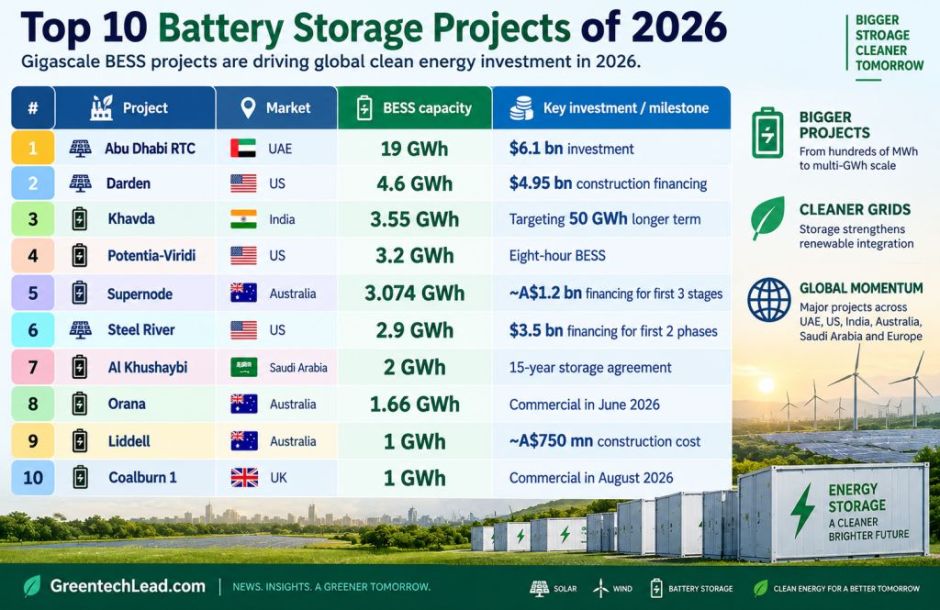
Global battery energy storage investment is accelerating in 2026 as utilities and renewable energy developers move toward multi-gigawatt-hour projects capable of shifting renewable electricity, supporting grids and delivering round-the-clock clean power.
The biggest developments span the Middle East, United States, India, Australia and Europe, with the largest project combining 19 GWh of battery storage and 5.2 GW of solar capacity. Multibillion-dollar financing packages and projects with four- to eight-hour storage durations show that BESS is becoming core power infrastructure rather than simply a grid-balancing technology.
1. Abu Dhabi Round-the-Clock Project — 19 GWh
Abu Dhabi is setting the scale for global battery investment with a 19 GWh BESS integrated with 5.2 GW of solar PV.
Developed by Masdar with Emirates Water and Electricity Company (EWEC), the project is designed to supply up to 1 GW of continuous clean electricity.
The project reached financial close in July 2026 with total investment of $6.1 billion, including $5.1 billion in financing from 13 banks and $1 billion of Masdar equity.
The Masdar $6.1 billion round-the-clock renewable energy project demonstrates how solar-plus-storage projects are moving toward supplying firm electricity traditionally associated with conventional generation.
Battery procurement is equally significant. BYD is supplying 11.275 GWh, while Sungrow is supplying 7.5 GWh, covering almost the entire 19 GWh requirement.
2. Darden Clean Energy Project — 4.6 GWh
The US Darden Clean Energy Project combines approximately 1.15 GWac of solar generation with 4.6 GWh of battery storage.
Developer IPX Power secured approximately $4.95 billion in construction financing, supplemented by tax-equity commitments and investment tax-credit arrangements. Commercial operation is targeted for 2028.
3. Khavda BESS, India — 3.55 GWh and Growing
India is rapidly joining the world’s largest battery-storage markets.
Adani Green Energy commissioned a cumulative 3.37 GWh BESS at Khavda, Gujarat, in May 2026, describing it as the world’s largest single-location battery storage deployment outside China. The deployment was completed within about 10 months of on-site construction starting.
Expansion continued during Q1 FY27. Adani Green subsequently reported total installed BESS capacity at Khavda of 3,551 MWh, after commissioning 1,972 MWh during the quarter.
The company’s Khavda battery storage expansion strategy targets more than 10 GWh of additional storage capacity in FY27 and 50 GWh over the next five years.
Khavda is particularly important because Adani Green is developing a 30 GW renewable energy complex at the location, making storage essential for converting large amounts of variable solar and wind generation into more dispatchable electricity.
4. Potentia-Viridi BESS — 3.2 GWh
California’s Potentia-Viridi project represents another important shift toward longer-duration storage.
The standalone battery project is designed for 400 MW / 3.2 GWh, providing an eight-hour storage duration.
That configuration stands out in a US market historically dominated by two- and four-hour batteries. Longer-duration storage could provide greater flexibility during evening demand peaks and extended periods of low renewable generation.
5. Supernode, Australia — 3.074 GWh
Quinbrook’s Supernode development in Queensland is expected to reach approximately 780 MW / 3.074 GWh across its first three stages.
Stage 1, comprising 260 MW / 619 MWh, entered commercial operation in February 2026.
CATL is supplying battery technology, while financing for Stage 3 reached approximately A$469 million, taking financing for the first three stages to roughly A$1.2 billion.
Supernode also highlights an emerging BESS investment theme: using large batteries to support both renewable integration and rising electricity requirements from digital infrastructure.
6. Steel River Energy Center — 2.9 GWh
Cypress Creek Renewables’ Steel River Energy Center in Arkansas combines a planned 2.45 GW solar portfolio with approximately 2.9 GWh of battery storage.
Google is an anchor offtaker, demonstrating how electricity demand from technology companies and data centers is beginning to support large-scale renewable and storage investments.
Around $3.5 billion in financing was secured in 2026 for the first two phases, covering approximately 1.63 GW of solar and 1.9 GWh of storage.
7. Al Khushaybi BESS, Saudi Arabia — 2 GWh
Saudi Arabia is emerging as another major battery-storage investment market.
The Al Khushaybi BESS, developed by ENGIE and Haji Abdullah Alireza, will provide 500 MW / 2 GWh, equivalent to four hours of storage.
The project is supported by a 15-year Storage Services Agreement and forms part of Saudi Arabia’s push into standalone utility-scale storage.
ENGIE has disclosed $220 million in foreign investment associated with the development.
8. Orana BESS, Australia — 1.66 GWh
Akaysha Energy’s Orana battery in New South Wales reached operation in June 2026 with 415 MW of power capacity and 1,660 MWh of storage.
The project can provide electricity for up to four hours and is located in the Central-West Orana Renewable Energy Zone, where around 3 GW of new wind and solar capacity is forecast.
The Orana BESS commercial operation milestone pushed Akaysha Energy’s operational battery portfolio beyond 4 GWh.
9. Liddell Battery, Australia — 1 GWh
AGL’s Liddell Battery in New South Wales reached commercial operation in 2026 with 500 MW / 1 GWh of capacity.
The two-hour system uses Fluence technology and involved construction cost of approximately A$750 million. More than 600 workers contributed during construction and commissioning.
The project is especially significant because it occupies the site of the former Liddell coal-fired power station, demonstrating how existing thermal power locations can be repurposed for storage while taking advantage of established transmission infrastructure.
10. Coalburn 1, Scotland — 1 GWh
Europe’s BESS market reached another milestone in August when Coalburn 1 entered commercial operation in Scotland.
Developed by Copenhagen Infrastructure Partners through Copenhagen Infrastructure IV, Coalburn 1 provides 500 MW / 1 GWh and has a two-hour duration. CIP described it as Europe’s largest operational battery when commercial operations began.
The Coalburn 1 battery storage project is part of a Scottish portfolio comprising Coalburn 1, Coalburn 2 and Devilla. Together, the three projects are expected to provide 1.5 GW / 3 GWh.
Sungrow, Tesla, CATL and BYD Compete for BESS Growth
The investment boom is creating a major opportunity for battery manufacturers and system integrators.
Wood Mackenzie’s 2026 global BESS integrator ranking places Sungrow first, followed by Tesla and CATL, with BYD fourth. Envision and Trina Storage share fifth position, while Fluence, LG Energy Solution, Canadian Solar and Wärtsilä are also among the top suppliers.
Chinese suppliers have a particularly powerful position. Wood Mackenzie estimates Chinese system integrators captured 76 percent of the global BESS market in 2025.
The Abu Dhabi project illustrates that dominance at project level: BYD and Sungrow alone are supplying nearly 19 GWh of storage systems for one development.
CATL is supplying technology for Australia’s Supernode, Fluence is involved in Liddell, and Canadian Solar’s e-STORAGE technology is being deployed at Coalburn.
Battery Storage Moves From MW to Multi-GWh Scale
The largest 2026 projects reveal three major shifts in the global battery market.
First is scale. Abu Dhabi’s 19 GWh project is several times larger than many utility-scale batteries commissioned only a few years ago.
Second is duration. While two-hour systems remain common, projects such as the 3.2 GWh Potentia-Viridi BESS offer eight hours of storage, reflecting demand for batteries capable of handling longer periods of grid stress.
Third is investment size. Abu Dhabi represents $6.1 billion, Darden has secured $4.95 billion in construction financing, and the first two phases of Steel River attracted approximately $3.5 billion.
Storage is consequently evolving from an auxiliary technology attached to renewable generation into a major power infrastructure asset in its own right.
Outlook for Battery Storage Investment
The 2026 project pipeline shows that the center of gravity for BESS investment is widening geographically.
The Middle East is moving rapidly into gigascale storage, led by the UAE and Saudi Arabia. The United States continues to attract multibillion-dollar financing for solar-plus-storage projects. India is scaling BESS alongside huge renewable energy parks, while Australia has become one of the most active markets for large two- and four-hour batteries.
The biggest signal comes from Abu Dhabi: a 5.2 GW solar plant combined with 19 GWh of storage and $6.1 billion of investment is being financed as infrastructure capable of delivering 1 GW of continuous clean power.
That model could define the next stage of the global energy transition. Battery storage is increasingly being built not simply to support renewable electricity, but to transform variable solar and wind generation into reliable, dispatchable power capable of competing with conventional generation.
SHAFANA FAZAL