


South Korea, one of the most advanced financial markets in the ASEAN+3 bloc, is underperforming in climate finance despite its strong institutional and capital base, according to a report by the Institute for Energy Economics and Financial Analysis (IEEFA).
The ASEAN+3 grouping – comprising Southeast Asian economies along with China, Japan, and South Korea – is becoming increasingly central to global energy transition financing, with rising capital requirements for decarbonization and climate resilience.
However, South Korea remains an outlier, as its strong financial ecosystem has not translated into equally strong climate finance outcomes.
South Korea shows the largest climate finance gap among developed ASEAN+3 economies
A comparative analysis of financial development and climate finance performance across ASEAN+3 highlights a striking imbalance for South Korea.
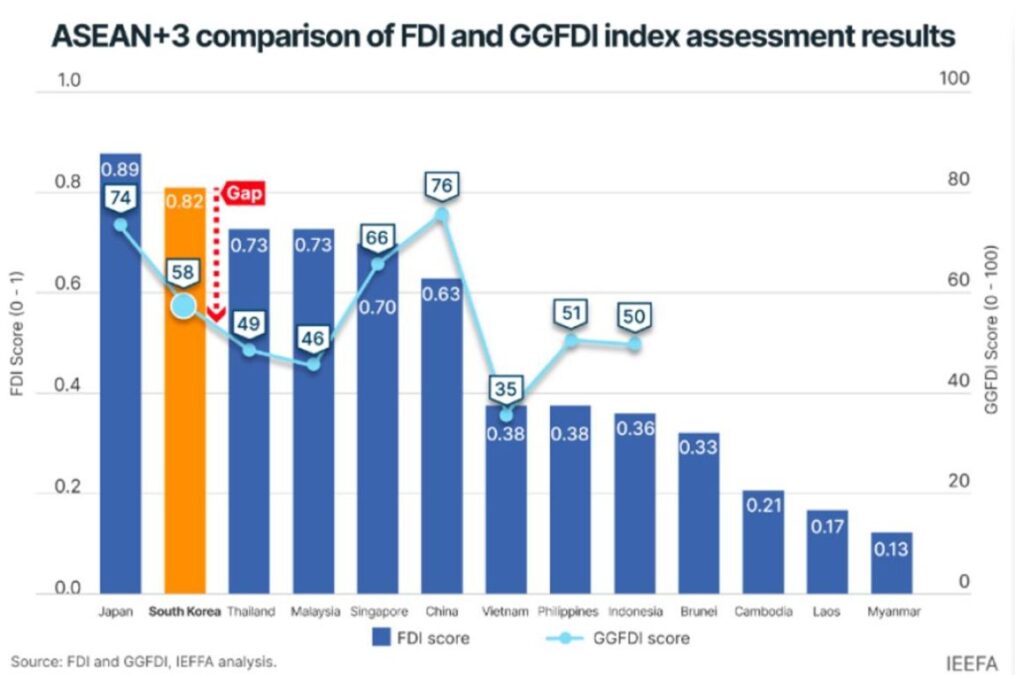
IEEFA’s Taewook Huh, in the report, estimated that South Korea has the largest gap between its Financial Development Index (FDI) score and Green Finance Development Index (GGFDI) performance among developed economies in the region.
South Korea records a strong FDI score of approximately 0.82, but its GGFDI score of around 58 reflects underperformance relative to its financial capabilities.
In contrast, Japan and China show stronger alignment between financial development and green finance outcomes, while Singapore continues to outperform through regulatory clarity and capital market efficiency.
Emerging markets such as Thailand and Malaysia are also narrowing the gap through targeted policy interventions.
This gap highlights a structural inefficiency in South Korea’s financial system, where capital is not being effectively channeled into climate-aligned investments.
South Korea’s weak green central banking performance adds to the gap
Beyond capital markets, South Korea’s underperformance is also evident in green central banking metrics, further reinforcing structural gaps in its climate finance ecosystem.
According to analysis referenced by IEEFA based on data from Positive Money, South Korea ranks near the bottom among ASEAN+3 economies in green central banking performance. South Korea’s total score stands at just 24 out of 130, placing it well behind regional peers.
In comparison, China leads with a score of 50, followed by Malaysia at 43 and Singapore at 42. Even Indonesia and the Philippines outperform South Korea with scores of 40.
Japan, despite being a developed economy, also performs better with a score of 39, highlighting South Korea’s relative lag even among advanced peers.
A deeper breakdown shows that South Korea scores modestly in research and advocacy, but performs particularly weakly in financial policy and “leading by example” metrics, indicating limited integration of climate considerations into central bank operations, asset purchases, and supervisory frameworks.
This weak performance suggests that the Bank of Korea has yet to fully embed climate risk into monetary policy, financial regulation, and institutional strategy, limiting the country’s ability to scale climate finance effectively.
Financial development vs climate finance: A persistent structural mismatch
South Korea ranks among the top ASEAN+3 economies in financial development, supported by deep capital markets and a strong banking sector.
However, its climate finance performance remains closer to mid-tier economies such as Indonesia, reflecting inefficiencies in capital allocation toward sustainable investments.
Sustainable finance investments trail regional competitors
South Korea’s lag is also visible in sustainable bond markets. Between 2016 and 2024, cumulative issuance reached USD 779 billion in China, USD 314 billion in Japan, USD 136 billion in South Korea, and USD 33 billion in Singapore.
While significant, South Korea’s issuance remains below its potential.
Meanwhile, China continues to lead global green investment, Japan is advancing transition finance frameworks, and Singapore is strengthening its global sustainable finance hub position.
Lack of strategic direction – not lack of capital – is the core issue
The analysis indicates that South Korea’s underperformance stems not from a shortage of capital, but from a lack of strategic alignment across institutions and policies.
Without a cohesive framework, capital is not efficiently mobilized toward climate priorities.
Climate risks pose growing macroeconomic threats
According to the Bank of Korea, climate risks could reduce annual GDP growth by approximately 0.30 percent, highlighting long-term economic vulnerabilities.
Global industry trends: Rapid expansion of climate finance
Global climate finance has exceeded USD 1 trillion annually, driven by investment in clean energy, electrification, and sustainable infrastructure.
Frameworks from the International Sustainability Standards Board are enhancing transparency, while central banks globally are integrating climate risk into policy frameworks.
Investment trends: Rising competition across Asia
China continues to dominate through large-scale state-backed investments, while Japan focuses on transition finance for industrial sectors. Singapore is attracting global capital through regulatory innovation.
This intensifies competitive pressure on South Korea.
Investment activities: South Korea’s evolving green finance strategy
South Korea is expanding investments in renewable energy, hydrogen, batteries, and green infrastructure. Offshore wind and solar projects are gaining traction, while companies are exploring opportunities in Southeast Asia.
However, its international climate finance footprint remains limited compared to China and Japan.
Four structural policy reforms to unlock climate finance
To strengthen climate finance capacity, the Institute for Energy Economics and Financial Analysis recommends four key measures.
South Korea needs to strengthen its green taxonomy, enhance the role of public financial institutions, shift toward measurable climate outcomes, and fully integrate climate risk into financial supervision and monetary policy frameworks.
Outlook: Closing the gap to lead the region
South Korea has the financial strength and technological capability to lead climate finance in ASEAN+3.
However, bridging the gap between financial development and climate performance – as well as strengthening central bank engagement – will be critical to achieving that leadership.
As competition intensifies across Asia, South Korea’s ability to align capital with climate goals will define its role in the global green economy.
FASNA SHABEER