


Green hydrogen could approach cost parity with grey hydrogen in China by 2030, while India, Europe and other markets may require additional time, investment and policy support. Falling electrolyzer costs, cheaper renewable electricity and expanding industrial demand are narrowing the gap, but conventional hydrogen remains less expensive in many regions.
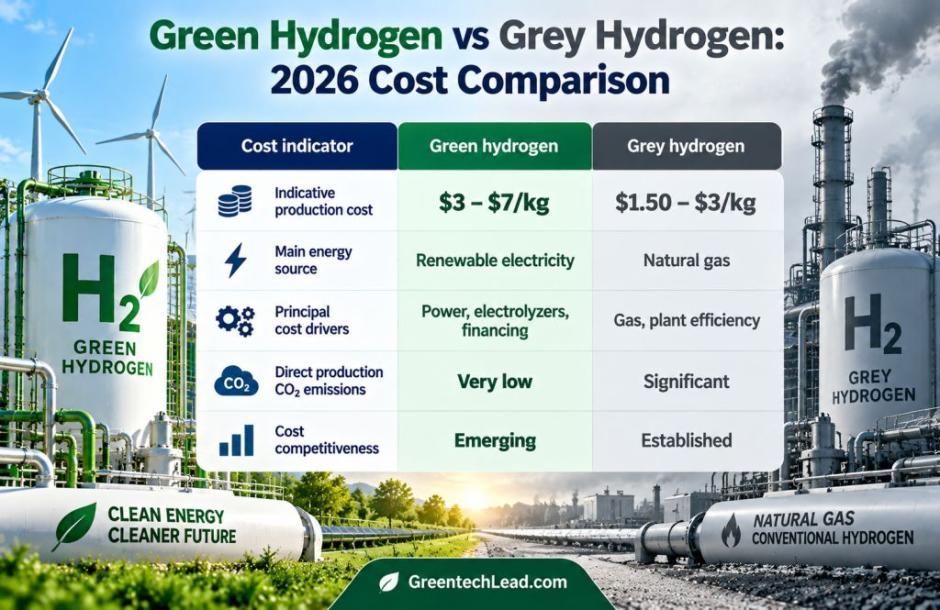
In 2026, green hydrogen production costs are estimated at approximately $3–$7 per kilogram in illustrative projects, compared with $1.50–$3/kg for natural-gas-based grey hydrogen under favorable conditions.
The International Energy Agency’s Global Hydrogen Review 2026 identifies China as a potential early market for cost competitiveness, although the outcome depends on electricity tariffs, equipment costs, financing and carbon policy.
Global hydrogen demand exceeded 100 million tonnes in 2025, while low-emissions hydrogen production remained close to 1 million tonnes. This enormous difference highlights the investment opportunity in replacing conventional hydrogen used by refineries, fertilizer manufacturers and chemical producers.
Green Hydrogen vs Grey Hydrogen: 2026 Cost Comparison
Green hydrogen uses renewable electricity to split water through electrolysis. Grey hydrogen is produced mainly from natural gas through steam methane reforming without carbon capture.
These are indicative ranges, not universal market averages. The cost difference can be smaller in markets with inexpensive renewable power and higher natural gas prices.
At a grey hydrogen cost of $2/kg, a green hydrogen project costing $4/kg needs a 50 percent reduction in production costs to achieve parity without subsidies or carbon charges.
Electricity Prices: The Biggest Factor in Green Hydrogen Parity
An electrolyzer consuming 52 kilowatt-hours (kWh) per kilogram incurs the following electricity costs:
| Renewable electricity price | Electricity cost per kg |
| $20/MWh | $1.04 |
| $30/MWh | $1.56 |
| $40/MWh | $2.08 |
| $50/MWh | $2.60 |
| $60/MWh | $3.12 |
These calculations exclude electrolyzer CAPEX, financing, maintenance, water treatment, compression and storage.
A project producing 10,000 tonnes of hydrogen annually could save approximately $10.4 million per year if electricity costs fall from $40/MWh to $20/MWh, assuming constant efficiency and output.
Low electricity prices are therefore essential, but plants must also operate enough hours annually to recover their capital investment.
China: Could Reach Green Hydrogen Cost Parity by 2030
China has the strongest near-term combination of inexpensive electrolyzers, renewable electricity deployment and industrial hydrogen demand.
IEA estimates indicate that Chinese alkaline electrolyzer capital costs were approximately $500–$1,100/kW in 2025, compared with $1,900–$2,500/kW outside China.
China also accounts for nearly 70 percent of global electrolyzer manufacturing capacity.
Major industrial projects include:
Sinopec Kuqa, Xinjiang: Designed for approximately 20,000 tonnes of green hydrogen annually, supported by large-scale solar generation.
Sinopec Inner Mongolia: A planned 100,000-tonne-per-year green hydrogen development serving industrial applications.
China’s equipment advantage could help selected projects approach parity by 2030, particularly where hydrogen is consumed locally.
However, low equipment purchase prices do not guarantee low installed costs or high electrolyzer utilization.
India: ₹279/kg Tender Signals Competitive Green Hydrogen Pricing
India is emerging as an important market for lower-cost green hydrogen through competitive procurement and domestic industrial demand.
NeuEN Green Energy, a BPCL–Sembcorp joint venture, won the Numaligarh Refinery green hydrogen tender in February 2026 at ₹279/kg, excluding taxes.
The contract covers 10,000 tonnes annually over 25 years, with commercial operations targeted for 2028.
At the contracted price, the annual hydrogen purchase value would be approximately ₹279 crore, excluding taxes and adjustments.
India’s National Green Hydrogen Mission targets at least 5 million tonnes of annual production capacity by 2030, supported by an initial government outlay of ₹19,744 crore.
By fiscal 2025–26, India had awarded 3,000 MW of annual electrolyzer manufacturing capacity and 862,000 tonnes of annual green hydrogen production capacity.
These awards indicate planned manufacturing and production capacity, not commissioned facilities.
Indian Green Hydrogen Projects: Refinery Demand Drives Investment
India’s refinery sector provides identifiable customers for renewable hydrogen.
Major projects include:
Indian Oil Panipat: A 10,000-tonne-per-year green hydrogen project intended to replace part of conventional refinery hydrogen consumption.
Numaligarh Refinery: A 10,000-tonne-per-year supply contract awarded at ₹279/kg.
AM Green Kakinada: A large-scale green ammonia project in Andhra Pradesh, with Phase I incorporating approximately 1,119 MW of electrolyzer capacity.
NTPC Pudimadaka: A proposed green hydrogen hub in Andhra Pradesh with planned investment of approximately ₹1.85 lakh crore across hydrogen and related industrial infrastructure.
India’s refinery-sector procurement awards cover approximately 30,000 tonnes of annual green hydrogen capacity across Panipat, Numaligarh, Bina and Visakhapatnam.
These developments could improve project bankability by connecting production with existing industrial customers.
Global Hydrogen Projects: Investment and Production Capacity
| Project | Country | Key investment or capacity |
| NEOM Green Hydrogen | Saudi Arabia | $8.4 billion; up to 600 tonnes/day |
| Hunter Valley Hydrogen Hub | Australia | 50 MW; 4,700 tonnes/year |
| Sinopec Kuqa | China | 20,000 tonnes/year design capacity |
| Fortescue Pecém | Brazil | 168,000 tonnes/year proposed |
| Scatec Egypt Green Hydrogen | Egypt | 100 MW electrolyzer |
These projects have different development statuses. Their investment amounts and capacities cannot be used directly to compare hydrogen production costs.
Carbon Pricing Could Close the Green Hydrogen Cost Gap
Carbon pricing changes the economics of replacing conventional hydrogen.
For example, if green hydrogen costs $4/kg and grey hydrogen costs $2/kg, the production premium is $2/kg.
Assuming verified emissions savings of 10 kg CO₂-equivalent per kilogram of hydrogen, a carbon price of approximately $200 per tonne would theoretically offset that premium.
The IEA’s hydrogen cost-acceptability analysis finds that, without policy support, acceptable hydrogen costs are below $2/kg for most regional and industrial applications. Even with incentives, cost gaps remain in many markets.
When Will Green Hydrogen Reach Cost Parity?
| Period | Expected competitiveness |
| 2026–2028 | Grey hydrogen remains cheaper in most markets |
| 2029–2030 | Selected Chinese projects could approach parity |
| 2030–2035 | More regional opportunities, dependent on costs and policy |
| Beyond 2035 | Wider parity remains uncertain |
These are indicative scenarios, not guaranteed deadlines.
The IEA reports that the global low-emissions hydrogen project pipeline has contracted to approximately 27 million tonnes annually by 2030. Projects already committed represent a much smaller proportion of announced capacity.
Hydrogen transport also matters: where pure hydrogen is needed, international shipping can add at least $2/kg, according to the IEA, potentially eliminating production-cost advantages.
Conclusion: China Leads, but India Offers Growing Opportunities
China has the strongest prospects for green hydrogen cost parity by 2030 because of low-cost electrolyzers, renewable energy deployment and industrial demand.
India’s ₹279/kg Numaligarh tender and 30,000 tonnes of annual refinery-sector capacity awards demonstrate growing commercial opportunities, although these figures do not establish parity with grey hydrogen.
The decisive factors will be affordable electricity, high plant utilization, lower equipment costs, carbon pricing and long-term industrial contracts. For investors and hydrogen buyers, delivered cost per kilogram and reliable production matter more than announced project capacity or ambitious cost targets.
SHAFANA FAZAL