
Global green hydrogen investment could approach $10 billion in 2026, even as developers cancel, postpone or reduce projects that lack customers, financing and competitive electricity supplies.
The International Energy Agency’s Global Hydrogen Review 2026 shows that the industry is moving away from ambitious project announcements toward developments that have secured final investment decisions, binding offtake agreements and government support.
IEA Global Hydrogen Review 2026 indicated that committed low-emissions hydrogen production capacity for 2030 increased 3 percent to 4.3 million tonnes annually. It could exceed six million tonnes if projects with strong prospects reach final investment decisions during 2026 and 2027.
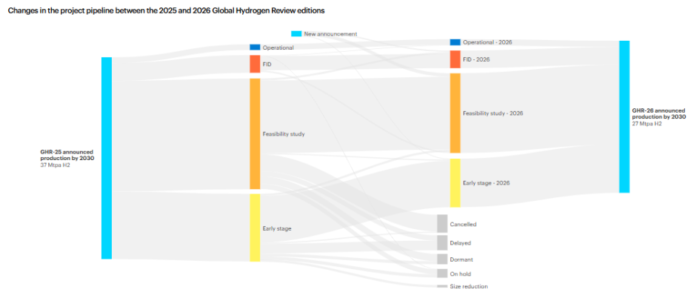
However, the broader project pipeline declined by 10 million tonnes to 27 million tonnes of annual production capacity. More than 100 GW of announced electrolyser capacity could miss the opportunity to begin operations by 2030 unless developers take investment decisions before the end of 2027.
Hydrogen Investment Nearly Doubled to $7 Billion
Capital spending on low-emissions hydrogen projects reached nearly $7 billion in 2025, almost double the amount invested during 2024.
The IEA expects investment to approach $10 billion in 2026, with electrolyser projects accounting for approximately 70 percent of the total.
More than 85 percent of existing investment is directed toward current hydrogen applications in refining and industry or the production of hydrogen-based fuels. This concentration shows that capital is favouring projects connected to established demand rather than applications that require entirely new markets.
Projects that have industrial customers, competitive renewable electricity, approved infrastructure and public funding are more likely to secure financing. Large developments without binding customers or affordable power are increasingly being delayed, downsized or cancelled.
China Controls Over 60 Percent of Committed Electrolyser Capacity
China accounts for more than 60 percent of committed global electrolysis capacity in 2026 but approximately 25 percent of expected investment. Its lower share of spending reflects comparatively low equipment, engineering and construction costs.
Europe represents less than 20 percent of committed capacity but attracts around 45 percent of global investment. European projects generally require substantially more capital for each megawatt of electrolysis capacity.
The difference demonstrates why electrolyser capacity alone is insufficient for comparing hydrogen markets. Project costs, renewable electricity prices, infrastructure requirements and access to industrial customers can be more important than headline capacity.
Electrolyser manufacturers are also facing excess capacity as project construction advances more slowly than expected. Firm equipment orders linked to financed projects are therefore becoming more valuable than potential orders associated with speculative pipelines.
Orica Hunter Valley Hydrogen Hub final investment decision in New South Wales demonstrates why hydrogen projects connected to existing industrial demand are attracting investment.
The 50 MW project is expected to produce approximately 4,700 tonnes of renewable hydrogen annually. Orica will use the hydrogen at its Kooragang Island ammonia facility, reducing the site’s natural-gas consumption by approximately 7.5 percent.
The project has secured a production-based support agreement worth A$432 million through Australia’s Hydrogen Headstart program. Plug Power will supply the 50 MW electrolyser following the project’s final investment decision.
The hub benefits from a clearly identified hydrogen consumer, an established industrial location and existing ammonia infrastructure. These features reduce the commercial risks associated with finding future customers and building an entirely new supply chain.
Moeve Onuba green hydrogen project in Spain is another major development moving forward with government support and defined industrial applications.
The first phase will include 300 MW of electrolyser capacity and require more than €1 billion of investment, including associated infrastructure and dedicated solar generation.
Onuba is expected to produce approximately 45,000 tonnes of renewable hydrogen annually and avoid around 250,000 tonnes of carbon emissions every year. The output will support renewable fuels, chemicals, fertilisers and other industrial applications.
Spain’s hydrogen valley funding program is providing approximately €304 million of public support. Thyssenkrupp Nucera has been selected to supply 300 MW of alkaline water electrolysis equipment.
Onuba’s phased structure allows Moeve to establish hydrogen production, infrastructure and customer demand before pursuing further expansion. It reduces the upfront investment risk compared with attempting to finance a much larger hydrogen complex in one stage.
Australia’s 26 GW Megaproject Shrinks to 1 GW
The restructuring of the Australian Renewable Energy Hub illustrates the difficulties facing hydrogen megaprojects.
The original proposal included 26 GW of renewable generation, as much as 14 GW of electrolysers, 10.8 GW of solar capacity and 1,753 wind turbines across more than 660,000 hectares. It aimed to produce green hydrogen and ammonia for export.
Developers withdrew the green hydrogen-to-ammonia component in August 2026 following commercial and feasibility challenges. The revised strategy focuses on a smaller 1 GW first phase linked to the Pilbara Green Link transmission project and potential industrial electricity customers.
The project had already encountered a setback when BP withdrew its 40.5 percent stake in July 2025. The absence of sufficient long-term offtake commitments was among the factors weakening the original commercial model.
Reducing the project from 26 GW to an initial 1 GW phase limits capital exposure and gives developers an opportunity to establish transmission infrastructure and customer demand before considering expansion.
Woodside 2026 energy-transition investment strategy provides another example of greater capital discipline in the hydrogen industry.
The company abandoned its earlier plan to invest $5 billion in clean energy by 2030. It also discontinued the H2OK hydrogen project in Oklahoma, citing inadequate economics and insufficient customer demand.
Woodside’s approximately $2.35 billion Beaumont New Ammonia asset in Texas is undergoing a strategic review.
The decisions show that hydrogen projects must compete for capital with conventional energy developments and other corporate investments. Technical feasibility alone cannot justify construction if a project lacks reliable customers or acceptable financial returns.
Fortescue Electrolyser Factory Highlights Demand Risk
Fortescue’s shelved electrolyser manufacturing development in Gladstone demonstrates the risks of building production capacity before hydrogen projects create sufficient equipment demand.
The Queensland government contributed A$66 million to the proposed plant, while the wider support package was valued at approximately A$92 million.
Fortescue and the government subsequently reached a settlement that returned land, an electrical substation and associated infrastructure.
The outcome reflects broader pressure on electrolyser manufacturers. Production capacity expanded in anticipation of rapid hydrogen growth, but project delays have created excess manufacturing capacity and increased competition.
Public Hydrogen Finance Reaches $3.3 Billion in Emerging Markets
Government support remains essential because renewable hydrogen is still more expensive than fossil-based hydrogen in most markets.
International public-finance commitments for low-emissions hydrogen projects in emerging economies reached approximately $3.3 billion by the first quarter of 2026.
Around $650 million had reached individual projects, primarily to support development work and reduce financing costs.
Production incentives, capital grants and infrastructure funding can help projects reach final investment decisions. However, public support is most effective when it complements an existing commercial case based on competitive electricity, credible customers and realistic construction costs.
2027 Deadline Will Reshape the Hydrogen Pipeline
The global green hydrogen industry is not experiencing a complete investment retreat. Capital is becoming concentrated in projects with the strongest commercial foundations.
Committed production capacity has increased to 4.3 million tonnes annually, while investment could reach $10 billion in 2026. But the total 2030 pipeline has contracted to 27 million tonnes, and more than 100 GW of electrolysis capacity requires investment decisions by the end of 2027 to retain a credible pathway to operation.
Orica’s 50 MW Hunter Valley hub and Moeve’s 300 MW Onuba development demonstrate the advantages of industrial integration, government backing and confirmed equipment procurement. The downsizing of the Australian Renewable Energy Hub and Woodside’s retreat from its $5 billion clean-energy plan reveal the risks of pursuing large hydrogen developments without adequate customers or competitive economics.
The next green hydrogen leaders will therefore be determined by their ability to convert announced capacity into financed, contracted and operating projects. Final investment decisions, binding offtake agreements and actual construction — not the size of development pipelines — are becoming the industry’s most important measures of progress.
SHAFANA FAZAL
