


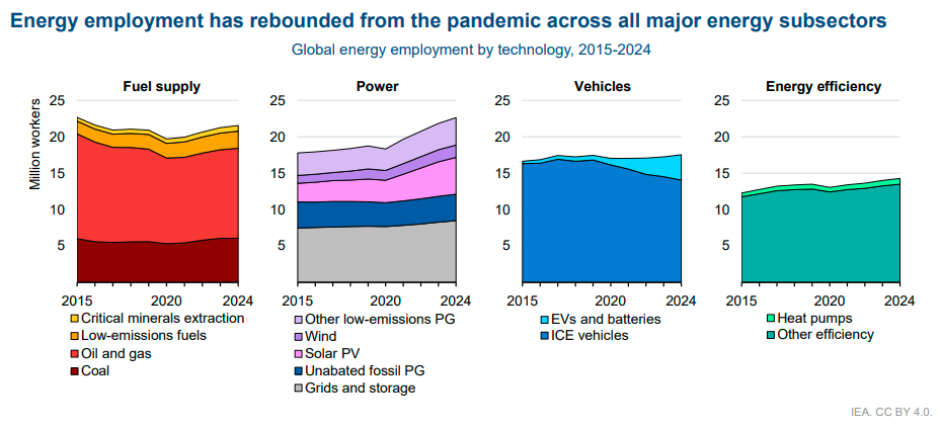
Global energy employment continued to expand rapidly in 2024, outpacing job growth in the wider economy for the third consecutive year, IEA report said.
Energy-sector employment rose 2.2 percent, nearly double the economy-wide gain of 1.3 percent, bringing total jobs in the sector to 76 million. Since 2019, the energy industry has added 5.4 million workers, accounting for 2.4 percent of all new jobs globally. In China, one in five new jobs since 2022 came from the energy sector, while in the United States it was one in ten.
Power Sector Becomes the Largest Employer
The power sector overtook fuel supply as the largest employer in global energy. It accounted for nearly three quarters of all new energy jobs added since 2019, driven by solar PV, nuclear energy, grid expansion and storage systems. Solar PV remained the single biggest source of job creation. Wind employment, however, faced headwinds due to weaker offshore activity and manufacturing layoffs, leading to a 6 percent decline in turbine manufacturing roles in 2024.
EV Growth Transforms Automotive Employment
Electrification is reshaping the automotive industry. Nearly 800000 new jobs in 2024 were linked to electric vehicles and battery manufacturing. In China, almost 40 percent of vehicle manufacturing jobs are now tied to EVs. Buildings and industrial electrification also supported employment growth, supported by workers retraining for new roles such as heat pump installation or EV assembly.
Fossil Fuel Jobs Remain Resilient
Despite rising clean energy investment, fossil fuel employment remained stable. Coal jobs increased in China, India and Indonesia, pushing global coal employment 8 percent above 2019 levels, even as advanced economies saw declines. Oil and gas employment has also mostly recovered from 2020 losses, although weaker prices and lower revenues have led to job cuts planned for 2025.
Emerging Markets Lead Job Growth
Emerging market and developing economies drove global energy job expansion in 2024. Employment rose 5.8 percent in India, 4.8 percent in Indonesia, 3.5 percent in the Middle East and 2.2 percent in China. Advanced economies recorded only 0.4 percent growth. Energy employment is especially concentrated in regions with strong industrial bases such as the Middle East, Korea and Canada, where more than 4 percent of the workforce is employed in energy compared to the global average of 2 percent.
Moderation Expected in 2025
Energy employment growth is expected to slow to 1.3 percent in 2025 due to economic uncertainty and tighter labour markets. Depending on investment trends, global energy jobs could grow by 3.4 to 4.6 million by 2035. Achieving a net-zero pathway by 2050 would require nearly 15 million additional workers by 2035, underscoring the need for long-term workforce planning.
Skills Shortages Threaten Project Timelines
More than half of 700 firms, unions and training institutions surveyed by the IEA reported severe hiring bottlenecks. Shortages are most acute in applied technical roles such as electricians, pipefitters, line workers, technicians, plant operators and nuclear engineers. These roles make up more than half of the global energy workforce and have added 2.5 million workers since 2019.
IEA Executive Director Fatih Birol warned that the global transition cannot succeed without a stronger labour pipeline. He noted that project delays, higher system costs and energy security risks will intensify if shortages persist.
Ageing Workforce Adds New Pressure
The energy sector has an older workforce compared to the broader economy. In advanced economies, 2.4 workers are nearing retirement for every new entrant under age 25. Nuclear and grid roles face the steepest demographic imbalances, with retirements outpacing new entrants by ratios of 1.7 to 1 and 1.4 to 1 respectively. By 2035, two out of every three new hires will be needed simply to replace retirees.
Training Pipelines Must Expand
The supply of newly qualified workers is not keeping up with demand. Between 2015 and 2022, demand for applied technical workers rose 16 percent, while vocational training completions grew only 9 percent. To prevent shortages from worsening, the number of graduates entering energy-relevant fields must rise by about 40 percent. This would require roughly 2.6 billion dollars per year in additional global training investment, less than 0.1 percent of worldwide education spending.
Key barriers include high training costs, lost wages during training, and limited awareness of available programmes. Recommended solutions include expanded apprenticeships, stronger industry participation in curriculum design, modern training facilities, targeted financial support and structured reskilling programs for workers transitioning from fossil fuel roles.
Reskilling Offers Partial Relief
More than 40 percent of energy firms prefer internal recruitment to retain technical expertise. Targeted retraining can allow two thirds of oil and gas supply workers and about half of fossil fuel power workers to shift into other energy segments. Coal workers, particularly in regions with informal labour markets, require more specialised support to avoid economic displacement.
AI Enhances Productivity but Cannot Fill Technical Gaps
AI adoption is rising in the energy sector, improving permitting, safety and training through tools such as virtual reality. However, AI use in energy remains far behind other industries, and current applications do little to reduce demand for hands-on technical labour. Applied technical roles are among the least exposed to automation, meaning human workers will remain essential.
Baburajan Kizhakedath