


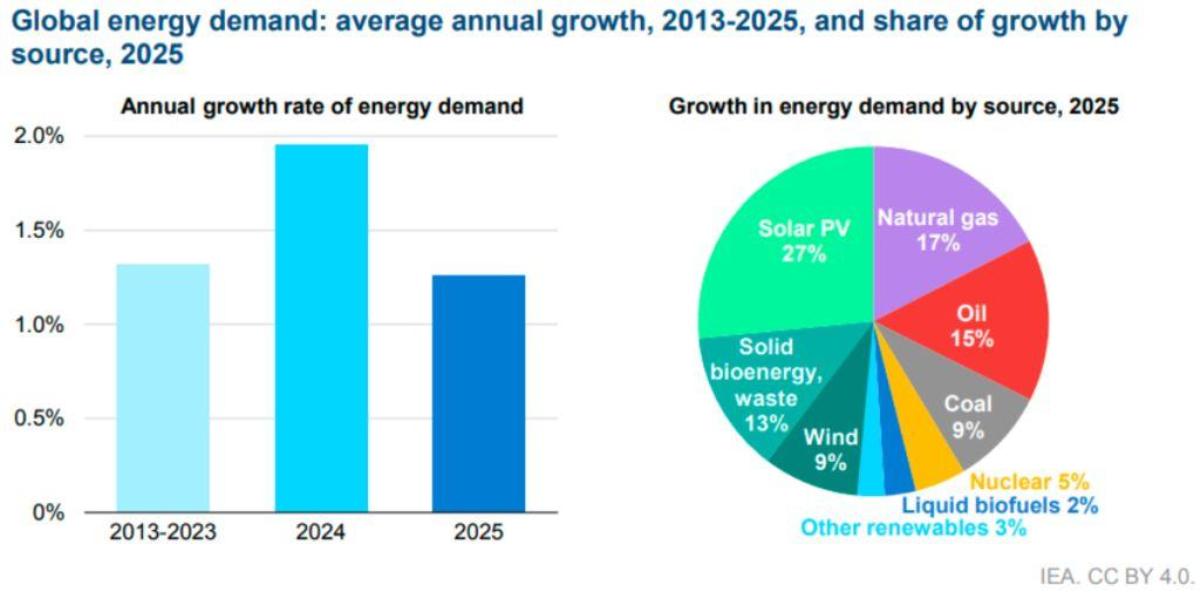
Global energy demand growth moderated in 2025, rising by 1.3 percent, below the previous decade’s average, as weaker economic expansion, milder weather conditions, and improved energy efficiency reduced overall consumption. However, electricity demand remained a standout, increasing by around 3 percent, more than twice the pace of total energy demand, driven by growth across buildings, industry, electric vehicles, and data centres.
Solar PV emerged as the single largest contributor to global energy supply growth, accounting for over 25 percent of the increase – marking the first time a modern renewable source has led global energy expansion. Renewables and nuclear together met nearly 60 percent of demand growth, highlighting accelerating clean energy adoption, IEA report said.
Oil demand grew modestly by 0.7 percent, constrained by rising electric vehicle adoption, with global EV sales surpassing 20 million units. Coal demand growth slowed overall, though regional trends varied, while natural gas contributed 17 percent of demand growth, supported by power sector needs.
Energy-related CO2 emissions rose by only 0.4 percent, reflecting the impact of renewables expansion, with China’s emissions declining and India’s remaining flat. Meanwhile, solar PV generation recorded a historic increase of 600 TWh, and battery storage additions reached about 110 GW, reinforcing the rapid shift toward electrification and low-emission energy systems.
Here are 10 key points focusing on renewable energy, solar, wind, investment, and demand based on insights from the Global Energy Review 2026:
Solar PV was the largest contributor to global energy demand growth in 2025, accounting for more than 25 percent of the increase.
Low-emissions sources including solar, wind, nuclear, and others contributed nearly 60 percent of total global energy demand growth.
Global renewable capacity additions reached a record 800 GW in 2025, with solar contributing about 75 percent of new capacity.
Solar PV generation surged by 600 TWh in 2025, marking the largest-ever annual increase by any power source.
Solar PV now accounts for over 8 percent of global electricity generation, more than doubling output since 2022.
Wind power generation grew by around 8 percent, though growth was impacted by weaker wind conditions in some regions.
Renewables and nuclear together generated more electricity growth than total demand increase, reducing reliance on fossil fuels.
The share of renewables in global electricity generation rose to 34 percent in 2025, up from 32 percent in 2024.
Investment momentum is accelerating, with battery storage capacity additions rising about 40 percent to nearly 110 GW, supporting renewable integration.
Clean energy deployment since 2019 has avoided around 7 percent of global fossil fuel demand and prevented about 3 billion tonnes of CO2 annually, highlighting strong demand for renewables.
BABURAJAN KIZHAKEDATH