


Global energy investment is shifting toward electricity, renewable power, grids and energy storage as economies prepare for substantially higher power demand. According to the International Energy Agency’s (IEA) new Special Report on Electrification, investment in electricity supply and grids is set to reach $1.6 trillion in 2026, rising to $2 trillion when investment associated with end-use electrification is included.
That means electricity and electrification will account for around 60 percent of total global energy investment in 2026, highlighting how the energy transition is increasingly becoming an investment story centred on renewable generation, power networks, batteries and electric technologies.
The investment opportunity could expand considerably over the coming decade as the world moves toward the COP31 ambition of increasing electricity’s share of final energy consumption from around 23 percent today to 35 percent by 2035.
Renewable Energy Becomes Main Engine of Electricity Growth
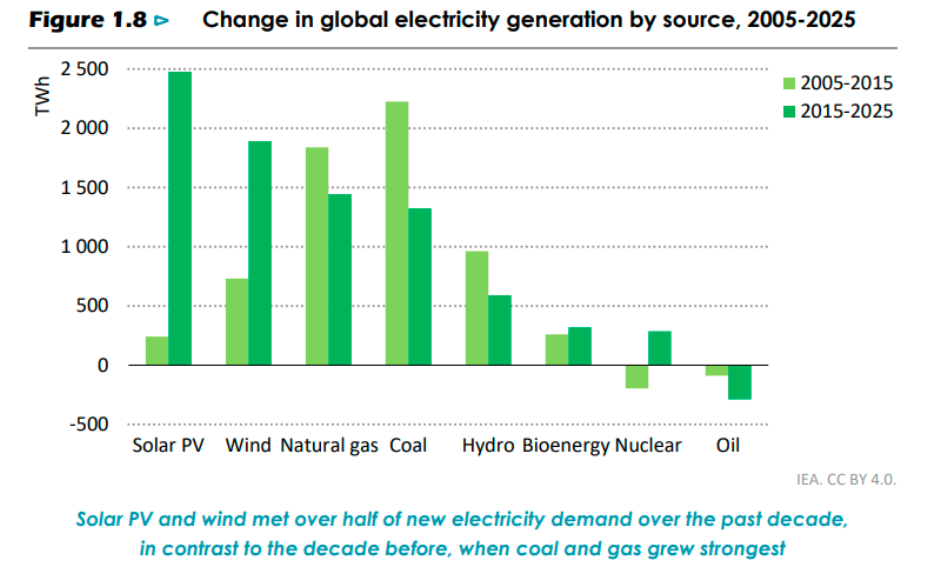
Solar and wind have already emerged as the biggest sources of incremental electricity generation.
Over the past decade, solar PV and wind together supplied more than half of new global electricity demand. Solar generation increased more than 11-fold, while wind generation more than tripled. More strikingly, renewables accounted for over 95 percent of the growth in electricity generation between 2024 and 2025.
Solar PV deployment approached 600 GW in 2025, more than ten times annual deployment a decade earlier. Annual wind additions reached nearly 140 GW, more than twice the level recorded ten years earlier.
These figures indicate that the investment requirements created by electrification will increasingly translate into opportunities for solar developers, wind companies, battery manufacturers, utilities and grid equipment suppliers.
The trend is detailed in the IEA Special Report on Electrification, which assesses how rising electricity consumption could reshape energy systems and investment requirements.
Solar Investment Could Accelerate Toward 1,200 GW Annual Additions
The next phase could be significantly larger.
In an electricity supply pathway aligned with net zero emissions by 2050, the IEA estimates that annual solar PV installations would need to double to more than 1,200 GW by 2035.
Annual wind additions would need to increase around 2.5 times to approximately 400 GW.
That implies an enormous expansion of renewable-energy investment across utility-scale solar, rooftop solar, onshore wind, offshore wind, transmission infrastructure, substations, inverters and energy storage.
Renewable developers will also need to move beyond standalone generation projects. The IEA points to hybrid portfolios combining solar, wind and batteries as an increasingly competitive solution for delivering more reliable renewable electricity.
A representative configuration capable of providing 100 MW of firm capacity, for example, could combine 400 MW of solar PV, 200 MW of onshore wind and a 300 MW/1,200 MWh battery system. The IEA estimates the levelised cost of electricity from such hybrid portfolios at around $80/MWh in China and $120/MWh in the European Union.
Grid Investment Rises to $450 Billion
Renewable generation alone will not be sufficient to support the coming electrification wave.
Investment in global power grids increased from approximately $315 billion in 2015 to $450 billion in 2025, reflecting both expansion requirements and higher prices for equipment including transformers and cables.
Battery storage is growing even faster. Almost 120 GW of stationary battery capacity was added during 2025, with annual additions nearly 100 times higher than in 2015.
The investment challenge will intensify toward 2035. Under the IEA’s High Electrification Scenario, global electricity networks would reach approximately 115 million kilometres by 2035, requiring grids to expand about 40 percent faster than during the previous decade.
Battery storage capacity could meanwhile approach 2,900 GW by 2035 in a net-zero-aligned pathway.
This creates major investment opportunities for transmission and distribution utilities as well as suppliers of transformers, switchgear, cables, power electronics, grid software and battery energy storage systems.
$1 Trillion Investment Opportunity in End-Use Electrification
Investment is also moving downstream from electricity generation into transport, buildings and industry.
Under the High Electrification Scenario, annual global investment in end-use electrification is projected to triple to around $1 trillion by 2035.
Unlike utility-scale power investments, much of this capital will need to come from households, businesses and public authorities investing in electric vehicles, charging infrastructure, heat pumps and industrial electrification.
Electric vehicles represent one of the largest opportunities because lithium-ion battery pack costs have fallen by around 90 percent since 2010. The IEA estimates that roughly half of oil-based road transport demand could already be electrified competitively, potentially increasing to more than four-fifths if battery costs continue declining.
Investors can also track the wider renewable investment outlook through the IEA World Energy Investment analysis.
Electrification Creates $2.6 Trillion Industrial Ecosystem
The investment boom is creating a much larger industrial ecosystem around electricity.
Listed companies participating in the electrification ecosystem generated approximately $2.6 trillion in revenue in 2025. The market extends well beyond renewable-energy equipment and includes EVs, batteries, grid equipment, power electronics, digital technologies, critical minerals and technologies for buildings and industrial electrification.
Global revenues of companies supporting electrification have increased at around 15 percent annually since 2020, illustrating the industrial opportunity emerging alongside renewable-energy investment.
Renewable Investment Faces Financing and Grid Bottlenecks
The biggest challenge may no longer be renewable technology availability, but financing and infrastructure.
By 2025, 124 countries had established national renewable-electricity targets, yet the IEA identifies grid infrastructure, regulation and access to finance as major barriers to faster deployment.
Financing is particularly challenging in emerging and developing economies, where the cost and availability of capital can restrict investment in renewable generation, battery storage and grids.
This creates an important agenda for governments, multilateral lenders and private investors: renewable generation investment needs to be coordinated with transmission, storage and flexible demand rather than treated as separate markets.
The COP31 electrification agenda reinforces this connection between clean electricity and broader energy investment. The Presidency’s 35-by-35 target seeks to lift electricity to 35 percent of final energy consumption by 2035, complementing existing international goals for renewables, efficiency, grids and finance. More information on the climate conference is available through the official COP31 website.
Renewable Energy Investment Enters a New Growth Cycle
The IEA numbers point toward a structural shift in global energy capital.
Electricity demand under the High Electrification Scenario could grow by around 1,400 TWh annually through 2035, nearly twice the pace recorded during the previous decade. Meeting that demand while decarbonising electricity requires annual solar additions exceeding 1,200 GW, wind additions approaching 400 GW, massive grid expansion and battery storage capacity reaching around 2,900 GW.
For the renewable-energy industry, electrification therefore represents more than higher electricity consumption. It creates a multi-decade investment cycle spanning solar, wind, battery storage, transmission and distribution grids, EV charging, heat pumps, industrial electrification and digital power infrastructure.
The $2 trillion expected to flow into electricity supply, grids and end-use electrification in 2026 may consequently be an early indication of a much larger transformation in global energy investment as electricity becomes the central platform for the renewable-energy economy.
SHAFANA FAZAL