


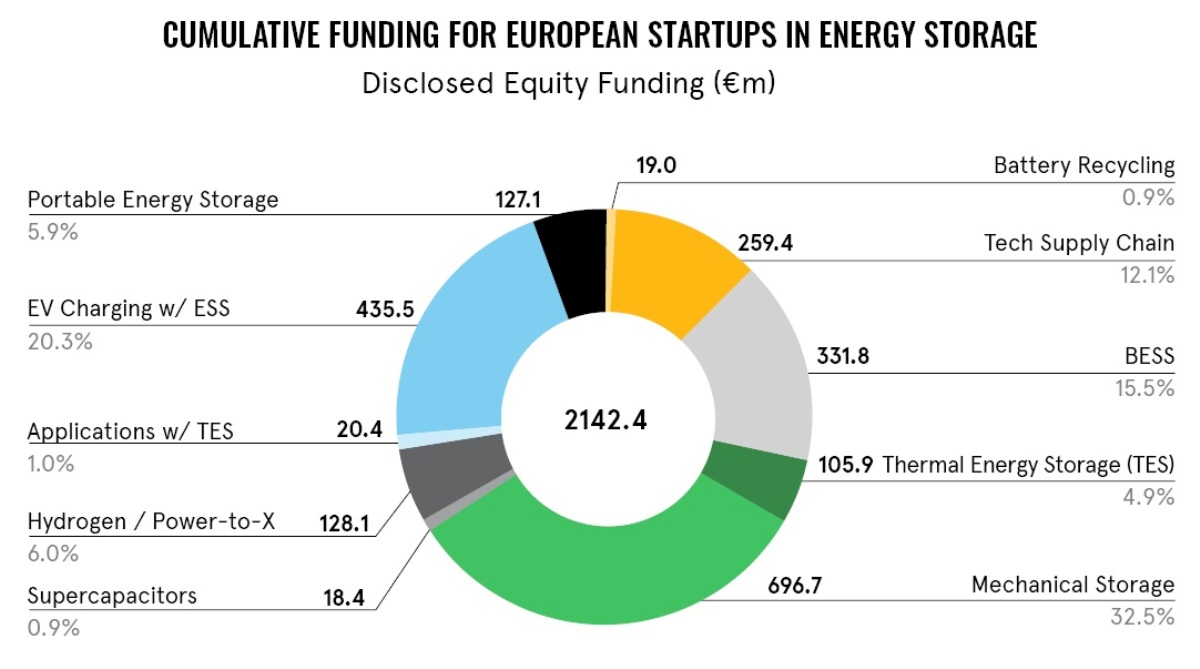
European energy storage startups have attracted total equity funding of more than €2.14 billion, underlining the sector’s growing importance for renewable energy integration, grid stability and long-term energy security. New research by Avnet Silica, based on Crunchbase data, shows that investment momentum has intensified in recent years, with 46.7 percent of the total funding raised in the last three years and 84.4 percent secured within the past five years.
As Europe accelerates the deployment of solar and wind power, energy storage has emerged as a critical enabler. Avnet Silica’s analysis highlights how funding is distributed across battery energy storage systems, mechanical storage, thermal solutions and emerging technologies, offering a detailed snapshot of where investors are placing their bets.
Battery Energy Storage Systems secure €331.8 million
European startups manufacturing Battery Energy Storage Systems have raised €331.8 million in disclosed equity funding. Lithium-based technologies dominate this segment, accounting for €236 million of the total. Of this, €221 million has gone into lithium-ion battery manufacturing, while lithium-sulfur technology has attracted €15 million.
Beyond lithium, redox flow batteries have drawn €76.1 million in equity funding. Iron-based flow batteries account for the majority, with €66.7 million invested. Germany’s VoltStorage has raised €38.75 million, while Cyprus-based Redox One has secured just under €28 million. In contrast, vanadium flow batteries have received less disclosed equity funding despite their relatively advanced commercial maturity. However, Jersey-based Invinity Energy Systems has raised €18.2 million in grants and an additional €105.1 million in post-IPO funding.
At the early-stage end of the market, Sweden’s Enerpoly has raised €1.8 million for zinc-ion battery development, while Switzerland’s Unbound Potential has secured €6.7 million for membraneless redox flow batteries. Hybrid battery technologies have also gained attention, with €17 million invested. Spain’s Hybrid Energy Storage Solutions raised €14.9 million for its lithium-ion and ultracapacitor hybrid system, while Finland’s Geyser Batteries attracted €2.1 million for its aqueous hybrid solution.
Mechanical energy storage leads with €696.7 million
Mechanical energy storage has emerged as the largest funding category, attracting €696.7 million in equity investment. This is more than double the funding directed toward BESS, despite fewer companies operating in the space and fewer reaching full commercial maturity.
The bulk of this funding has been concentrated in two companies. UK-based Highview Power has raised €339 million for its liquid air energy storage technology, while Switzerland’s Energy Vault has secured €200.5 million for its gravity-based storage solution. Both companies are now publicly traded, with Energy Vault raising a further $500 million in post-IPO equity, including $200 million in 2023 and $300 million in 2025.
Italy’s Energy Dome has also attracted significant interest, raising €90.2 million in private investments for its thermomechanical CO2 battery technology. Other mechanical storage approaches have seen comparatively modest funding. Compressed air energy storage startups have secured a combined €6.7 million, while three flywheel companies have attracted limited disclosed investment, with one raising €224,414.
Thermal energy storage gains momentum
Thermal energy storage startups have raised €105.9 million in private funding, reflecting rising interest in solutions that can decarbonize industrial heat and improve energy efficiency. Sensible heat storage accounts for €80.4 million, with companies using materials such as glass, ceramic, rock, gravel and salt. Latent heat storage technologies based on phase change materials have attracted €24.5 million.
In addition, more than €20 million has been invested in application-specific solutions that integrate thermal storage. This includes €4.9 million for industrial heat pumps with thermal storage, €1.1 million for combined solar and thermal storage systems, and €14.5 million for refrigeration technologies with built-in thermal energy storage.
Hydrogen, power-to-X and supercapacitors attract €146.5 million
A diverse group of alternative energy storage technologies has drawn €146.5 million in funding. Companies producing supercapacitors have raised €18.4 million, while hydrogen energy storage startups have attracted €73.7 million. A further €54.4 million has gone into power-to-X energy storage solutions, focusing on hydrogen and related technologies as storage mechanisms rather than solely fuel production pathways.
EV charging and portable storage see strong investor interest
Startups offering EV charging infrastructure with integrated energy storage have secured €435.5 million in funding. These solutions target off-grid and remote locations, as well as battery-buffered high-power charging applications. In parallel, three European startups developing portable energy storage systems have raised a combined €127.1 million to serve construction sites, events and other temporary power needs.
Investment strengthens the energy storage supply chain
More than €259.4 million has been invested in startups focused on the energy storage supply chain. Seventy-eight percent of this funding has been concentrated in next-generation battery chemistry, which received €113.2 million, and in the production of cells, modules and battery packs, which attracted €89.0 million. The study also includes companies developing critical manufacturing software such as battery management systems, diagnostics and testing tools.
Recycling completes the circular economy
Supporting the circular economy, battery recycling startups have raised €19 million. Luxembourg-based Circu Li-ion secured €4.5 million, while Germany’s tozero raised €14.5 million. In addition, 14 BESS startups are promoting the use of second-life batteries, either exclusively or as an option within their product portfolios.
Overall, the €2.14 billion invested in European energy storage startups highlights strong confidence in the sector’s role in supporting Europe’s clean energy transition, with mechanical storage, advanced batteries and integrated solutions emerging as key investment priorities.
BABURAJAN KIZHAKEDATH