


A fresh analysis by Ember shows that the recent Middle East conflict involving Israel, the United States, and Iran triggered a sharp surge in European energy prices, pushing gas-fired power costs up by more than 50 percent within days.
The report prepared by Dr Chris Rosslowe and Dr Beatrice Petrovich said European benchmark gas prices (Dutch TTF) climbed from €31/MWh to €45/MWh during March 2-6, reflecting how quickly geopolitical disruptions translate into higher electricity costs. The spike forced the EU to spend an additional €2.5 billion on fossil fuel imports in just ten days, highlighting the economic exposure of import-dependent regions.
According to Chris Rosslowe, the episode underscores a persistent vulnerability in Europe’s energy system, where external shocks continue to dictate domestic power prices.
Gas Dependency Continues to Shape Electricity Prices
Gas remains a key driver of electricity pricing across Europe, even as renewable energy expands. It accounts for roughly 17 percent of EU electricity generation and frequently sets the marginal price in power markets. This means fluctuations in gas prices quickly ripple through the entire electricity system.
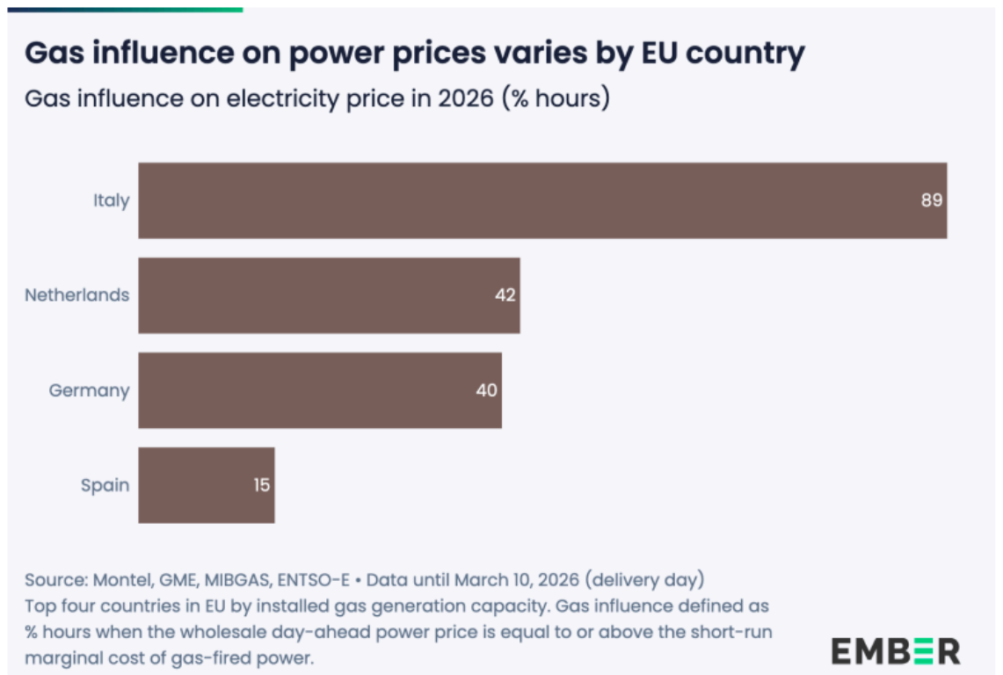
The impact is particularly severe in countries with high reliance on gas. Italy, for instance, saw gas influence electricity prices in 89 percent of hours in 2026 so far. In contrast, Spain limited this exposure to just 15 percent of hours due to rapid growth in wind and solar capacity since 2019.
This structural difference translated into real price outcomes. While electricity prices surged to yearly highs in countries such as Germany, the Netherlands, Italy, and Belgium, Spain managed to keep power prices below the cost of gas-fired generation during the same period. Other lower gas-dependent regions, including Portugal, France, and the Nordics, were also less affected.
Industrial Exposure and Market Volatility Increase Risks
The energy shock has broader implications beyond power markets. Around 39 percent of Europe’s industrial energy demand still depends on gas, leaving key sectors highly vulnerable to supply disruptions and cost spikes.
Electricity price volatility has already intensified, particularly during peak demand periods when gas-fired plants are used to balance the grid. This reinforces the role of gas not only as a fuel source but also as a stabilizing mechanism that comes with significant cost risks.
Although Europe has reduced its reliance on Russian gas since 2022, it remains exposed to global LNG markets, effectively shifting rather than eliminating dependency risks.
Carbon Costs Take a Back Seat to Gas Prices
The surge in gas prices has also reframed the debate around the EU Emissions Trading Scheme. Current data shows that rising gas costs add roughly twice as much to electricity generation costs as carbon pricing.
Carbon costs account for about 10 percent of an average EU household electricity bill, which is lower than typical VAT levels. Despite this, policy discussions on reforming the ETS continue, particularly ahead of the European Council meeting on March 19-20.
Rosslowe cautioned that reducing carbon pricing could undermine incentives for clean energy investments, including renewables, battery storage, and demand-side flexibility.
Renewables Provide Stability but Not Full Immunity
Renewable energy now generates around 71 percent of EU electricity, significantly strengthening the region’s energy mix. However, the continued role of gas in price-setting means that even high renewable penetration does not fully shield consumers from fossil fuel volatility.
Countries with stronger renewable capacity have demonstrated greater resilience during the latest shock, reinforcing the importance of accelerating clean energy deployment.
Shift to Electrification Seen as Critical
The findings highlight a clear structural challenge: Europe’s energy system remains tied to volatile fossil fuel markets. The report concludes that long-term energy security will depend on scaling up renewable power, electrification, and storage to reduce reliance on imported fuels.
As geopolitical tensions continue to influence global energy markets, the transition toward a more electrified and renewable-based system is increasingly seen as essential for stabilizing prices and strengthening economic resilience.
BABURAJAN KIZHAKEDATH