


Europe’s renewable energy transition is becoming the cornerstone of its energy security strategy, with new research showing that accelerating clean energy deployment could reduce European Union gas demand by 25 percent by 2030 — saving twice the amount of liquefied natural gas (LNG) Europe could potentially import from Qatar.
The IEEFA report said renewable energy has evolved from a climate policy tool into a strategic asset that strengthens Europe’s energy independence, economic competitiveness and geopolitical resilience.
REPowerEU Accelerates Europe’s Energy Transformation
Europe’s energy strategy shifted dramatically following Russia’s full-scale invasion of Ukraine in February 2022, exposing the risks of heavy dependence on imported natural gas. In response, the European Commission launched the REPowerEU Plan in May 2022, setting ambitious targets to reduce fossil fuel imports, expand renewable electricity, improve energy efficiency and accelerate electrification, Ana Maria Jaller-Makarewicz, Lead Energy Analyst at IEEFA, said.
Though the European Union increased LNG imports by 84 percent between 2021 and 2025 to maintain energy security, replacing one imported supplier with another cannot provide lasting energy independence. Geopolitical tensions in the Middle East, security concerns surrounding the Strait of Hormuz and disruptions affecting LNG exports from Qatar reinforce the need to expand domestic renewable energy generation.
EU Gas Demand Falls 20 Percent Since 2021
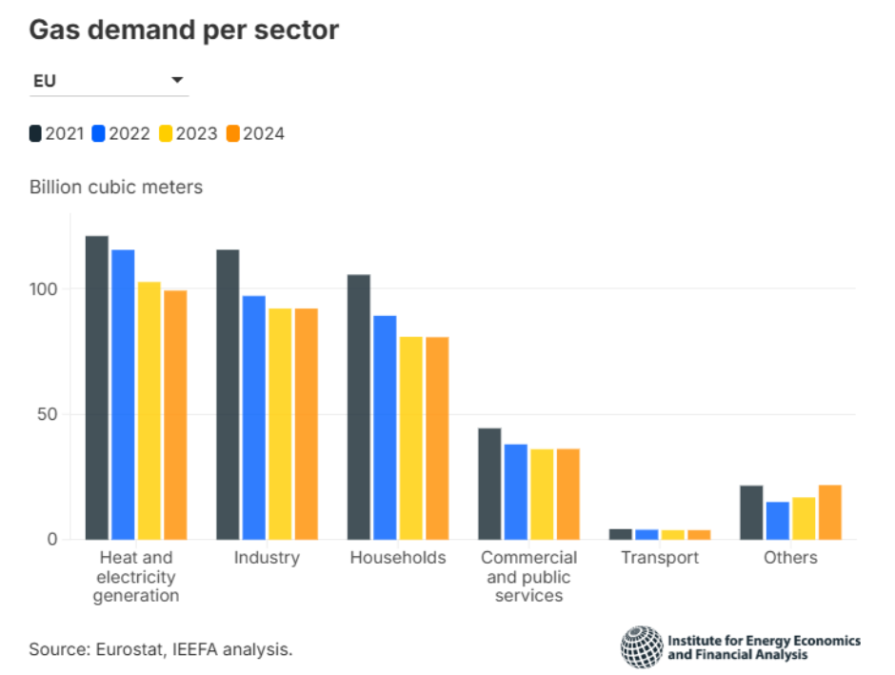
Significant progress already achieved across Europe. Between 2021 and 2024, total EU gas demand declined by 20 percent, reducing consumption by approximately 78.5 billion cubic meters (bcm). According to IEEFA, these savings increasingly reflect structural changes rather than temporary factors such as mild weather or high gas prices.
Gas demand declined across every major sector:
Households: 24 percent reduction.
Industry: 20 percent reduction.
Commercial and public services: 19 percent reduction.
Electricity and heat generation: 18 percent reduction.
These reductions were driven by wider adoption of renewable energy, electrification, improved energy efficiency and changing consumption patterns.
Heat Pumps, Solar and Wind Already Deliver Major Gas Savings
Renewable technologies are already reducing Europe’s dependence on imported natural gas.
During 2024, heat pumps, solar photovoltaic (PV) systems and wind power together reduced EU gas demand by approximately 8.8 bcm, equivalent to nearly two-thirds of all LNG imported from Qatar during the year.
Heat pumps have become one of the fastest-growing electrification technologies. Between 2022 and 2024, approximately 7.6 million heat pumps were installed across the European Union.
Leading markets included:
France: approximately 2 million installations.
Italy: 1.5 million installations.
Germany: nearly 1 million installations.
These systems have significantly reduced natural gas demand for heating while improving energy efficiency.
Solar deployment has expanded rapidly. Between 2022 and 2024, EU member states installed 146 gigawatts (GW) of new solar PV capacity. Approximately 39 percent of the new capacity came from utility-scale projects, while rooftop installations accounted for the remaining share. Germany, Spain, Poland, Italy, France and the Netherlands led solar deployment across Europe.
Wind energy also continued to expand. More than 43 GW of new wind capacity was installed between 2022 and 2024, with Germany, Finland, Sweden, France, Spain, the Netherlands and Poland leading new projects.
Meeting 2030 Targets Could Double Qatar LNG Savings
According to IEEFA, maintaining the current pace of renewable deployment will be critical to achieving Europe’s long-term energy security objectives.
The report estimates that the European Union must install:
At least 4 million heat pumps every year.
75 GW of new solar PV capacity annually.
22 GW of new wind capacity each year.
If these annual deployment targets are achieved over the next five years, EU gas demand could decline by approximately 25 percent by 2030.
The resulting gas savings would equal twice the volume of LNG Europe could potentially import from Qatar by 2030, highlighting how domestic renewable energy can provide greater long-term energy security than additional fossil fuel imports.
Energy Independence Becomes a Strategic Priority
The report notes that renewable energy expansion is being supported by an increasingly ambitious European policy framework.
Alongside the REPowerEU strategy, the European Union plans to implement a complete ban on Russian gas imports by 2027, while also pursuing a 2040 electrification target to reduce dependence on imported oil and natural gas across transport, buildings, industry and heating.
According to IEEFA, renewable energy is now central not only to climate policy but also to industrial competitiveness, economic resilience and strategic autonomy.
Renewable Energy Strengthens Europe’s Long-Term Competitiveness
Ana Maria Jaller-Makarewicz’s analysis shows Europe has already reduced gas demand by 20 percent, saving 78.5 bcm between 2021 and 2024, while installing 7.6 million heat pumps, 146 GW of solar PV and more than 43 GW of wind capacity. Renewable technologies alone saved 8.8 bcm of gas during 2024.
Looking ahead, annual deployment of 4 million heat pumps, 75 GW of solar PV and 22 GW of wind power could reduce EU gas demand by another 25 percent by 2030, generating gas savings equivalent to twice Qatar’s potential LNG supply to Europe. Combined with the REPowerEU Plan, the 2027 Russian gas import ban and the 2040 electrification strategy, the findings reinforce that renewable energy is becoming the foundation of Europe’s energy security, economic resilience and long-term competitiveness.
SHAFANA FAZAL