


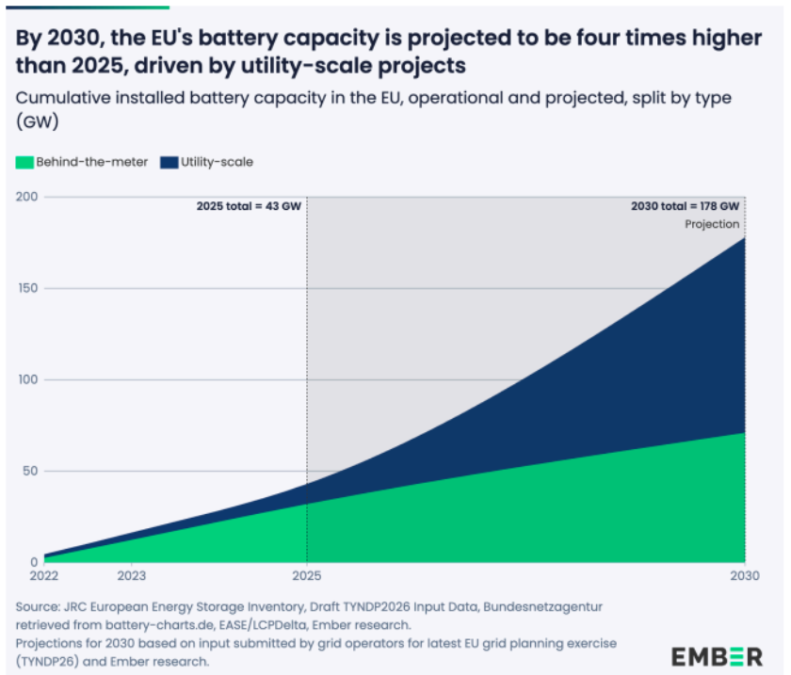
Battery energy storage capacity in the European Union is projected to rise from 43 GW in 2025 to 178 GW by 2030, according to a new report from Ember. The four-fold increase in battery deployment, combined with smarter electric vehicle (EV) charging and heat pump management, is expected to significantly reduce the bloc’s reliance on gas-fired power plants while accelerating renewable energy integration.
The report – prepared by Beatrice Petrovich and Gianluca Geneletti — highlights a major shift in the EU’s power system, where batteries, EVs, and heat pumps are emerging as critical sources of flexibility. By 2030, batteries could provide more than 80 percent of the hourly power output of all EU gas-fired power plants, compared with just 25 percent in 2025, reducing the need for fossil-fuel backup generation.
Utility-Scale Batteries Drive Growth
Utility-scale battery storage is expected to be the primary driver of expansion. The ratio of installed utility-scale battery capacity to wind and solar capacity is forecast to increase from 3 percent in 2025 to 12 percent by 2030, indicating that storage infrastructure is rapidly catching up with renewable energy deployment.
Battery projects are becoming increasingly competitive with gas power plants for short-term grid balancing. By 2030, utility-scale batteries could provide flexibility at around 20 percent lower cost than new gas peaker plants. According to ACER, projected capital costs for a 4-hour utility-scale battery system in 2030 are about €560 per kW, compared with at least €650 per kW for a new open-cycle gas turbine (OCGT) peaker plant.
Battery economics continue to improve rapidly. Estimates from Ember and IRENA indicate that utility-scale 4-hour battery projects already cost approximately €412 per kW in 2025, including equipment, installation, and grid connection costs, with further declines expected over the remainder of the decade.
Battery Deployment Accelerates Across Europe
Falling battery prices are fueling record deployment. Grid-scale battery costs reached an all-time low in 2025, extending a decade-long decline, while installed capacity more than doubled over the previous two years to exceed 10 GW.
If only projects already under construction at the end of 2025 become operational by 2030, EU battery capacity would increase by just 30 percent, reaching 54 GW. However, EU grid operators expect a much more ambitious outcome, with total battery capacity reaching 178 GW by 2030 across all member states.
This level of deployment would bring Europe close to the AccelerateEU storage target of 200 GW, which includes battery storage and other technologies such as pumped hydro. Pumped hydro storage alone is expected to account for around 40 GW of installed capacity by the end of 2025.
Batteries Boost Solar and Wind Utilization
As storage capacity expands, batteries will play a larger role in shifting renewable electricity generation to periods of higher demand. By 2030, all EU batteries combined could shift 10 percent of daily wind and solar generation from peak production periods to evening demand peaks, up from 5 percent in 2025.
Behind-the-meter batteries installed in homes and commercial buildings are also expected to grow strongly, doubling by 2030. These systems are projected to increase the share of rooftop solar generation shifted to evening hours from 12 percent in 2025 to 17 percent by 2030, improving solar self-consumption and reducing strain on distribution networks.
Smart EV Charging and Heat Pumps Add Flexibility
Consumer technologies are expected to become an increasingly important source of grid flexibility. By 2030, one in six vehicles in the EU could be electric, and half of those EVs could automatically shift charging to periods of high renewable generation and lower electricity prices.
Smart EV charging alone could absorb approximately 7 percent of peak wind and utility-scale solar generation, helping reduce curtailment and improve renewable energy utilization.
The report also projects that one in five EU households could have a heat pump by 2030. Around 15 percent of heat pump electricity demand could be shifted to periods of high wind and solar output without affecting consumer comfort. This flexibility could reduce peak electricity demand by roughly 3 percent, easing grid bottlenecks and lowering the need for fossil-fuel backup capacity.
Policy Support Crucial for Growth
Ember notes that technology costs and market readiness are no longer the main barriers to deployment. Instead, policy decisions will determine how quickly batteries and demand-side flexibility scale across Europe.
A significant milestone is expected in January 2027, when all EU member states are due to publish national objectives for energy storage and demand-side flexibility for the first time. The report argues that ambitious targets, combined with streamlined permitting, support for smart meters, and incentives for consumer participation, could accelerate the adoption of clean flexibility solutions and prevent costly overinvestment in fossil-fuel infrastructure.
With battery capacity expected to increase from 43 GW to 178 GW within five years, Europe is rapidly building the storage infrastructure needed to support a renewable-powered electricity system, reduce gas dependence, and strengthen energy security across the continent.
BABURAJAN KIZHAKEDATH