


The U.S. Energy Information Administration (EIA) has projected the strongest four-year growth in U.S. electricity demand since 2000, largely fueled by the rapid expansion of data centers and other large computing facilities. The outlook is detailed in the agency’s January Short-Term Energy Outlook (STEO), which, for the first time, includes forecasts extending through 2027.
According to the EIA, U.S. electricity consumption is expected to grow by 1 percent in 2026 and accelerate to 3 percent in 2027. If realized, this would mark the first time since 2007 that electricity demand has increased for four consecutive years and would represent the most robust four-year growth period since the turn of the century.
Data centers emerge as a key demand driver
Rising power consumption from data centers, cloud infrastructure and advanced computing facilities is the primary factor behind the projected surge in electricity demand. Growth in the commercial and industrial sectors is expected to outpace residential demand, reflecting the increasing energy intensity of the digital economy.
“U.S. energy production remains strong, and natural gas output is expected to grow to nearly 109 billion cubic feet per day this year,” said Tristan Abbey, Administrator of the U.S. Energy Information Administration. “Natural gas supply is critical as we forecast that U.S. liquefied natural gas exports expand and electricity demand rises through 2027, driven largely by increasing demand from large computing facilities, including data centers.”
Natural gas to play a critical balancing role
Natural gas remains central to the U.S. power and energy outlook. While production growth is expected to continue in the near term, the EIA forecasts that rising demand from liquefied natural gas exports and the electric power sector will eventually outpace supply growth.
The benchmark Henry Hub natural gas price is expected to average just under $3.50 per million British thermal units in 2026, slightly lower than in 2025, before climbing to about $4.60 per million British thermal units in 2027. The increase reflects stronger export demand and higher gas-fired power generation as electricity consumption rises.
Solar leads power generation growth
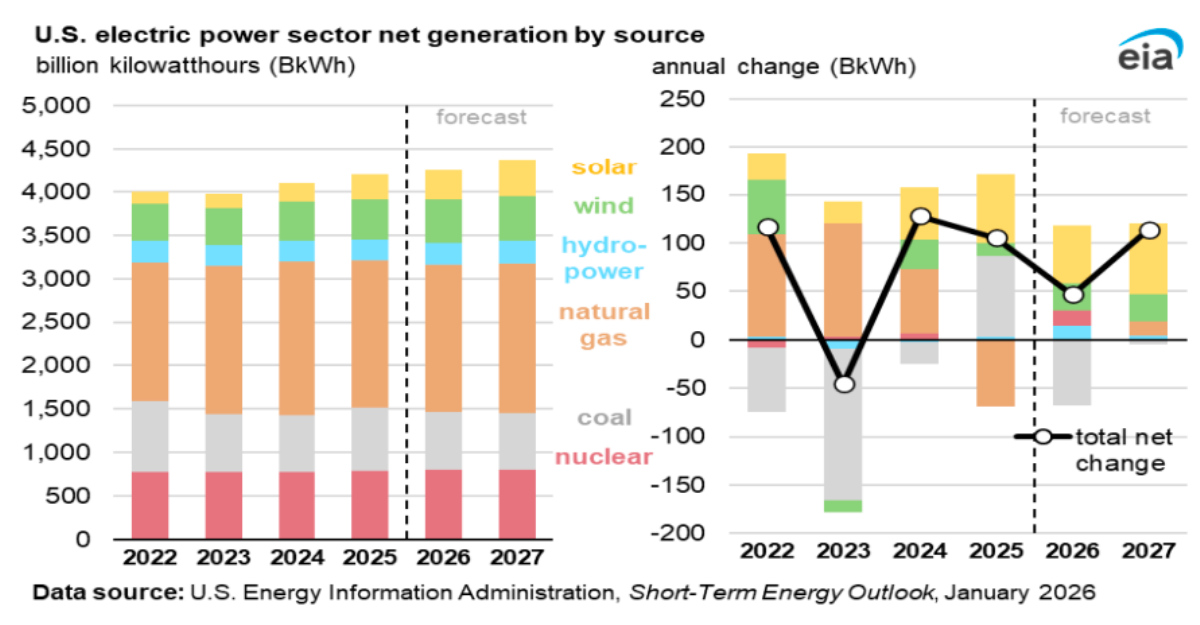
On the generation side, solar energy is forecast to deliver the largest increase in U.S. power output over the next two years. The EIA expects nearly 69 gigawatts of new solar capacity additions during the forecast period, resulting in a 21 percent increase in solar generation in both 2026 and 2027.
Natural gas-fired power generation is projected to remain flat in 2026 before increasing by about 1 percent in 2027. In contrast, coal-fired power generation is expected to decline sharply, falling by 9 percent in 2026 and remaining nearly flat in 2027, underscoring the ongoing structural shift in the U.S. power mix.
Oil prices seen under pressure as supply outpaces demand
Beyond electricity markets, the January STEO points to a softer outlook for global oil prices. The EIA expects global production of liquid fuels to exceed demand in 2026 and 2027, leading to rising inventories and downward pressure on prices.
Brent crude oil prices are forecast to average $56 per barrel in 2026, about 19 percent lower than in 2025, before easing further to $54 per barrel in 2027. West Texas Intermediate prices are projected at $52 per barrel in 2026 and $50 per barrel in 2027.
Lower prices are expected to reduce drilling activity in the United States. After reaching a record 13.6 million barrels per day in 2025, U.S. crude oil production is forecast to decline by less than 1 percent in 2026 and by about 2 percent in 2027.
Gasoline prices expected to ease
The EIA also forecasts relief for consumers at the pump. U.S. retail gasoline prices are expected to decline in 2026, largely due to lower crude oil costs, and remain relatively flat in 2027. Average gasoline prices are projected at just over $2.90 per gallon in both years, nearly 20 cents per gallon lower than in 2025.
Venezuela sanctions remain a key uncertainty
The outlook assumes that existing U.S. sanctions on Venezuela remain in place through 2027. The EIA noted that any policy changes allowing higher Venezuelan oil production could add further downward pressure on global oil prices.
Overall, the January STEO highlights a U.S. energy landscape shaped by rising electricity demand from data centers, accelerating solar deployment and shifting fuel dynamics, even as oil markets face oversupply and price weakness.
BABURAJAN KIZHAKEDATH