


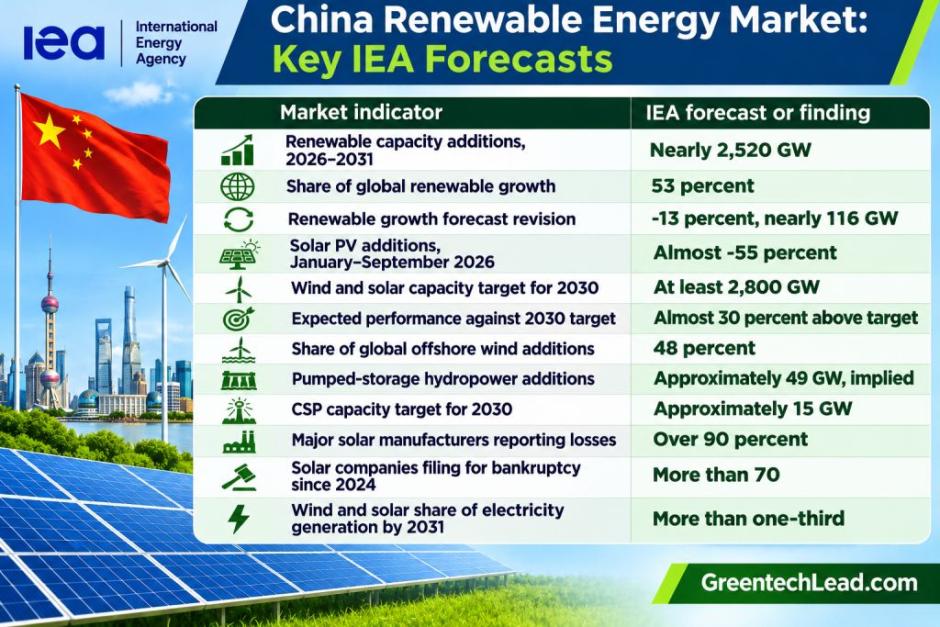
China will remain the world’s largest renewable energy market through 2031, accounting for 53 percent of global renewable capacity expansion, despite a sharp slowdown in solar installations, declining project profitability and mounting financial pressure on equipment manufacturers, according to the International Energy Agency’s (IEA) Renewables 2026 report.
IEA’s Renewables 2026 report indicated there will be reduction in its forecast for China’s renewable energy capacity growth by 13 percent, or nearly 116 gigawatts (GW), compared with its previous outlook, largely reflecting the country’s transition from fixed electricity tariffs to competitive auctions.
China’s solar photovoltaic (PV) capacity additions declined almost 55 percent year on year during the first nine months of 2026, reflecting weaker project economics following electricity market reforms introduced in June 2025.
Despite the slowdown, China’s renewable energy market is expected to exceed the wind and solar capacity targets announced under its 15th Five-Year Plan for Renewable Energy Development.
The country’s renewable energy industry is undergoing a significant transition, with stronger competition, expanding wind and energy storage investments, and financial challenges across the solar manufacturing supply chain.
1. China to Account for 53 Percent of Global Renewable Capacity Growth
China will contribute approximately 53 percent of global renewable capacity additions during 2026–2031, compared with more than 60 percent in 2025.
The IEA expects global renewable capacity additions to exceed 4,770 GW during the six-year forecast period, with China remaining the largest contributor.
China’s annual renewable capacity additions are projected to recover gradually following the slowdown in 2026, although installations in 2031 are expected to remain 13 percent below the 2025 level.
The slowdown in China will be partly offset by stronger renewable energy expansion in India, Southeast Asia, the United States, Africa and Latin America.
2. China’s Solar Power Installations Decline 55 Percent in 2026
China’s solar PV capacity additions fell almost 55 percent during January–September 2026 compared with the corresponding period in 2025.
The decline followed the government’s transition from fixed remuneration arrangements to competitive electricity auctions in June 2025.
The reforms have reduced project profitability for both utility-scale and distributed solar PV developers.
China’s slowdown is a major factor behind the IEA’s forecast that global renewable capacity additions will decline 11 percent to 733 GW in 2026, ending 21 consecutive years of record annual expansion.
Despite the decline, 2026 is expected to remain the second-highest year on record for global renewable installations.
3. China’s Renewable Energy Forecast Reduced by 116 GW
The IEA has lowered China’s renewable capacity expansion forecast by nearly 116 GW, equivalent to a 13 percent reduction from its previous assessment.
The downward revision primarily reflects weaker solar PV installations and lower project returns under competitive market arrangements.
However, the IEA has raised its outlook for China’s onshore wind, hydropower and concentrated solar power sectors.
Onshore wind benefits from policies supporting large renewable energy megabase projects, while hydropower and concentrated solar power benefit from stronger investment in electricity system flexibility.
The downward revision for China is the largest among the major renewable energy markets covered in the report.
4. China Targets 2,800 GW of Wind and Solar Capacity by 2030
China’s 15th Five-Year Plan for Renewable Energy Development, released in July 2026, establishes an indicative target of at least 2,800 GW of combined wind and solar PV capacity by 2030, measured in alternating current (AC).
Achieving this target implies average combined wind and solar installations of approximately 190 GW annually through 2030.
However, the IEA expects China’s installed capacity to exceed the government’s target by almost 30 percent under its main forecast scenario.
This indicates that China is expected to continue expanding renewable capacity significantly despite the near-term slowdown in solar project development.
The government’s renewable energy strategy includes large-scale solar and wind bases, transmission investments, competitive electricity procurement and storage technologies.
5. China to Add Nearly 2,520 GW of Renewable Capacity by 2031
The IEA projects that China will install nearly 2,520 GW of additional renewable power capacity during 2026–2031, maintaining its position as the world’s largest renewable energy growth market.
Solar PV will remain the principal contributor to China’s renewable expansion, supported by large-scale renewable energy bases and transmission infrastructure.
However, the country’s share of global renewable capacity additions will decline from approximately 61 percent in 2025 to 53 percent during the forecast period.
China’s renewable energy expansion will increasingly depend on competitive auctions, project profitability and investments in electricity storage.
6. China’s Wind Power Market Benefits From Stronger Project Economics
China’s onshore wind energy market has demonstrated greater resilience than solar PV following electricity market reforms.
The IEA reports that onshore wind capacity additions remained broadly at the record level achieved in 2025, leading to an upward revision in its forecast.
Wind power projects benefit from electricity capture prices almost 40 percent higher than those achieved by solar PV.
China is also expected to account for approximately 48 percent of global offshore wind capacity additions during 2026–2031.
However, the IEA has reduced its offshore wind forecast because of higher project costs, weaker investment returns and limited provincial government support following the transition to competitive auctions.
7. Over 90 Percent of China’s Major Solar Manufacturers Report Losses
China’s solar manufacturing industry faces significant financial pressure despite its dominance of global supply chains.
According to the IEA, more than 90 percent of major Chinese solar PV manufacturers reported losses in 2026.
More than 70 solar companies have filed for bankruptcy since 2024 as manufacturing overcapacity and declining equipment prices weakened profitability.
China continues to dominate the production of polysilicon, wafers, solar cells and modules.
However, India is expected to emerge as the only other country capable of manufacturing every major solar PV supply chain component at scale by 2031.
The financial challenges facing Chinese manufacturers highlight the gap between expanding solar equipment production and achieving sustainable industry profitability.
8. China to Lead Global Pumped-Storage Hydropower Expansion
China is expected to account for approximately two-thirds of the 74 GW of global pumped-storage hydropower capacity additions forecast during 2026–2031.
This implies approximately 49 GW of additional pumped-storage capacity in China during the period.
The expansion is driven by the need to integrate growing solar and wind generation into the electricity network.
China’s policies supporting long-duration electricity storage are also accelerating investment in pumped-storage hydropower projects.
The IEA has raised its forecast for China’s hydropower sector, reflecting faster pumped-storage approvals and stronger government support.
9. China Targets 15 GW of Concentrated Solar Power by 2030
China is expected to account for all global concentrated solar power (CSP) capacity growth during 2026–2031.
The country’s 15th Five-Year Plan includes a target of approximately 15 GW of CSP capacity by 2030.
Concentrated solar power projects equipped with thermal storage can provide electricity beyond daylight hours, supporting greater flexibility in renewable electricity generation.
The IEA has raised its CSP outlook for China following more ambitious targets announced in December 2025.
China’s investment in CSP complements its expansion of conventional solar PV, wind power and pumped-storage hydropower.
10. China’s Renewable Electricity Share to Rise as Grid Challenges Increase
China’s wind and solar PV generation is expected to account for more than one-third of national electricity generation by 2031, compared with approximately 20 percent in 2025.
The increasing contribution of variable renewable energy will require additional transmission capacity, storage investment and electricity market flexibility.
China’s renewable energy strategy includes large-scale wind and solar developments in inland regions, supported by grid expansion and energy storage.
However, rising renewable electricity curtailment, weaker project revenues and the transition to competitive electricity pricing remain challenges for developers.
The IEA expects China’s renewable energy market to continue expanding through 2031, although financial sustainability and electricity system integration will become increasingly important.
Outlook for China’s Renewable Energy Industry
China’s renewable energy market is moving from rapid capacity expansion supported by fixed tariffs toward a more competitive model that places greater emphasis on electricity prices, project returns and grid integration.
The IEA’s Renewables 2026 outlook indicates that China will retain its global leadership in renewable installations and solar manufacturing despite a significant slowdown in 2026.
The country’s projected 2,520 GW of renewable capacity additions through 2031 will create continued demand for solar equipment, wind turbines, transmission infrastructure, pumped-storage hydropower and electricity storage technologies.
However, falling solar project profitability, manufacturing overcapacity, offshore wind costs and renewable electricity curtailment could affect investment decisions and industry consolidation.
BABURAJAN KIZHAKEDATH