


The global battery storage industry is entering a new phase of rapid growth, with short-duration energy storage systems becoming critical infrastructure for modern electricity grids and paving the way for long-duration energy storage technologies, according to new analysis from the Institute for Energy Economics and Financial Analysis and projections from the U.S. Energy Information Administration.
The findings indicate that battery storage has moved beyond its status as an emerging technology and is now becoming a core component of renewable energy systems worldwide. The sector is attracting substantial investments from major industry players including Tesla, BYD, CATL, Fluence Energy, Sungrow, and Wärtsilä, which are expanding manufacturing capacity, securing large-scale supply agreements, and deploying utility-scale storage projects globally.
Battery energy storage capacity in the United States has expanded dramatically over the past five years, driven by rising renewable energy penetration, increasing peak electricity demand, and declining lithium-ion battery costs. Installed battery storage capacity has already surpassed 43 GW in 2026, according to IEEFA estimates.
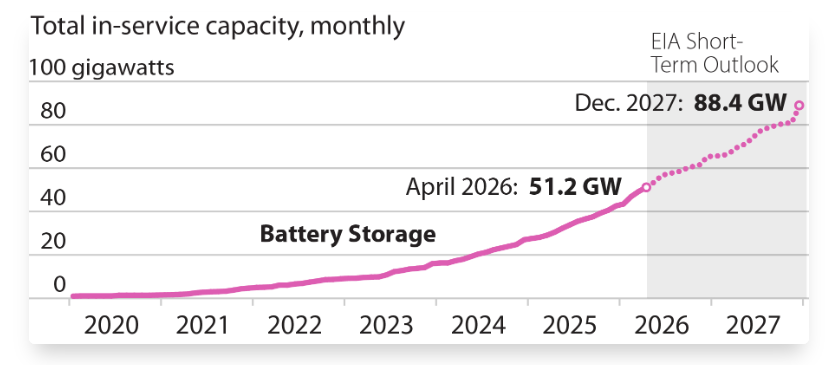
The EIA’s Short-Term Energy Outlook projects that total in-service battery storage capacity will increase to 51.2 GW by April 2026 before surging to approximately 88.4 GW by December 2027, representing nearly a doubling of capacity within two years. The rapid expansion highlights the growing role of battery storage in supporting grid reliability and renewable energy integration.
Short-duration lithium-ion battery systems, typically capable of providing two to four hours of electricity discharge, have become mainstream assets in major electricity markets such as Texas and California. Utilities increasingly rely on these systems for peak demand management, frequency regulation, and balancing intermittent solar and wind generation.
Tesla continues to strengthen its position through its Megapack platform, expanding manufacturing operations in California, Texas, and Shanghai. The company recently secured a major battery procurement agreement from Clearway Energy covering projects in California and Colorado, while also signing a multi-billion-dollar battery supply deal with LG Energy Solution to support future Megapack production.
BYD has emerged as one of the world’s largest battery storage system integrators, expanding deployments across China, Europe, the Middle East, and Latin America. Meanwhile, CATL continues investing heavily in advanced battery technologies designed to improve energy density, battery lifespan, and storage duration.
According to IEEFA, the commercial success of short-duration battery systems is accelerating investment in long-duration energy storage technologies. These include flow batteries, iron-air batteries, and thermal energy storage solutions capable of delivering electricity for eight hours or more, and potentially over multiple days.
Three major factors are driving interest in long-duration storage. Increasing renewable energy penetration is creating longer periods of low solar and wind generation, requiring deeper storage capabilities. Rising electricity demand from artificial intelligence infrastructure and hyperscale data centers is increasing the need for highly reliable power supplies. In addition, governments are introducing procurement mandates and policy incentives to support long-duration storage deployment.
Fluence Energy has secured several of the world’s largest battery storage projects, including a 500 MW / 2,000 MWh installation for AGL Energy in Australia. The company is also expanding across Europe and has partnered with Nvidia and Siemens to develop energy solutions for next-generation AI data centers.
Sungrow continues expanding battery storage deployments across Asia-Pacific, Europe, and the Middle East by integrating battery systems with its solar inverter and power electronics technologies. Wärtsilä Energy is also growing its utility-scale storage portfolio through projects that combine battery systems with advanced software platforms to optimize renewable energy integration and grid performance.
The rise of AI computing infrastructure is creating a new growth market for battery storage providers. Hyperscale data centers increasingly require uninterrupted power supplies and resilient energy infrastructure, making them important customers for both short-duration and long-duration storage systems.
IEEFA believes the projected increase to 88.4 GW of battery storage capacity by 2027 represents a major structural shift in electricity markets. As renewable energy adoption accelerates, battery storage is becoming a critical bridge between intermittent generation and real-time power demand, reducing dependence on fossil-fuel peaker plants and improving grid flexibility.
The next stage of competition is expected to focus on long-duration storage technologies, which will play a crucial role in managing multi-day fluctuations in renewable energy output. With growing investments from battery manufacturers, utilities, renewable energy developers, and data center operators, battery storage is expected to remain one of the fastest-growing segments of the global energy industry through the remainder of the decade.
FASNA SHABEER