


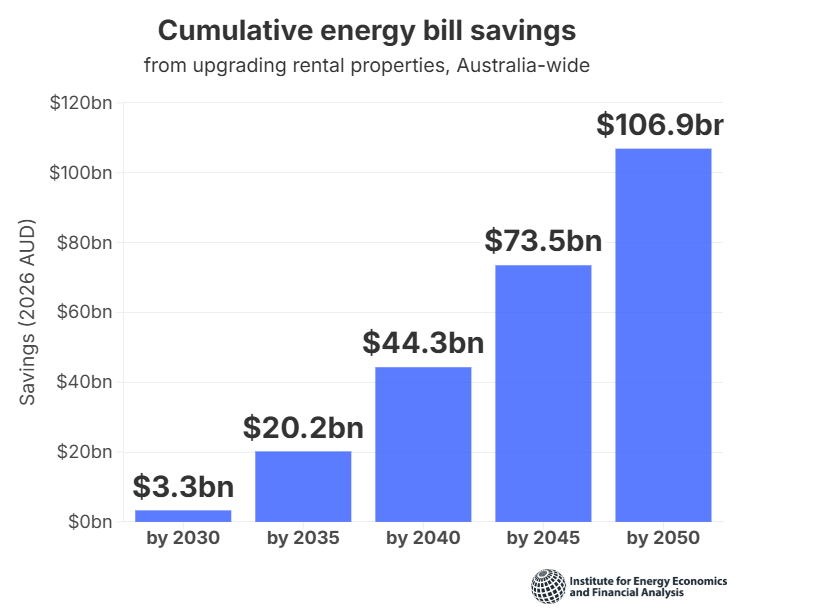
Australia could unlock nearly AU$107 billion in cumulative energy bill savings for renters by 2050 if governments introduce stronger minimum energy efficiency standards for rental properties, according to a new report from the Institute for Energy Economics and Financial Analysis (IEEFA).
The report highlights a growing divide between renters and homeowners as rooftop solar, battery storage, electrification, and energy-efficient technologies reshape Australia’s residential energy market. While many homeowners are benefiting from lower energy bills through solar panels, batteries, insulation, and efficient appliances, renters often lack access to these upgrades because landlords typically control investment decisions.
IEEFA estimates cumulative energy bill savings from rental property upgrades could reach AU$3.3 billion by 2030, AU$20.2 billion by 2035, AU$44.3 billion by 2040, AU$73.5 billion by 2045, and approximately AU$106.9 billion by 2050. The analysis, based on more than 100,000 household and climate-zone scenarios, found that combining rooftop solar, insulation, draught-proofing, efficient electric appliances, improved heating and cooling systems, battery storage, and electrification could cut renters’ energy bills by around 50 percent.
More than 30 percent of Australians live in rental accommodation, yet only 11 percent of renters have access to rooftop solar compared with about 44 percent of owner-occupiers. Renters are also nearly twice as likely to live in homes without adequate insulation, leaving many exposed to higher energy costs and reduced comfort, Jay Gordon, an Energy Finance Analyst at IEEFA, said.
IEEFA argues that mandatory minimum energy efficiency standards are the most effective way to overcome the long-standing “split incentive” problem, where landlords pay for upgrades while tenants receive most of the savings. Similar regulations have already been implemented in the United Kingdom, New Zealand, France, Germany, Belgium, and the Netherlands. Within Australia, the Australian Capital Territory and Victoria have introduced or are implementing rental energy efficiency requirements, while New South Wales and Tasmania are considering reforms.
Beyond lowering household bills, widespread adoption of insulation, efficient appliances, rooftop solar, and battery storage could reduce peak electricity demand, improve grid reliability, strengthen energy security, and support Australia’s decarbonization goals. The report estimates a positive net present value of AU$24.8 billion through 2050, indicating that long-term economic benefits significantly outweigh upgrade costs.
The findings come as investment in clean energy technologies accelerates globally. Companies such as Tesla, BYD, CATL, and Fluence continue expanding battery storage deployments, while solar developers including Enel Green Power, Waaree Energies, and First Solar are increasing renewable energy investments worldwide.
IEEFA says Australia’s clean energy transition will be incomplete unless renters can access the benefits of rooftop solar, batteries, electrification, and energy-efficient housing. The organization argues that stronger minimum energy efficiency standards, combined with affordable financing and targeted support programs, could help close the energy affordability gap between renters and homeowners while accelerating Australia’s transition to a cleaner and more resilient energy system.
FASNA SHABEER