


The U.S. power market is entering a major investment cycle as renewable generation, battery storage, electricity networks and rapidly rising power demand become increasingly interconnected.
The latest IEEFA analysis of renewable energy and battery storage in U.S. power markets shows a widening gap between regions rapidly deploying solar, wind and batteries and markets constrained by slow interconnections, limited storage and dependence on aging conventional generation.
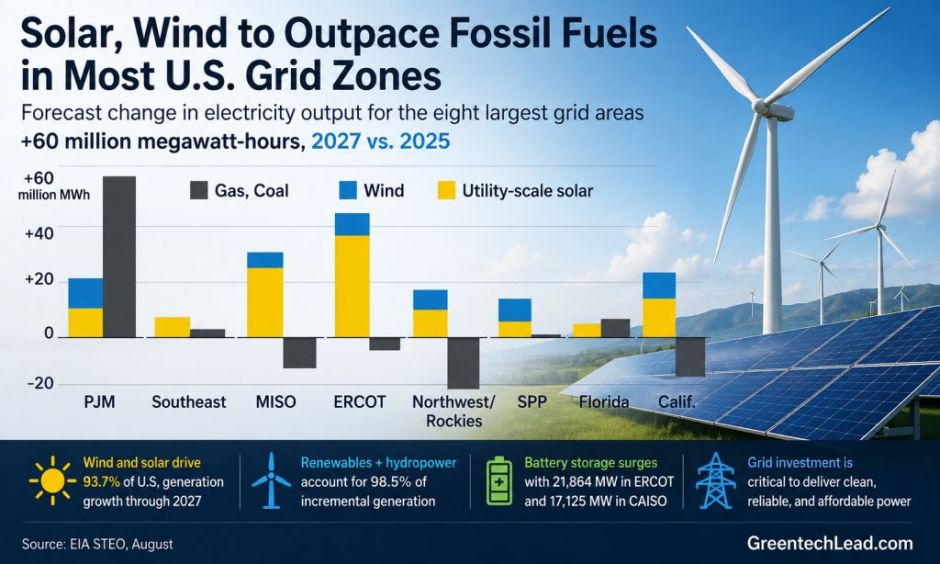
The U.S. Energy Information Administration (EIA) expects total U.S. electricity generation to increase 4.6 percent from the beginning of 2026 through the end of 2027. Of the projected 198.8 million MWh increase, wind and solar will provide 186.4 million MWh, or 93.7 percent.
Including hydropower, renewables will contribute 195.9 million MWh, equivalent to 98.5 percent of incremental generation. Coal and natural gas together are expected to add only 1.3 million MWh.
The investment opportunity therefore extends beyond renewable generation into batteries, transmission, distribution, transformers, substations and grid digitalization needed to deliver reliable electricity.
Wind and Solar Dominate New U.S. Electricity Supply
EIA expects wind and solar generation to grow faster than gas and coal in nine of the 11 major U.S. power markets through 2027. Across those nine regions, wind and solar output is projected to increase by 161 million MWh while coal and gas generation declines by 63 million MWh.
The trend means the economic value of new renewable projects will increasingly depend on their ability to connect to the grid, store electricity and deliver power when demand is highest.
ERCOT Shows Value of Solar and Battery Storage
EIA expects ERCOT electricity generation to increase by 42.4 million MWh through 2027, with the entire increase supplied by wind and solar.
The impact was visible during Texas’ record electricity demand on July 22, 2026. ERCOT demand reached 91,089 MW at 6 p.m., 5,508 MW above the previous record of 85,508 MW set in August 2023.
Despite record demand, the average real-time electricity price during the peak hour was only $29.11/MWh. During the comparable 2023 peak, prices reached $4,477.12/MWh and remained above $1,000/MWh for much of the afternoon and early evening.
Solar generation reached a daily high of 33,634 MW on July 22 and produced 28,712 MW during the peak hour, meeting 31.5 percent of demand. In 2023, solar peaked at 12,993 MW and provided 10,435 MW, slightly more than 12 percent of demand, during the peak hour.
As solar output declined in 2026, batteries supplied more than 10,000 MW for over an hour beginning at 7:45 p.m., covering between 10 percent and 14 percent of ERCOT demand.
ERCOT has 21,864 MW of installed battery-storage capacity, with approximately another 16,000 MW expected by the end of 2027. California’s CAISO had 17,125 MW of battery capacity as of August 1, 2026.
PJM Faces Nearly $50 Billion in Additional Capacity Costs
PJM presents a contrasting picture. Almost three-quarters of its projected generation growth through 2027 is expected to come from natural gas and coal, with aging coal plants accounting for approximately 44 percent of the increase, according to IEEFA’s Dennis Wamsted.
PJM electricity demand reached a record 168,158 MW on July 2, 2026, surpassing the previous 165,563 MW record established in 2006.
Real-time electricity prices approached $2,000/MWh during the peak hour and remained above $200/MWh from 11:10 a.m. until 9:30 p.m.
IEEFA estimates that PJM customers will pay almost $50 billion in additional capacity costs over three years.
The contrast with ERCOT demonstrates how the timing of renewable, battery and grid investments can influence a market’s ability to respond to rapidly rising electricity demand.
Battery Storage Attracts New Investment
Rapid U.S. storage deployment is creating opportunities for battery manufacturers expanding beyond electric vehicles.
SK On has signed an agreement with U.S.-based NeoVolta Power covering 9 GWh of U.S.-manufactured lithium iron phosphate battery cells between 2027 and 2031. The agreement is estimated at approximately $1.09 billion.
Under the SK On and NeoVolta U.S. battery storage agreement, another 9 GWh collaboration is planned, potentially increasing their combined activity to 18 GWh.
SK On is targeting more than 20 GWh of global ESS orders in 2026 and is reportedly negotiating additional U.S. supply contracts totaling more than 10 GWh.
Iberdrola Puts €37 Billion Behind Electricity Networks
Grid infrastructure is attracting an increasing share of energy-sector capital.
Iberdrola’s €58 billion Strategic Plan through 2028 allocates €37 billion to electricity networks and €21 billion to renewables and customers.
Approximately two-thirds of network investment will go toward distribution and one-third toward transmission.
Iberdrola expects its regulated asset base to increase approximately 40 percent from €49 billion in 2024 to around €70 billion by 2028, including about €50 billion in distribution and €20 billion in transmission.
More than 70 percent of network investment will be concentrated in the UK and United States, while around 80 percent will be deployed in A-rated countries.
The broader investment program allocates €20 billion to the UK, €16 billion to the United States, €9 billion to Iberia, €7 billion to Brazil and €5 billion to other EU markets and Australia.
Enel Plans More Than €26 Billion for Grids
Enel is pursuing a similar combination of renewable and network investment.
Under the Enel 2026-2028 Strategic Plan, total investment is expected to reach approximately €53 billion, including more than €26 billion for grids and approximately €20 billion for renewables.
Renewable investment will add roughly 15 GW of capacity, with more than 75 percent coming from wind and battery energy-storage systems.
Enel expects renewable capacity to exceed 80 GW by 2028, compared with an estimated 68 GW in 2025. Its grid regulated asset base is expected to increase from approximately €47 billion to €58 billion over the same period.
NextEra Plans $97 Billion-$107 Billion Investment
NextEra Energy’s capital program illustrates the scale of U.S. electricity infrastructure requirements.
The company outlined approximately $97 billion to $107 billion of U.S. infrastructure investment through 2027, covering renewable generation, battery storage and utility infrastructure.
NextEra Energy Resources was targeting approximately 36.5 GW to 46.5 GW of new renewable and storage capacity between 2023 and 2027.
Such investments are becoming more important as data centers, AI infrastructure, industrial projects and electrification increase electricity demand and require additional generation and grid capacity.
Renewable-Plus-Storage Changes Project Economics
Battery storage is also changing renewable project economics.
Solar projects generate heavily during daylight hours, when high regional output can depress wholesale electricity prices. Batteries allow developers to shift part of that electricity into evening periods when solar production falls and demand can remain high.
Storage can generate revenue from energy arbitrage, capacity markets, frequency regulation, reserves and other grid services.
ERCOT demonstrated this role when more than 10,000 MW of batteries supported the system as solar production declined during its record-demand day.
U.S. Power Investment Shifts Toward Flexibility
The emerging investment cycle is increasingly about flexibility rather than generation capacity alone.
Wind and solar are expected to supply 93.7 percent of incremental U.S. electricity generation through 2027, increasing to 98.5 percent for renewables when hydropower is included. That expansion requires corresponding investment in storage, transmission and distribution infrastructure.
Corporate spending plans reinforce the trend. Iberdrola plans €58 billion of investment through 2028, including €37 billion for networks. Enel expects approximately €53 billion of investment during 2026-2028, while NextEra has outlined $97 billion-$107 billion of U.S. infrastructure investment through 2027. SK On’s estimated $1.09 billion NeoVolta agreement demonstrates the parallel expansion of stationary battery storage.
The contrast between ERCOT and PJM underscores the investment case. ERCOT met record demand of 91,089 MW while solar and batteries provided substantial capacity, whereas PJM’s dependence on conventional generation coincided with prices approaching $2,000/MWh and almost $50 billion in projected additional capacity costs.
For utilities, renewable developers, battery manufacturers and infrastructure investors, the next U.S. power investment cycle will increasingly center on integrating renewable generation with storage and stronger electricity networks.
SHAFANA FAZAL