


The International Energy Agency (IEA) has highlighted that energy efficiency is no longer just about reducing electricity bills. Businesses that invest in efficient equipment, electrification, digital energy management and process optimization can significantly improve productivity, reduce maintenance costs, strengthen product quality, enhance workforce health and gain a competitive advantage. The IEA report shows that the financial value created by these additional benefits often equals or even exceeds direct energy savings.
Top 10 Business Benefits of Energy Efficiency
1. Global energy savings create value beyond lower utility bills
Energy efficiency is described as the “first fuel” because the cheapest energy is the energy that is not consumed. Beyond lower energy bills, businesses gain through higher productivity, reduced waste, better quality, improved worker health and stronger competitiveness. Every dollar saved on energy can generate more than one additional dollar in business benefits.
2. Productivity increases by up to 30 cents for every dollar saved
For every $1 saved in energy costs, businesses can realize up to 30 cents in additional productivity gains. Analysis of more than 1,000 energy efficiency projects in US SMEs found an average productivity gain of 13 cents per dollar, with some categories reaching 30 cents.
3. Manufacturers can reduce energy use by 90 percent
Real-world examples show substantial operational gains. A textile manufacturer in Scotland replaced 14 conventional looms with a more efficient knitting machine, reducing energy costs by about 90 percent while increasing production. A food manufacturing facility in Brazil increased production capacity by 20 percent while lowering energy consumption.
4. Maintenance costs fall by as much as 80 percent
Efficient and electrified equipment experiences less wear and fewer failures. Maintenance costs typically decline by 25 percent to 80 percent depending on the technology. A high-efficiency compressor reduced energy consumption by more than 40 percent and maintenance costs by 85 percent, while variable-speed HVAC motors cut energy use by 30 percent and maintenance costs by 20 percent.
5. Resource efficiency can nearly double financial returns
Reducing waste, water use and raw material consumption significantly increases the value of energy efficiency investments. On average, businesses gain an additional 90 cents for every $1 of energy savings through resource efficiency. A wood products manufacturer saved around $6 million in one year, while a UK beverage producer reused around 90 percent of surplus steam heat and saved approximately 2 million litres of water annually.
6. Better process control improves product quality
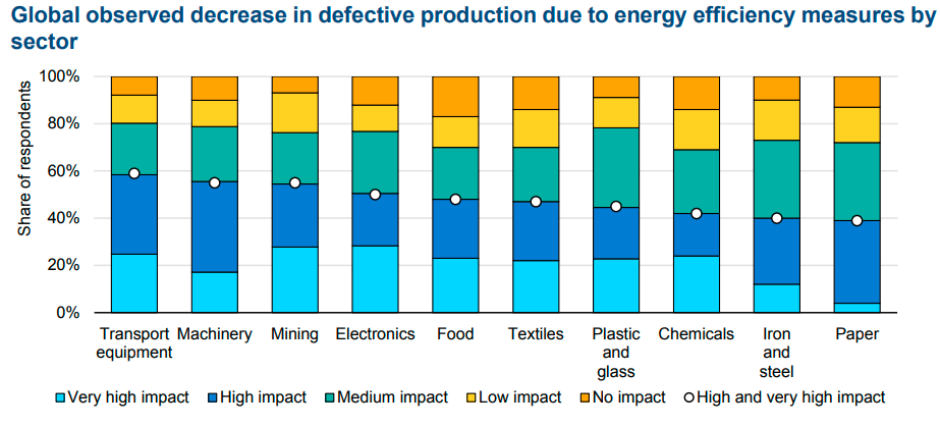
Energy-efficient production delivers more consistent manufacturing quality. A survey of 1,000 manufacturing companies across 14 countries found that around two-thirds reported at least a medium reduction in production defects, while almost half experienced a high or very high improvement after implementing energy efficiency measures. An Irish manufacturer also reduced waste compactor use by 80 percent through improved equipment and waste heat recovery.
7. More than half of consumers will pay more for sustainable products
Energy efficiency also strengthens brand reputation. Consumer research covering 6,120 respondents across Australia, Germany, India, the Netherlands, the United Kingdom and the United States found that more than 50 percent are willing to pay a premium for products made using more sustainable production methods. Apple’s supplier energy efficiency initiatives also reduced emissions by 2 million tonnes of CO₂ equivalent during 2025.
8. Healthier workplaces improve employee productivity
Replacing conventional industrial processes with efficient technologies creates healthier workplaces. Induction heating reduces energy demand by around 70 percent, while LED lighting in apparel manufacturing lowered energy use by around 85 percent and reduced indoor temperatures by up to 2.4°C. Office employees also experience 2 to 3 fewer sick days annually, resulting in nearly 8 additional productive working days per employee each year.
9. Heat pumps deliver 350 percent efficiency with zero local emissions
Industrial heat pumps significantly outperform fossil-fuel heating technologies. The IEA report shows industrial heat pumps achieve efficiency levels of around 350 percent, compared with 99 percent for electric boilers, 90 percent for natural gas boilers, 85 percent for oil boilers and 80 percent for coal and biomass boilers. Electric heating technologies also produce zero local emissions of NOx, SO₂, CO and PM2.5. Around 70 percent of manufacturing processes use low- and medium-temperature heat that can benefit from cleaner technologies. Air pollution currently contributes to an estimated 6.7 million premature deaths worldwide each year.
10. Energy management can reduce energy use by up to 60 percent
The IEA recommends integrating energy efficiency into strategic business planning. Establishing energy management systems can reduce energy use by 10 percent to 18 percent in the early years and by as much as 60 percent over the longer term. Many energy efficiency investments also deliver rapid returns, with motor upgrades typically achieving payback in around three years, while LED lighting projects often recover costs within months. The IEA notes that improved investment evaluation can help businesses contribute to the global goal of doubling energy efficiency improvements by 2030.
BABURAJAN KIZHAKEDATH