


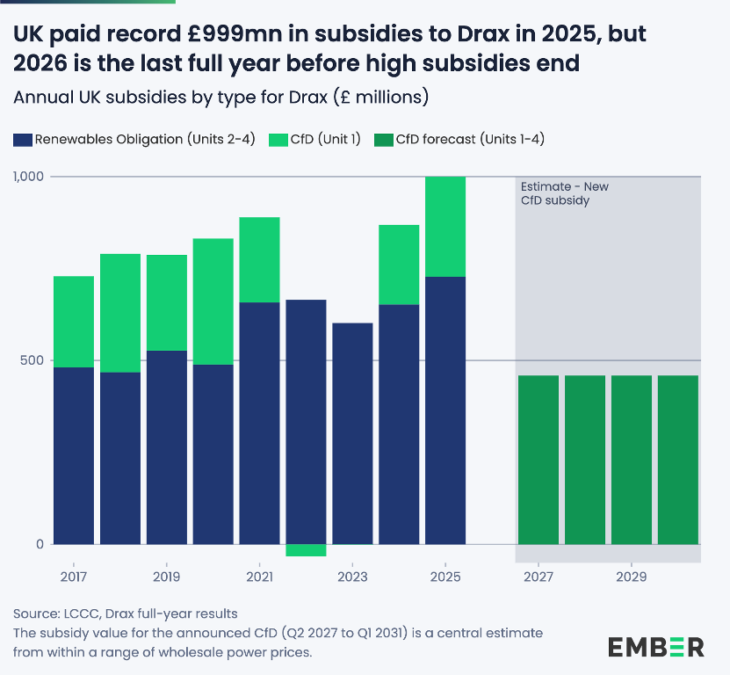
A new analysis by Ember reveals that Drax Power Station received a record £999 million in subsidies in 2025, highlighting the growing financial burden of biomass energy on UK consumers. The subsidy level equates to approximately £2.7 million per day and adds around £13 annually to each UK household’s energy bill.
Record subsidies driven by policy structure and rising payments
Despite being the UK’s largest carbon emitter for ten consecutive years, Drax continues to qualify for subsidies because emissions from burning woody biomass are classified as zero in carbon accounting. Subsidies increased by 15 percent in 2025 compared to 2024, rising by £130 million.
The payments are distributed through two key schemes:
Renewables Obligation (RO): £728 million covering three generating units
Contracts for Difference (CfD): £271 million covering one unit
Since 2012, total subsidies to Drax have reached £8.72 billion, with the RO scheme contributing the majority. Payment rates remain significant, with RO subsidies valued at £70 per unit of energy and CfD providing an average top-up of £54 per MWh.
Subsidy reduction expected from 2027, but emissions remain high
The current subsidy regime is nearing its end. In April 2026, Drax entered the final year of high subsidy payments. From 2027, subsidies are expected to fall by roughly 50 percent to about £460 million annually, or £1.25 million per day.
A new capped CfD scheme will replace existing support, running until 2031. While the strike price will increase to £157 per MWh, subsidised generation will be limited to a 27 percent capacity factor, nearly half of historical levels. This is expected to reduce consumer costs but not eliminate emissions.
Drax likely to remain UK’s largest emitter until 2030
Even with reduced subsidies and lower generation, Ember analysis indicates that Drax will likely remain the UK’s largest emitter through at least 2030. The scale of biomass burning continues to outweigh reductions, maintaining its dominant emissions profile among industrial sites.
Frankie Mayo, Senior UK Analyst at Ember, said the scale of subsidies raises serious concerns about value for money and policy design, especially as energy prices remain high for consumers.
Carbon capture uncertainty weakens long-term case for subsidies
The long-term outlook for Drax is increasingly uncertain as plans to deploy carbon capture technology lose momentum. The company has signalled reduced confidence in delivering the project, following delays, closure of trials, and job cuts.
Earlier analysis suggests that transitioning to bioenergy with carbon capture would require around £30 billion in additional subsidies, exceeding the UK’s entire carbon capture and storage budget. Without this pathway, the justification for continued public support weakens significantly.
Outlook: phase-out of subsidies begins amid policy scrutiny
The wind-down of subsidies starting in 2027 marks a turning point for biomass energy policy in the UK. While consumers may see some relief in energy bills, the continued high emissions from Drax and uncertainty around carbon capture investments are expected to keep the debate over biomass subsidies firmly in focus.
BABURAJAN KIZHAKEDATH