


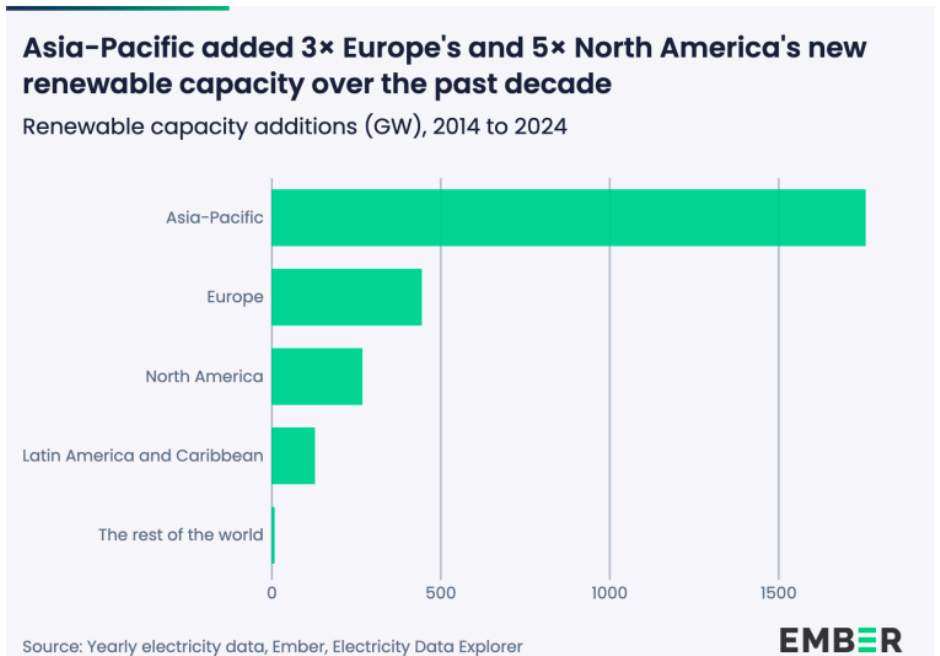
Asia-Pacific power grids are undergoing a massive transformation driven by rapid renewable energy expansion and rising climate-related disruptions, according to a new report from Ember released at the Asia Action Summit in Singapore.
The report said Asia-Pacific generated nearly half of the world’s renewable electricity in 2024 and is expected to account for more than 60 percent of global renewable electricity generation by mid-century under the International Energy Agency Stated Policies Scenario. Wind and solar power generation in the region is projected to surge from around 3,000 TWh in 2025 to over 20,000 TWh by 2050, representing more than 85 percent of total renewable electricity generation.
Since 2014, about 90 percent of all new renewable energy capacity added in Asia-Pacific has come from wind and solar projects, reflecting the region’s aggressive transition toward clean energy infrastructure.
Asia-Pacific is also emerging as the largest contributor to global electricity demand growth. The region consumed slightly over half of the world’s electricity in 2024 and is forecast to drive nearly 60 percent of global electricity demand growth through 2050. India and major Southeast Asian economies are projected to generate approximately 6,100 TWh of renewable electricity annually by 2050, surpassing Europe’s current total electricity generation.
The report highlighted massive investments in electricity grid modernization, particularly in China, where annual grid investment crossed 600 billion RMB, or around $85 billion, in 2024. China is also planning to invest another 4 trillion RMB, approximately $574 billion, in grid upgrades through 2030.
Battery energy storage deployment in China has accelerated sharply. The country commissioned a record 37 GW / 91 GWh of battery storage in 2024 alone, exceeding the combined additions of the United States, which added 12 GW / 37 GWh, and Europe, which added 12 GW / 21 GWh. China’s battery storage capacity has more than tripled since 2021.
In Southeast Asia, a financing initiative launched in 2025 by the Asian Development Bank, the World Bank, and ASEAN aims to double cross-border power interconnection capacity by 2040.
However, the report warned that renewable energy growth and grid flexibility measures alone cannot fully address the mounting risks from climate change. Heatwaves, floods, droughts, tropical cyclones, and compound weather events are already causing power shortages and infrastructure failures across Asia-Pacific.
China recorded its hottest average summer temperature in 2025 at 22.31°C, the highest since records began in 1961, following its hottest August in 2023 and warmest year in 2024. Japan experienced its third consecutive year of record summer heat in 2025, while South Korea surpassed its previous all-time summer heat record.
Southeast Asia’s annual average temperature has increased by 0.14°C to 0.20°C per decade since the 1960s. During the April-May 2023 heatwave, nearly 70 percent of weather stations across Cambodia, Laos, Thailand, Malaysia, and Vietnam recorded daily maximum temperatures above 42°C. Thailand’s Tak province reached 45.4°C, Laos registered a national record of 42.9°C, and Vietnam hit a record 44.1°C.
The report also documented severe climate-linked power disruptions. During China’s 2022 heatwave and drought, hydropower generation in Sichuan province fell to less than half of normal levels, triggering industrial power rationing. Typhoon Trami in 2024 caused power outages across more than 350 municipalities in the Philippines, while Typhoon Kajiki in 2025 disrupted electricity supply for around 1.6 million people in Vietnam. The Philippines was also hit by six tropical storms in November 2024 alone.
Global carbon emissions increased 1.1 percent in 2025, while the United Nations Environment Programme Emissions Gap Report 2025 warned that global temperatures are likely to exceed the 1.5°C warming threshold within the next decade.
According to the Intergovernmental Panel on Climate Change Sixth Assessment Report, a 1-in-10-year extreme heat event would occur 4.1 times more frequently at 1.5°C warming, while a 1-in-50-year extreme heat event would happen 8.6 times more often. Heavy rainfall events are projected to occur 1.5 times more frequently at 1.5°C warming and 1.7 times more frequently at 2°C warming.
The Ember report identified three major barriers limiting climate adaptation in power systems: fragmented climate and grid datasets, isolated sectoral models unable to capture compound risks, and growing decision-making complexity that exceeds the capability of traditional planning systems.
According to Muyi Yang, artificial intelligence can help utilities and governments integrate diverse datasets, connect cross-sector models, and improve planning decisions without replacing engineering expertise.
“Asia-Pacific’s grids are being asked to absorb the world’s fastest renewable surge while staying reliable in an increasingly climate-volatile operating environment. Flexibility investments are essential, but they address only half the challenge. Climate adaptation is no longer an optional add-on; it is a core design requirement for system reliability,” said Muyi Yang, Senior Energy Analyst at Ember.
BABURAJAN KIZHAKEDATH