


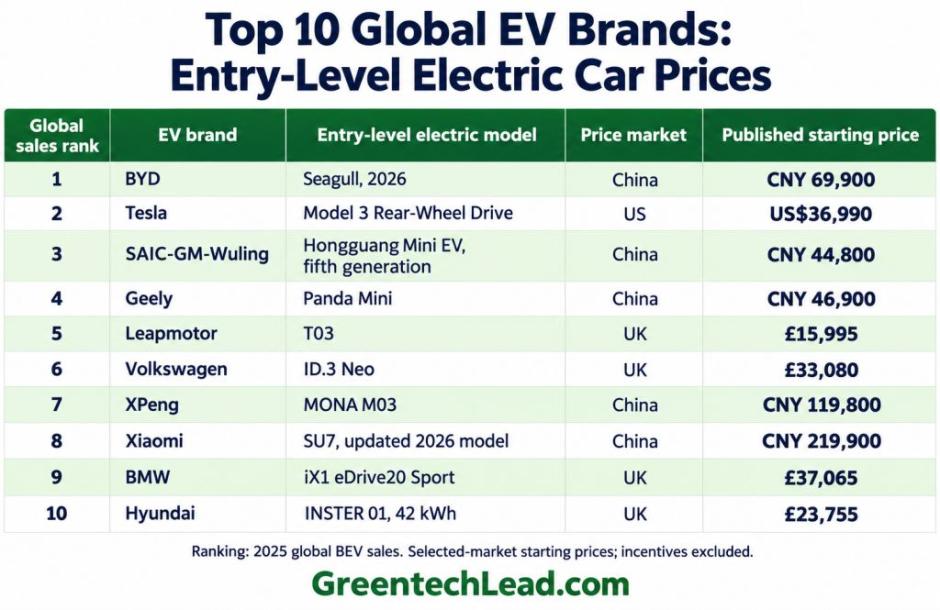
Chinese electric vehicles are often cheaper because manufacturers combine affordable batteries, integrated production, large supplier networks and intense domestic competition. These advantages reinforce one another, helping automakers reduce costs across the vehicle rather than relying on a single saving.
The International Energy Agency’s manufacturing comparison found that battery-electric vehicle production costs were more than 30 percent lower in China than in advanced economies. Batteries accounted for around one-third of the difference, while a similar manufacturing gap existed for conventional cars. The comparison used standardized small SUVs and 2024 cost data; it is not a universal discount across all Chinese models.
The IEA’s 2026 research shows how this industrial advantage translates into affordable vehicles, while examples from BYD and overseas markets demonstrate why prices vary by location.
Battery Prices Give Chinese EV Manufacturers a Head Start
BloombergNEF’s 2025 battery price survey recorded a global average lithium-ion battery pack price of $108 per kilowatt-hour, down 8 percent from 2024.
China’s regional average was $84/kWh. North American and European pack prices were respectively 44 percent and 56 percent higher. These regional averages cover multiple applications and battery chemistries, rather than identical automotive packs.
An illustrative 60-kWh pack shows the financial effect:
| Battery-price benchmark | Illustrative 60-kWh pack value |
| China average: $84/kWh | $5,040 |
| Global average: $108/kWh | $6,480 |
| Difference | $1,440 |
This calculation demonstrates the sensitivity of vehicle costs to battery prices. It is not a quotation for a particular EV battery.
Manufacturers can use lower battery expenditure to reduce selling prices, improve margins or add features without increasing the final price.
LFP Batteries Lower Material Costs
Lithium iron phosphate, or LFP, batteries avoid nickel and cobalt in their cathode chemistry, reducing exposure to these expensive materials.
The IEA’s Global EV Outlook 2026 battery analysis says LFP accounted for more than 55 percent of EV battery deployment in 2025, up from nearly 50 percent in 2024. China also produced more than 80 percent of global battery output.
LFP is particularly useful for affordable vehicles where manufacturers balance purchase price, range and battery size. Higher-energy-density chemistries remain relevant for other applications, so the cheapest chemistry is not automatically the best choice for every model.
Battery sizing creates another saving. At an illustrative $100/kWh, reducing capacity from 60 kWh to 45 kWh lowers pack expenditure by $1,500. The trade-off is less stored energy, making vehicle efficiency and intended use important.
BYD Combines Battery Expertise With Integrated Vehicle Technology
BYD provides a practical example of integrating battery and vehicle development.
The company highlights its Blade Battery, Cell-to-Body integration and 8-in-1 electric powertrain as important technologies across its electric lineup. BYD reported selling more than 4.6 million new-energy vehicles in 2025, including battery-electric vehicles and plug-in hybrids.
Integrated development can help engineers coordinate battery packaging, electronics and drivetrain design. Producing key technologies internally can also reduce some purchasing layers and simplify component coordination.
However, vertical integration requires capital and manufacturing expertise. It supports lower costs when internal production is efficient and volumes justify the investment.
BYD’s example therefore combines two advantages: control over important technologies and a large vehicle business over which to spread development expenditure.
Factory Scale Reduces Costs When Capacity Is Used
China produced approximately 16 million electric cars in 2025, exceeding domestic demand by around 20 percent, according to the IEA. Electric-car exports doubled to more than 2.5 million. These figures include battery-electric cars and plug-in hybrids.
Large production volumes can spread tooling, engineering and factory overhead across more vehicles.
For example, assume a plant has $200 million in annual fixed costs. Producing 500,000 vehicles allocates $400 per vehicle; producing 250,000 allocates $800. This simplified illustration excludes variable costs but shows why utilisation matters.
High capacity alone does not guarantee low costs. Underused factories can increase unit costs, while manufacturers may cut prices to maintain output and clear inventory.
Supplier Concentration and Automation Improve Efficiency
China’s advantage extends upstream into battery materials. In 2025, it accounted for approximately 85 percent of cathode active-material production and more than 90 percent of anode active-material production used in electric-car batteries.
Concentrated supplier networks can shorten delivery routes, support engineering collaboration and enable larger component orders.
The IEA’s EV manufacturing cost analysis also identifies manufacturing efficiency and automation as major contributors to battery cost competitiveness.
Shared vehicle platforms provide another opportunity. Using common motors, electronics and battery systems across several models can reduce duplicated development and tooling.
As an illustration, $600 million in platform development expenditure spread across one million vehicles equals $600 per vehicle, compared with $1,200 across 500,000.
Price Competition Makes Chinese EVs More Affordable
The IEA’s 2026 electric-car market analysis found that average battery-electric car prices in China fell more than 10 percent in 2025. Around 30 percent of BEV models had entry prices below $20,000.
Nearly 70 percent of BEVs sold in China were cheaper than their conventional equivalents before government incentives, indicating that affordability extends beyond consumer subsidies.
Competition encourages manufacturers to pass savings to buyers. Nevertheless, selling prices and manufacturing costs are different measures: discounts may also reflect thinner margins or inventory clearance.
Thailand Shows How Overseas Production Can Change Prices
The BYD Dolphin illustrates how localisation can affect affordability.
The IEA reported that its Thai list price declined from approximately THB700,000 in 2024 to THB640,000 in 2025 as production shifted from China to BYD’s Thai facilities. That represents an approximate 8.6 percent price reduction, although localisation was not necessarily the sole cause.
Overseas prices also include shipping, duties, certification, distribution and warranty support. A low domestic Chinese price therefore cannot be assumed to apply in India, Europe or another export market.
Buyers Should Compare Ownership Costs as Well as Price
A cheaper EV delivers stronger value when supported by reliable servicing, suitable charging access and competitive operating costs.
For an illustrative driver covering 15,000 km annually, consumption of 15 kWh per 100 km requires 2,250 kWh. At ₹8/kWh, electricity expenditure would be ₹18,000, excluding charging losses. Actual costs depend on the vehicle, driving conditions and charging tariffs.
Chinese EV affordability ultimately reflects an integrated industrial system: batteries, suppliers, efficient production, shared technologies and strong competition. Buyers should assess that purchase-price advantage alongside warranty terms, insurance, repair support and resale value.
SHAFANA FAZAL