


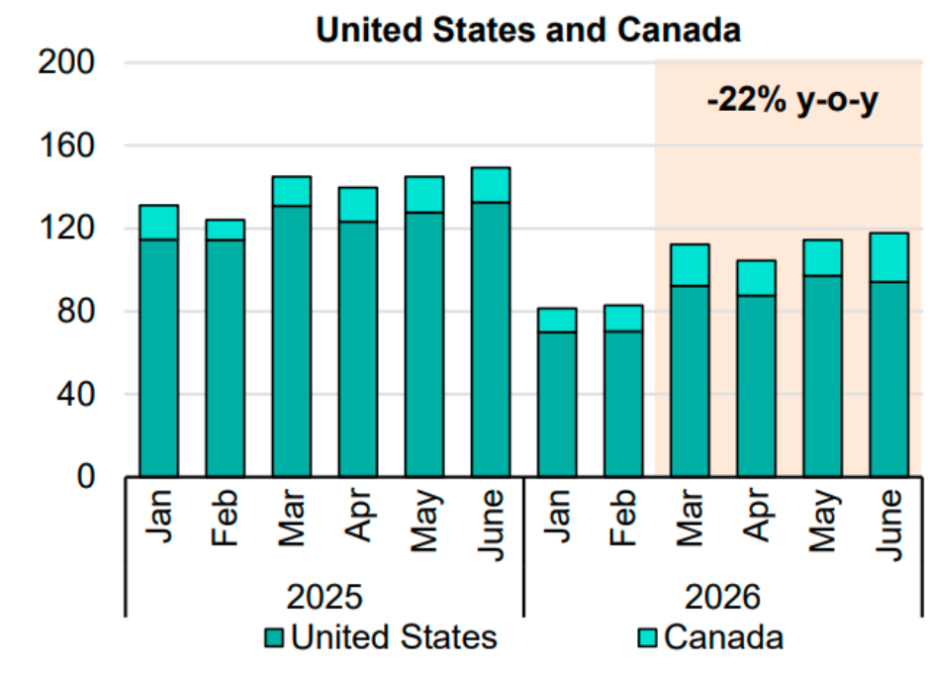
The United States electric vehicle market is facing a significant slowdown in 2026 as weaker demand and the end of federal EV tax incentives weigh on sales. While electric car sales improved sequentially during the second quarter, volumes remained substantially below 2025 levels, according to the International Energy Agency’s Electric Car Markets in a Time of Uncertainty, an update to the Global EV Outlook 2026.
Electric car sales in the US exceeded 275,000 units in Q2 of 2026, registering a 20 percent increase from the first quarter. However, Q2 sales were approximately 25 percent lower than in Q2 2025, highlighting the pressure facing the US EV market, IEA report said.
The dip in EV sales followed the expiration of the US federal EV tax credit in the third quarter of 2025. Though monthly EV sales began recovering in March 2026 after particularly weak results in January and February, the improvement has not restored the market to last year’s levels.
The IEA data also shows that combined electric car sales in the United States and Canada declined 22 percent year-on-year between March and June 2026, contrasting sharply with EV growth of 33 percent in Europe, 62 percent in Southeast Asia, 101 percent across other Asia-Pacific markets and 132 percent in Latin America over the same period.
EV penetration in the United States has also weakened. Electric cars accounted for an average of only 7 percent of US new-car sales in early 2026, compared with an average 10 percent share during 2025. This three-percentage-point decline indicates that the slowdown is not simply a consequence of weakness in the broader automobile industry.
The overall US car market is nevertheless under pressure as well. Total new-car sales declined more than 3 percent year-on-year in H1 2026, despite a recovery during May and June. For the full year, the IEA expects US automobile sales to finish close to 3 percent below 2025 levels.
The US slowdown stands out against the broader global EV market. More than 9 million electric cars were sold worldwide during H1 2026, including more than 5 million in Q2. Global Q2 EV sales increased 35 percent from Q1 and 4 percent year-on-year, although first-half sales remained around 1 percent below H1 2025. EVs represented 24 percent of global new-car sales, compared with only around 7 percent in the United States.
The gap could widen further as other markets accelerate electrification. The IEA expects global EV sales to increase around 10 percent in 2026 to 23 million vehicles, lifting electric cars to 29 percent of worldwide car sales. That compares with the much lower EV penetration currently recorded in the United States.
Policy support, however, is emerging at the state level. On July 13, 2026, California approved a new instant rebate program for zero-emission vehicles as part of a broader $600 million clean transportation investment. Such state-level incentives could provide some support after the withdrawal of federal incentives.
Competition is another important factor shaping the US EV industry. The United States was the world’s second-largest national car market in 2025, with approximately 15.2 million new-car sales, according to the IEA chart on page 20. US-headquartered manufacturers maintain a particularly strong position in their domestic market, including in electric vehicles.
Tesla, General Motors, Ford, Rivian and Hyundai Motor Group remain among the most important EV players investing in US production capacity, even as EV demand weakened in 2026.
Tesla said in its 2025 annual filing that it planned to ramp six production lines during 2026, spanning vehicles, energy storage, batteries and its Optimus robot program. During Q1 2026, Tesla was ramping additional AI computing capacity and new battery and battery-material factories.
General Motors (GM) announced $4 billion of investment over two years at plants in Michigan, Kansas and Tennessee to expand US production of both electric and gasoline vehicles. GM has also invested $2.3 billion in its second battery-cell manufacturing plant. Its battery strategy extends beyond vehicles: GM and Redwood Materials are deploying roughly 10,000 repurposed GM EV batteries into energy infrastructure, including an AI data center in Nevada.
Ford is restructuring its EV investment strategy. Ford continues to develop its Universal EV platform, including plans for an approximately $30,000 electric pickup scheduled for 2027 in Kentucky. The company has previously committed about $3 billion to a Michigan plant designed to manufacture around 20 GWh of lithium iron phosphate battery capacity. However, Ford’s EV sales fell more than 57 percent in H1 2026, while its EV and software operations lost $919 million in Q2. Ford also recorded a $3.6 billion charge associated with dissolving its battery joint venture with SK On.
Rivian’s Georgia manufacturing facility represents a multi-billion-dollar investment and is expected to create around 7,500 jobs by 2030. Rivian has optimized the first phase of the project to increase planned production capacity by 50 percent.
Hyundai Motor Group plans to invest $21 billion in the United States between 2025 and 2028, covering automotive production, parts, logistics, steel and advanced technologies. This builds on its dedicated Georgia EV and battery manufacturing project, originally announced with an investment of $5.54 billion and planned annual production capacity of 300,000 vehicles.
The figures from IEA point to a challenging transition for the US EV market in 2026. Q2 EV sales above 275,000 units and 20 percent sequential growth indicate that demand has started recovering from the weak first quarter, but the 25 percent year-on-year decline and fall in EV market share from 10 percent in 2025 to around 7 percent in 2026 show that the market remains well below its previous trajectory.
BABURAJAN KIZHAKEDATH