


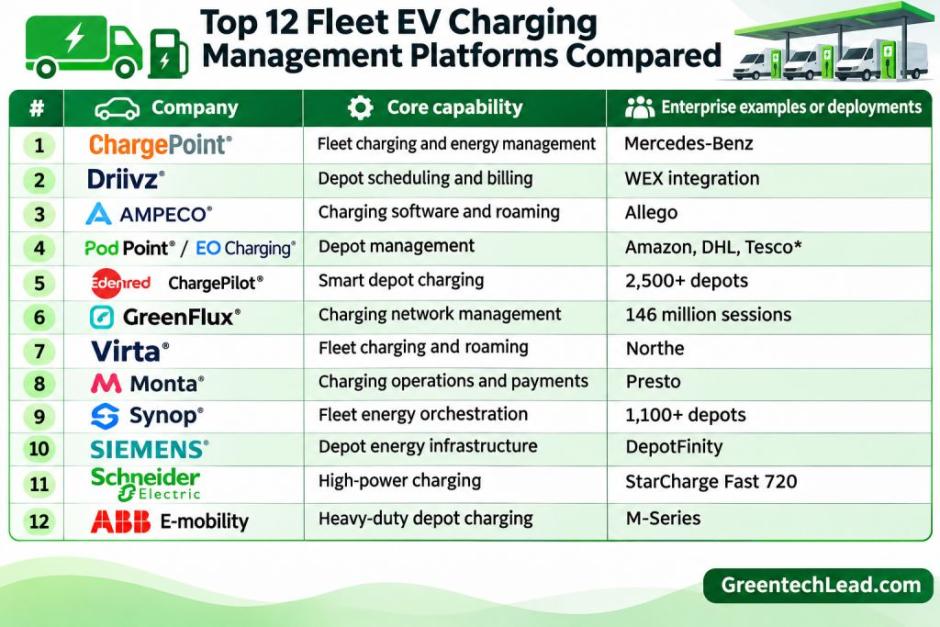
Fleet EV charging management is becoming a major investment priority for logistics companies, bus operators, delivery fleets and corporate transport providers. Leading platforms, including ChargePoint, Driivz, AMPECO, Edenred ChargePilot, GreenFlux, Virta, Monta and Synop, are competing to help enterprises manage charging infrastructure, electricity costs, vehicle availability and depot operations.
According to the EY-Eurelectric fleet electrification study, European fleet operators could achieve up to €246 billion in cumulative operating-cost savings by 2030 through electrification, energy efficiency and lower vehicle operating expenses.
However, charging software cannot independently resolve grid connection delays, equipment failures or insufficient depot power capacity. Enterprises must evaluate charging reliability, software integration, electricity tariffs and maintenance costs before selecting a platform.
1. ChargePoint: Enterprise Fleet Charging Management
ChargePoint combines charging hardware, fleet software, load management, reporting and installation services.
In August 2026, ChargePoint expanded its Mercedes-Benz fleet electrification partnership across the United Kingdom and Germany.
The arrangement covers site assessments, charging equipment, installation, software and operational support, targeting businesses transitioning commercial vehicles to electric power.
2. Driivz: Depot Charging and Energy Management
Driivz, owned by Vontier, provides charging management, energy optimization, billing and fleet software.
Its InSite platform supports charging schedules, vehicle prioritization and employee home-charging reimbursement.
Driivz’s 2026 integration with WEX enables commercial drivers to access supported public charging locations using WEX cards and DriverDash, initially including a California commercial-vehicle charging hub.
3. AMPECO: Enterprise Charging Software
AMPECO offers white-label charging management, smart charging, billing, roaming and API integrations.
European charging operator Allego completed its migration to AMPECO in October 2026, transferring more than 32,000 charging points in under five hours.
The migration demonstrates large-scale charging network integration, although it was not exclusively a fleet deployment.
4. Pod Point and EO Charging: Fleet Depot Infrastructure
Pod Point acquired selected EO Charging assets in May 2026 after EO entered administration.
EO previously supplied charging technology to enterprise fleets associated with Amazon, DHL and Tesco.
The acquisition included depot charging management technology. Historical EO customers should not automatically be counted as current Pod Point customers.
5. Edenred ChargePilot: Smart Charging for Commercial Fleets
Edenred acquired The Mobility House Solutions, the business behind ChargePilot, in 2026.
The acquired operation reported more than 5,000 customers and over 2,500 managed depots.
ChargePilot coordinates charging schedules, vehicle availability and electricity demand, making it relevant to bus fleets, logistics operators and commercial depots.
6. GreenFlux: EV Charging Network and Payment Management
GreenFlux provides charging network management, payments, roaming and energy software.
By March 31, 2026, its platform had recorded 146 million charging sessions and delivered 3.26 billion kWh of electricity.
These are platform-wide operating figures rather than fleet-specific transactions.
7. Virta: Fleet Charging and Roaming
Virta combines charging management, roaming, payments and energy services.
Its Northe fleet platform gained access to more than 20,000 Tesla Superchargers across over 1,500 locations in 12 European markets during 2026.
The arrangement expands public charging access for commercial fleets but does not represent Virta-owned charging infrastructure.
8. Monta: Commercial EV Charging Operations
Monta provides charge-point management, billing, payments and charging network integrations.
In June 2026, Monta and Presto announced an OCPI integration opening more than 600 Monta-operator charging sites in the United States to Presto customers.
The agreement targets fleet, rideshare, rental and delivery vehicle charging. The sites are network access locations, not dedicated fleet depots.
9. Synop: Fleet Charging and Grid Integration
Synop provides charging management, energy orchestration and grid coordination for commercial fleets.
The company reports more than 8.5 GWh of managed electrical infrastructure across over 1,100 depots.
Its April 2026 partnership with OptiGrid combines fleet software with battery-integrated fast charging for locations facing grid capacity constraints.
10. Siemens: Depot Charging Infrastructure
Siemens offers electrical infrastructure, charging technology and energy management.
Its DepotFinity proposition coordinates vehicle assignments, charging schedules and available site power.
Siemens is particularly relevant to large bus depots and logistics facilities requiring charging integration with transformers, switchgear and electrical distribution systems.
11. Schneider Electric: High-Power Fleet Charging
Schneider Electric combines charging infrastructure with energy management and electrical distribution.
Its StarCharge Fast 720 delivers up to 720 kW, supports as many as 12 vehicles simultaneously and has a stated efficiency of 97 percent.
Dynamic load management distributes available electricity across connected vehicles, helping operators manage site capacity.
12. ABB E-mobility: Heavy-Duty Fleet Charging
ABB E-mobility supplies high-power charging equipment for commercial transport.
Its M-Series supports power configurations from 200 kW to 1.2 MW and up to 24 charging points.
In February 2026, ABB and Esyasoft announced plans to develop fleet electrification projects across the Middle East, Africa and Latin America.
The collaboration was announced rather than confirmed as completed deployments.
Customer Complaints: Charger Failures, Software Problems and Fleet Downtime
Charging reliability remains a major complaint among commercial fleet operators.
An EV charging network reliability survey reported by EV Charging & Infrastructure found that 24 percent of fleet respondents experienced moderate to severe network reliability problems. Among fleet respondents, 49 percent reported existing charging sessions stopping because of network connectivity failures, while 46 percent reported recovery times of four to 24 hours.
Electric Vehicle Charging & Infrastructure
A California Public Utilities Commission evaluation documented fleet complaints involving damaged charging connectors, missing fault-code reporting and software updates that interrupted communication between vehicles and chargers.
A specific example involved Kerlin Bus Sales, where 23 electric school buses were not consistently maintaining full charge overnight. Staff arrived at 5 a.m. to manually reconnect chargers until Synop and Delta implemented a firmware correction, according to the Synop customer case study.
In India, Exicom’s 2026 charging reliability report identified charging downtime and long charging sessions as operational problems for commercial EV fleets, particularly ride-hailing operators.
These complaints concern charging infrastructure and operational reliability across the industry, not verified defects in every platform listed above.
Additional Enterprise Fleet Charging Deployments
Several documented deployments illustrate the scale of commercial charging operations.
Mexico’s S2G Energy selected AMPECO to manage charging for a fleet of more than 2,600 electric vehicles using 566 charging units, with expansion planned. The AMPECO fleet announcement describes integration with vehicle telematics and routing information.
Evolt Charging selected AMPECO for its UK charging management operations covering more than 10,000 charge points, 400,000 drivers and three million annual charging sessions. These are network-wide figures, not exclusively fleet charging.
Czech energy company ČEZ selected Driivz to manage charging across public, semi-public, private and fleet applications, according to the Driivz fleet management customer information.
Fleet EV Charging Market Outlook for 2027
Fleet operators should compare vehicle readiness, charging session success, software interoperability, electricity costs, depot utilization and maintenance response times.
The Indian PM-eBus Sewa programme targets 10,000 electric buses across 115 cities, creating opportunities for charging software, depot energy management and grid infrastructure.
For enterprises, the strongest fleet EV charging management platform will be the one that keeps vehicles operational while reducing electricity costs, charging failures and unplanned downtime.
SHAFANA FAZAL