


The global EV battery manufacturing industry is entering a more competitive phase in 2026. Gigafactory capacity is still expanding, but falling battery prices, uneven EV demand and rapid growth in energy storage are changing the economics of large battery plants.
Europe has emerged as a major growth center for electric vehicles, while battery makers in the U.S. and China are increasingly looking to stationary energy storage as a second demand engine. Several factories originally planned around EV production are now being adapted to serve both electric mobility and battery energy storage systems, or BESS.
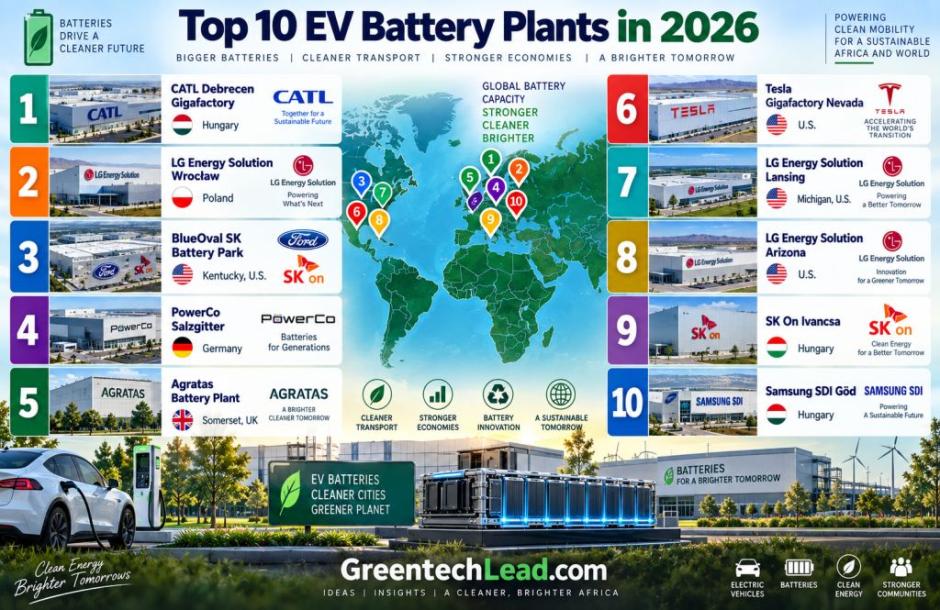
This ranking of the Top 10 EV Battery Plants in 2026 considers investment, annual capacity, employment, production status, chemistry, customer exposure and strategic importance rather than GWh capacity alone.
1. CATL Debrecen Gigafactory — Hungary
CATL’s Debrecen plant is one of Europe’s most important battery manufacturing projects.
The Chinese battery giant is investing approximately €7.34 billion in the Hungary facility, which is designed to reach up to 100 GWh of annual capacity. The project covers 221 hectares, with the first two phases representing around 72 GWh.
The factory will produce battery cells and modules for both EVs and energy storage systems. Its location gives CATL access to major European automotive customers including Mercedes-Benz, BMW, Stellantis and Volkswagen.
The CATL Debrecen battery project underlines the company’s strategy of localizing production close to automakers while retaining flexibility across EV and ESS demand.
2. LG Energy Solution Wrocław — Poland
LG Energy Solution’s Wrocław complex has become one of Europe’s largest battery manufacturing hubs.
The site has approximately 80 GWh of production capacity, with a target of 90 GWh, and represents about $5 billion of investment. Customers include Audi, BMW, Fiat, Ford, Porsche and Volkswagen.
LG is also expanding the factory into next-generation technology and ESS production. Its 46inEU project targets around 12 GWh of annual 46-series cylindrical-cell capacity and more than 750 jobs.
The LG Energy Solution 46-series expansion strengthens Europe’s battery localization strategy while giving LG greater flexibility across vehicle and stationary-storage applications.
3. BlueOval SK Battery Park — Kentucky, U.S.
Ford and SK Innovation’s BlueOval SK project is one of the largest automaker-led battery investments in North America.
The Kentucky complex includes two factories with combined capacity of approximately 86 GWh, supported by around $5.8 billion of investment and designed to create about 5,000 jobs.
The facilities will supply batteries for Ford and Lincoln EVs.
Across Kentucky and Tennessee, the wider Ford-SK program represents about $11.4 billion in investment, nearly 11,000 jobs and 129 GWh of planned capacity.
The project demonstrates how automakers are bringing battery production closer to vehicle factories to improve supply security and qualify for domestic-content incentives.
4. PowerCo Salzgitter — Germany
Volkswagen Group’s PowerCo has made Salzgitter the foundation of its European battery strategy.
Production of Unified Cells began in December 2025, giving the factory an important operational role in 2026. Initial capacity is about 20 GWh annually, with expansion planned toward 40 GWh.
Volkswagen has earmarked approximately €2 billion through the start of production and expects more than 2,500 jobs at the site.
PowerCo is initially producing NMC-based Unified Cells while preparing LFP variants. Salzgitter also provides the manufacturing template for Volkswagen’s broader European battery strategy, which targets up to 240 GWh of capacity by 2030.
5. Agratas Battery Plant — Somerset, UK
Agratas, Tata Group’s battery business, is developing one of Britain’s biggest new battery factories.
The Somerset project represents approximately £4 billion of investment and is expected to create up to 4,000 direct jobs, along with thousands of supply-chain positions.
Jaguar Land Rover is expected to be a major customer, linking the plant directly with Tata’s automotive operations.
A definitive total GWh figure has not been established in the latest project information, but the plant remains strategically important because of its investment scale, employment impact and role in building a domestic UK battery supply chain.
6. Tesla Gigafactory Nevada — U.S.
Tesla’s Nevada factory remains one of the world’s most important integrated battery and powertrain manufacturing sites.
Tesla previously disclosed more than $6.2 billion invested, annual cell output of more than 37 GWh and over 11,000 direct employees. The company later announced an additional $3.6 billion investment for a 100 GWh 4680 cell factory and high-volume Semi production.
Nevada now spans battery cells, packs, powertrains and energy storage, while Tesla is also expanding LFP production.
Its strategic advantage is vertical integration: battery manufacturing supports both Tesla’s vehicle business and its rapidly growing energy-storage operations.
7. LG Energy Solution Lansing — Michigan, U.S.
LG Energy Solution’s Lansing plant became one of the most significant new U.S. battery facilities in 2026 after production started in August.
The project represents more than $2 billion of investment and is designed for more than 35 GWh of annual capacity. Around 900 employees were reported at production launch, with employment expected to reach about 1,700 at full scale.
The factory is designed to serve both EV and ESS markets.
That flexibility is becoming particularly valuable as LG shifts part of its North American manufacturing capacity toward energy storage in response to slower-than-expected EV demand.
8. LG Energy Solution Arizona — U.S.
LG Energy Solution’s Arizona complex represents approximately $5.5 billion of investment and around 53 GWh of revised total capacity.
The configuration includes approximately 36 GWh of cylindrical EV battery capacity and 17 GWh of LFP pouch-cell capacity for energy storage.
The combination is strategically important because LFP batteries are becoming increasingly competitive in cost-sensitive EV segments and stationary storage.
Arizona therefore represents the industry’s growing move toward factories capable of serving multiple chemistries and markets rather than being tied to one battery format.
9. SK On Iváncsa — Hungary
SK On invested around $2.3 billion in its Iváncsa battery plant, targeting approximately 30 GWh of annual production capacity and 2,500 jobs.
The project strengthens Hungary’s position as one of Europe’s largest battery-manufacturing clusters.
SK On is also expanding into storage. The company signed a 9 GWh LFP battery supply agreement with NeoVolta Power for 2027-2032, with the potential for another 9 GWh, and is targeting more than 20 GWh of ESS orders in 2026.
That shift highlights how storage demand is becoming a strategic hedge against volatility in EV production.
10. Samsung SDI Göd — Hungary
Samsung SDI’s Göd plant is one of Europe’s more mature battery manufacturing sites.
Production began in 2018 after the conversion of an existing display facility. A second-stage investment of approximately €1.2 billion supported major expansion and around 1,200 additional jobs.
Rather than ranking the plant by an uncertain current GWh figure, its importance comes from manufacturing maturity, proximity to European automakers and long-term integration into Hungary’s battery ecosystem.
India’s EV Battery Manufacturing Race
India is also moving toward localized battery manufacturing, but the gap between announced capacity and installed output remains significant.
The Advanced Chemistry Cell Production Linked Incentive program targets 50 GWh, with 40 GWh awarded to four beneficiaries. Government data showed only about 1 GWh installed by March 2026, while at least 10 additional manufacturers had announced around 178 GWh of future capacity.
Ola Electric is ramping its Gigafactory from about 2.5 GWh toward 6 GWh, while Premier Energies and Germany’s RCT Group have announced a joint venture for a 12 GWh BESS manufacturing facility in Telangana.
India’s battery opportunity is therefore evolving across both EVs and grid storage.
Why Battery Plants Are Pivoting Toward Energy Storage
One of the biggest trends in 2026 is the convergence of EV and energy-storage manufacturing.
Global energy-storage cell shipments reached approximately 612 GWh in 2025, nearly double the previous year. CATL alone sold around 121 GWh of storage cells, while energy storage accounted for roughly 15 percent of its revenue.
Battery prices are also falling. BloombergNEF reported an 8 percent decline in average lithium-ion battery prices to $108 per kWh in 2025, while the IEA found LFP packs were more than 40 percent cheaper on average than NMC packs.
This makes flexible manufacturing increasingly important.
What Will Define the Winning Battery Plants?
The biggest battery factories will no longer be judged only by nameplate GWh capacity.
The more important metrics are becoming utilization, manufacturing cost, cell yield, chemistry flexibility, customer contracts and supply-chain localization.
China retains a major scale and cost advantage. The U.S. is building capacity around local-content incentives and supply security. Europe is prioritizing battery sovereignty, while India is trying to create a domestic manufacturing ecosystem from a much smaller installed base.
The strongest EV battery plants in 2026 are evolving into multi-market manufacturing platforms. CATL, LG Energy Solution, Volkswagen, Tesla and SK On are all positioning factories to serve EVs and storage, use multiple chemistries and respond quickly to changing demand.
The next battery-manufacturing winners will be those that combine large-scale capacity with flexible technology, strong customers and the ability to keep factories highly utilized across both EV and ESS markets.
SHAFANA FAZAL