


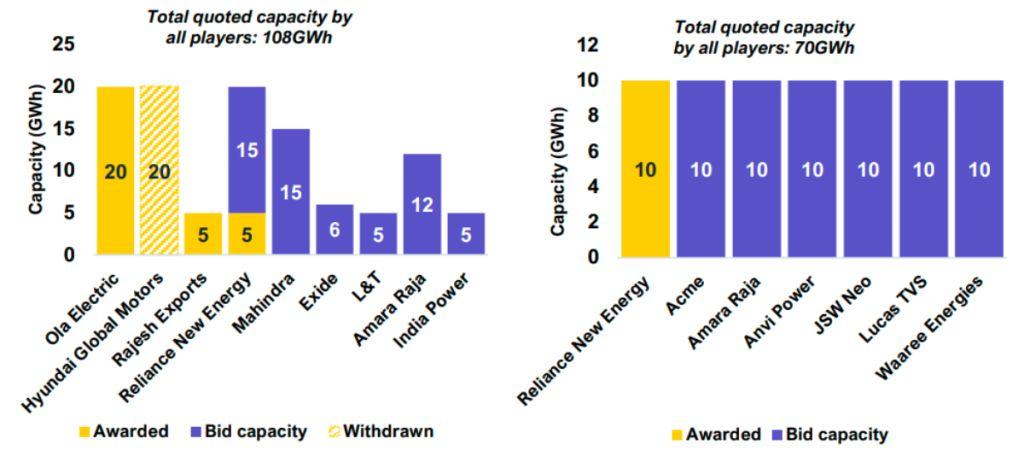
Despite goals to transform India into a global hub for electric vehicle (EV) battery production, the Advanced Chemistry Cell Production Linked Incentive (ACC PLI) scheme is facing significant headwinds. According to a new joint report by JMK Research & Analytics and the Institute for Energy Economics and Financial Analysis (IEEFA), only 2.8 percent (1.4 GWh) of the targeted 50 GWh capacity has been commissioned as of October 2025.
The Commissioning Gap: Expectations vs. Reality
Launched in October 2021 with an outlay of INR 181 billion (USD 2.08 billion), the ACC PLI scheme was designed to slash India’s near-100 percent dependence on imported lithium-ion cells, primarily from China.
The primary goal was to establish 50 GWh of domestic manufacturing capacity by 2025. However, the report reveals a stark reality:
Capacity Delivered: Only 1.4 GWh commissioned (all by Ola Electric).
Job Creation: 1,118 jobs generated against a target of 1.03 million (0.12 percent achievement).
Investment: INR 28.7 billion (USD 330 million) committed, just 25.58 percent of the targeted INR 112.5 billion.
Bottlenecks and Technical Hurdles
The report, titled ‘Assessing India’s incentive scheme to enhance the battery manufacturing ecosystem’, identifies several critical issues that have slowed progress.
“Although strong policy support led to substantial investment plans, on-ground progress remained sluggish,” says Prabhakar Sharma, Senior Consultant at JMK Research. One of the primary criticisms is the evaluation framework used to select beneficiaries.
The criteria heavily prioritized Domestic Value Addition (DVA) and aggressive subsidy benchmarks. This resulted in the selection of new entrants who lacked prior expertise in battery manufacturing, while established domestic players like Exide Industries and Amara Raja—who had the technical background—failed to qualify in the initial rounds.
Current Status of Major Beneficiaries
The landscape for the scheme’s winners remains mixed:
Ola Electric: While being the only company to commission capacity so far, it has significantly scaled back its ambitions. Originally planning for 20 GWh, the firm now aims for only 5 GWh by FY2029.
Reliance New Energy: Reporting “on-time” status for its 10 GWh allocation from the second auction round, though its initial 5 GWh allocation from the first round remains delayed.
Incentive Disbursement: As of October 2025, zero incentives have been disbursed to manufacturers from the targeted INR 29 billion.
The Path Forward: A Multi-Pronged Strategy
To salvage the scheme’s objectives and reduce reliance on imports, the IEEFA and JMK Research report suggests a holistic shift in strategy.
“Improving the effectiveness of ACC PLI will require introducing robust cell testing and certification infrastructure, scaling up equipment manufacturing, and developing skilled domestic talent,” notes co-author Saif Jahangir, Consultant at JMK Research.
For India to meet its 2030 EV targets, the government may need to reconsider its penalty structures — currently set at 0.1 percent of performance security for each day of delay — and focus on fostering a more mature ecosystem that includes recycling and domestic equipment supply chains.
BABURAJAN KIZHAKEDATH