


The financial result of General Motors indicated that the auto giant is recalibrating its electric vehicle (EV) business as it balances long-term electrification ambitions with near-term market realities.
In full-year 2025, GM reported net income of $2.7 billion and EBIT-adjusted of $12.7 billion, while the fourth quarter posted a net loss of $3.3 billion despite EBIT-adjusted earnings of $2.8 billion. The quarterly loss was largely driven by major EV-related charges as the automaker moved to right-size capacity and investments amid softer-than-expected EV demand and changes in U.S. government policy.
EV capacity realignment weighs on Q4 results
GM said Q4 results were reduced by more than $7.2 billion in special charges, primarily linked to the realignment of electric vehicle capacity and investments. These actions followed the termination of certain consumer EV incentives in the United States and a reduction in the stringency of emissions regulations, both of which have altered near-term demand dynamics for electric vehicles.
In Q3 2025, GM recorded $1.6 billion in EV-related charges, including $1.2 billion in non-cash impairment charges tied mainly to transitioning the Orion assembly plant from EV to internal combustion engine production, and $0.4 billion in cash charges related to contract cancellations and supplier settlements.
In Q4 2025, EV-related charges rose to $6.0 billion, comprising $1.8 billion in non-cash impairments, largely driven by the decision to discontinue production of the BrightDrop electric van and impair certain EV assets, along with $4.2 billion in cash charges for contract cancellations and supplier settlements.
GM expects to recognize additional EV-related charges in 2026, but said these will be materially smaller than those recorded in 2025 as restructuring actions take effect.
EV sales momentum
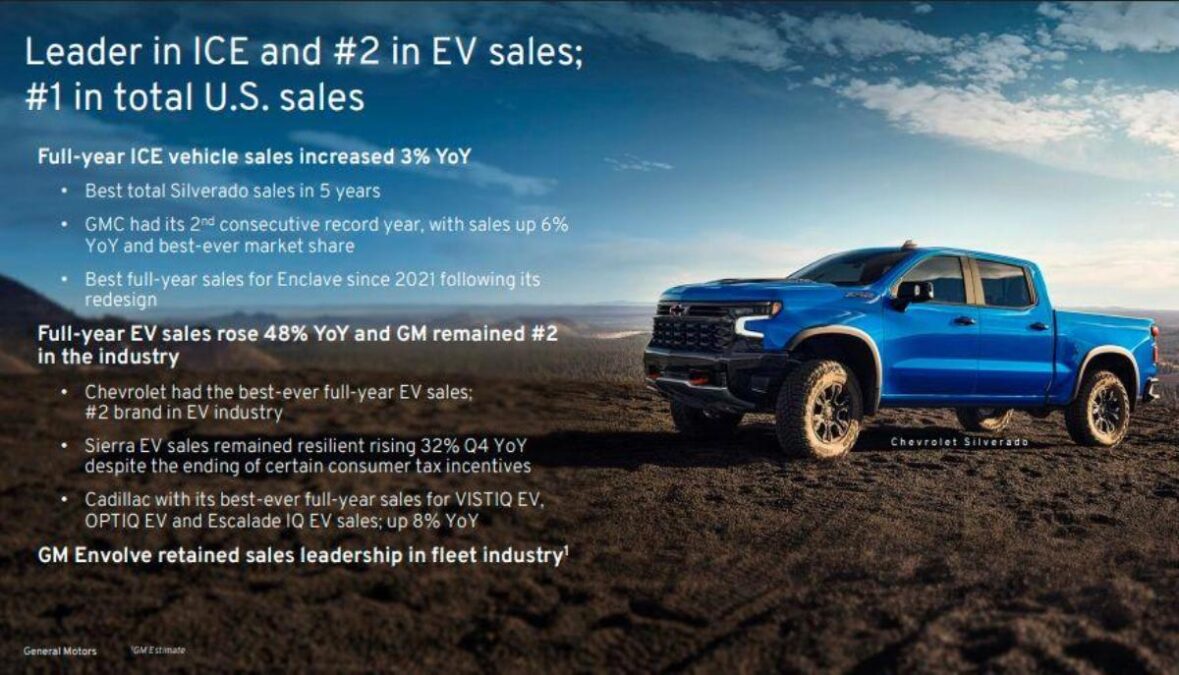
Despite the financial impact of restructuring, GM’s EV sales performance in 2025 remained robust. Full-year EV sales rose 48 percent year over year, enabling GM to retain its position as the number two EV seller in the industry. The company also maintained leadership in internal combustion engine vehicles and ranked number one in total U.S. vehicle sales.
Chevrolet delivered its best-ever full-year EV sales, emerging as the number two EV brand in the industry. GM China’s Sierra EV showed resilience, with sales rising 32 percent in the fourth quarter, even as certain consumer tax incentives ended. Cadillac posted strong results, achieving its best-ever full-year sales for the VISTIQ EV, OPTIQ EV, and Escalade IQ EV, with Cadillac EV sales up 8 percent.
China strategy centers on NEVs and profitability
In China, GM said it is revitalizing operations by right-sizing capacity and accelerating electrification. The company achieved a full year of profitability in the market, with growth in both retail sales and market share. New energy vehicles accounted for more than half of GM’s total sales in China, underscoring the strategic importance of EVs and plug-in hybrids in the region.
EV losses to narrow in 2026
Looking ahead, GM expects its EV losses to improve by $1.0 billion to $1.5 billion in 2026, driven by right-sizing EV capacity, a streamlined manufacturing footprint, and significantly lower volumes aligned with demand. The company’s 2026 financial guidance includes anticipated capital spending of $10.0 billion to $12.0 billion, inclusive of investments in battery cell manufacturing joint ventures.
GM also confirmed that its second-generation software-defined vehicle architecture, designed to support both ICE vehicles and EVs, will debut in 2028. This platform is expected to improve scalability, reduce complexity, and enhance profitability across future electric and conventional vehicle programs.
General Motors’ EV deliveries showed mixed performance in Q4 2025, with growth in some newer models offset by sharp declines in others. Cadillac’s EV portfolio was a key highlight, led by the Escalade IQ EV, which recorded strong growth both quarterly and year-to-date, reflecting rising demand for premium electric SUVs. New Cadillac EV models such as OPTIQ and VISTIQ also contributed meaningfully to overall EV volumes in 2025, marking continued expansion of the brand’s electric lineup.
Chevrolet’s mass-market EVs faced pressure in Q4. Blazer EV and Equinox EV deliveries declined sharply on a quarterly basis, though Equinox EV posted strong year-over-year growth, indicating improving traction over the full year despite short-term volatility. Silverado EV deliveries declined sequentially in Q4 but increased significantly on a full-year basis, highlighting gradual adoption in the electric pickup segment.
GMC’s EV performance was mixed. HUMMER EV deliveries fell in Q4 but remained higher year over year, while Sierra EV recorded strong growth both quarterly and annually, supported by expanding availability and rising interest in electric trucks. GM’s commercial EV business also gained momentum, with BrightDrop electric van deliveries rising sharply in both Q4 and full-year 2025, underscoring increasing fleet adoption of electric delivery vehicles
GM’s EV results in 2025 reflect a transition phase, with newer models and commercial EVs driving growth, while some earlier launches experienced demand and delivery fluctuations.
BABURAJAN KIZHAKEDATH