


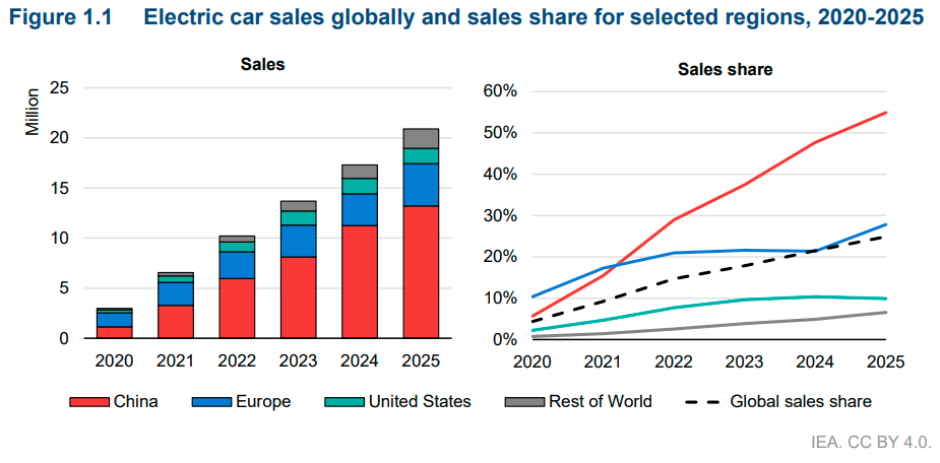
The global electric vehicle (EV) industry entered a historic expansion phase in 2025, with worldwide electric car sales surging 20 percent to exceed 20 million units, representing one-quarter of all new cars sold globally, according to the latest International Energy Agency Global EV Outlook 2026 report.
The report highlights how governments, automakers, battery manufacturers, and technology companies are accelerating investments in electric mobility, charging infrastructure, battery production, software, and artificial intelligence as EVs reshape the global automotive and energy sectors.
1. Global EV Sales Cross 20 Million for First Time
Global electric car sales surpassed 20 million units in 2025 after growing 20 percent year-on-year. Electric vehicles accounted for 25 percent of all new cars sold worldwide, marking the fifth consecutive year of annual sales growth of roughly 3.5 million vehicles.
The global EV fleet now represents around 5 percent of the world’s total car stock and displaced approximately 1.2 million barrels of oil per day in 2025.
2. China Dominates EV Market With 13 Million Sales
China remained the world’s largest EV market in 2025, selling more than 13 million electric cars and accounting for six out of every ten EVs sold globally. EVs represented nearly 55 percent of all new car sales in China.
The number of electric vehicles on Chinese roads reached an estimated 44 million units by the end of 2025, representing approximately 13 percent of the country’s total vehicle fleet.
China’s aggressive consumer incentive program offered subsidies of CNY 20,000 ($2,750) for buyers replacing older vehicles with electric cars and attracted 11.5 million applications in 2025. Nearly 60 percent of applications by November were for new energy vehicles.
3. Europe Emerges as Fastest-Growing Major EV Region
Europe recorded the strongest growth among major EV markets in 2025. Electric vehicle sales in Europe rose more than 30 percent to 4.2 million units, representing 28 percent of all new vehicle sales.
Within the European Union, EV sales approached 3 million units, while 24 out of 27 EU member states increased their EV sales shares. Germany alone sold a record 850,000 electric cars after a 50 percent annual increase.
The United Kingdom saw electric cars account for more than one-third of new vehicle sales in 2025, while Norway maintained global leadership with EVs representing 97 percent of all new car sales.
4. Southeast Asia Becomes Major EV Growth Engine
Southeast Asia emerged as one of the fastest-growing EV markets globally, with electric car sales more than doubling in 2025 to exceed half a million vehicles. EVs represented nearly 20 percent of all new car sales in the region.
Vietnam became Southeast Asia’s largest EV market after sales more than doubled, with electric vehicles accounting for nearly 40 percent of all new car sales. Domestic EV manufacturer VinFast dominated the market through affordable EV models such as the VF3 and VF5.
Thailand’s EV sales jumped 70 percent to approximately 140,000 units, while Indonesia’s EV sales more than doubled to capture 15 percent of new vehicle sales.
5. Latin America Records 75 Percent EV Growth
Electric car sales in Latin America increased 75 percent in 2025 to exceed 350,000 vehicles. Brazil and Mexico accounted for more than 75 percent of the region’s sales growth.
Brazil alone sold 180,000 electric cars, with EVs accounting for 9 percent of all new car sales. Nearly 85 percent of EVs sold in Brazil were made in China.
Chinese EV giant BYD expanded local production in Brazil, while Great Wall Motors also increased manufacturing operations in the country.
6. Global EV Fleet Could Reach 510 Million by 2035
The IEA projects the global EV fleet could increase more than sixfold from 2025 levels to reach 510 million vehicles by 2035, excluding electric two- and three-wheelers.
Electric vehicles are expected to account for around 50 percent of global car sales by 2035 under current and stated policy scenarios. In China, EVs could exceed 90 percent of total car sales by 2035.
7. EV Investments Accelerate in Battery Manufacturing
China continued dominating global battery manufacturing investments in 2025, accounting for more than 80 percent of global battery cell production.
Nearly all battery cells used globally are supplied by companies headquartered in China, Korea, or Japan. Chinese battery producers rapidly increased market share in Europe after almost doubling their presence since 2023.
Chinese battery giant CATL alone supplied 80 percent of electric truck batteries used in China.
8. Electric Truck Sales Double Globally
Global electric truck sales more than doubled in 2025 and accounted for 9 percent of all truck sales worldwide. China led the expansion, where one in four trucks sold was electric.
The European Union expanded charging infrastructure investments and now operates more than 1,000 charging points dedicated exclusively to electric trucks.
Electric trucks are projected to account for at least 20 percent of global truck sales by 2035, with China expected to achieve a 60 percent market share for electric trucks.
9. AI and Software Investments Reshape Automotive Industry
The EV industry is becoming increasingly software-driven, with automakers investing heavily in artificial intelligence, software-defined vehicles, autonomous driving systems, and connected car platforms.
Battery electric vehicles are leading adoption of centralized software systems that support remote updates, advanced driver assistance systems, automated steering, speed control, and AI-powered battery management technologies.
Driverless electric taxis are already operating commercially in more than 20 cities, primarily in China and the United States.
10. Charging Infrastructure and Energy Investments Expand Rapidly
The EV charging ecosystem is undergoing major infrastructure investment worldwide. Ultra-fast charging technologies, including 1,000-volt EV architectures introduced in 2025, are reducing charging times to under 10 minutes.
The IEA forecasts electricity demand from EVs could exceed 1,500 TWh by 2035, representing nearly sixfold growth from 2025 levels.
Vehicle-to-grid (V2G) technology also began commercial rollout in 2025, enabling EVs to return electricity back to power grids and support energy system flexibility.
BABURAJAN KIZHAKEDATH