


The global EV price war in 2026 is intensifying as BYD, Tesla, Renault, Dacia, Nissan, Citroen and other automakers compete to make electric vehicles affordable for buyers.
China has established the world’s deepest low-cost electric vehicle market. Europe is adding EVs below €30,000, while the US depends heavily on vehicles priced around $30,000-$40,000 and above.
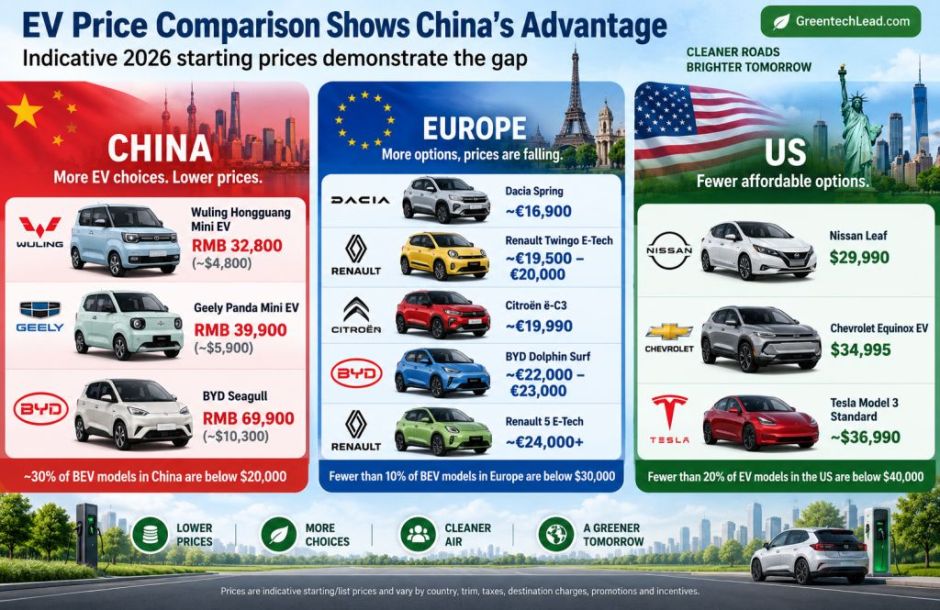
The regional divide is substantial. Around 30 percent of battery-electric vehicle models available in China had entry prices below $20,000 in 2025. In Europe, fewer than 10 percent were below $30,000, while fewer than 20 percent of EV models in the US started below approximately $40,000. The IEA Global EV Outlook 2026 affordability analysis highlights the widening affordability gap between the world’s major EV markets.
BYD Leads China’s Low-Cost EV Revolution
China’s biggest advantage is not simply having the world’s cheapest electric cars. The country has developed an entire ladder of EVs covering entry-level city cars, sedans, crossovers and increasingly sophisticated electric SUVs.
Around 70 percent of BEVs sold in China in 2025 were already cheaper than the average conventional car before incentives. Average Chinese BEV prices also dropped by more than 10 percent during 2025.
BYD illustrates how aggressive Chinese EV pricing has become.
The 2026 BYD Seagull starts at RMB 69,900, or about $10,300, while higher versions reach RMB 85,900. The small EV offers 305 km or 405 km of CLTC range, depending on configuration. BYD has even introduced an optional LiDAR-equipped version starting at RMB 90,900, putting advanced driver-assistance hardware into a remarkably low price bracket.
Wuling competes even lower in the market. The Wuling Hongguang Mini EV starts at around RMB 32,800, equivalent to less than $5,000, while the Geely Panda Mini EV starts at approximately RMB 39,900. The Wuling Bingo starts at about RMB 59,800.
These cars are smaller and generally offer less range and equipment than EVs sold for $30,000-$40,000 in Western markets. Nevertheless, their prices demonstrate the enormous cost advantage Chinese manufacturers have developed.
China Produces Three-Quarters of World’s Electric Cars
Manufacturing scale sits behind China’s price advantage.
China produced nearly three-quarters of the world’s electric cars in 2025 and more than 80 percent of global battery cells. Chinese electric-car exports exceeded 2.5 million vehicles.
China also represented approximately 60 percent of global EV battery deployment, compared with almost 15 percent for the European Union and around 10 percent for the United States.
This scale gives BYD, Geely, SAIC, Wuling and other Chinese manufacturers access to dense supply chains covering batteries, motors, power electronics, displays, semiconductors and vehicle software.
The IEA analysis of EV manufacturing and trade shows how China’s manufacturing position is increasingly shaping global EV competition.
Europe Gets More EVs Below €30,000
Europe remains significantly more expensive than China, but the affordability gap is beginning to narrow.
Fewer than 10 percent of BEV models in Europe were priced below $30,000 in 2025, compared with roughly one-quarter of combustion-engine models. Germany’s average BEV price nevertheless dropped about 6 percent during the year.
The market is changing quickly as Renault, Dacia, Citroën, Fiat, Hyundai and Chinese brands target affordable segments.
Among Europe’s lower-priced electric cars in 2026 are the Dacia Spring from around €16,900, Renault Twingo E-Tech at around €19,500-€20,000, Citroën ë-C3 at around €19,990 for its entry version, BYD Dolphin Surf from roughly €22,000 and Renault 5 E-Tech from around €24,000 depending on market and specification.
The Dacia Spring represents the simplest affordability strategy, offering a relatively small battery and modest range for city and suburban customers.
Citroen is taking a similar approach with the ë-C3. Its entry version combines a 30 kWh LFP battery and around 213 km of WLTP range, while the higher-range version offers a 44 kWh battery and approximately 324 km of range.
Renault is expanding its affordable EV strategy through the Twingo E-Tech and Renault 5 E-Tech, giving the French automaker coverage across multiple price points.
BYD Brings Chinese Price Pressure to Europe
Chinese brands are adding another dimension to Europe’s EV price war.
The BYD Dolphin Surf, the international version of BYD’s compact Seagull family, is available in parts of Europe from roughly €22,000-€23,000 before market-specific incentives and promotions.
Chinese-made electric-car sales in Europe increased almost 50 percent in 2025 to around 940,000 vehicles, increasing pressure on established European automakers.
However, Chinese EVs cannot simply reproduce their domestic prices overseas.
Shipping, homologation, tariffs, VAT, distribution expenses, dealer margins and other regulatory costs substantially increase the final price. European duties on Chinese-made EVs add another barrier.
That explains why a BYD EV costing close to $10,000 in China does not become a €10,000 car in Europe.
The next stage of competition will therefore depend heavily on local manufacturing. Chinese companies that can produce cars and batteries closer to European consumers could potentially reduce some of the cost disadvantages associated with imports.
US Affordable EVs Still Start Around $30,000
The US remains the most difficult of the three major markets for affordable EVs.
Fewer than 20 percent of electric models had a base price below approximately $40,000 in 2025, compared with more than 40 percent of conventional models.
Vehicle size is a major factor. More than 85 percent of EV models available in the US were large cars or SUVs, compared with roughly three-quarters in Europe and China. Bigger vehicles typically require more materials and larger batteries, making it harder to reach mass-market prices.
The 2026 Nissan Leaf starts at $29,990, making Nissan one of the few major manufacturers to break below the $30,000 threshold. The redesigned Leaf can deliver up to 303 miles of EPA-estimated range in the S+ version.
Chevrolet’s 2026 Equinox EV starts at $34,995 and offers an EPA-estimated 319 miles of range with front-wheel drive.
Tesla has also pushed deeper into the lower-priced segment. The Tesla Model 3 Standard is listed around $36,990, while a lower-priced Model Y configuration is around $39,990.
That makes the contrast with China striking: US consumers generally enter the credible long-range EV market around $30,000-$40,000, while Chinese buyers can access multiple electric cars well below $15,000.
Battery Costs Give Chinese EV Makers an Edge
The underlying EV price battle is fundamentally a battery and manufacturing-cost battle.
China’s dominance in battery production gives domestic manufacturers enormous scale advantages. Dense local supply chains also reduce transportation costs and shorten product-development cycles.
The economic cycle is powerful: higher EV volumes increase battery and component production; greater production scale lowers unit costs; lower costs allow automakers to cut vehicle prices; and cheaper EVs stimulate additional demand.
This helps explain why China reached an important milestone in 2025: BEVs achieved price parity with conventional vehicles in China’s SUV segment for the first time.
Europe and the US are investing heavily in local battery and EV manufacturing, but reproducing China’s integrated ecosystem will take time.
Cheapest EV Does Not Always Mean Best Value
China clearly wins on sticker price, but consumers should not judge an electric vehicle on purchase price alone.
Range, battery capacity, charging speed, safety, reliability, interior space, software, warranty, insurance, maintenance and resale value all affect the economic case.
A $5,000 Chinese micro-EV is fundamentally different from a $35,000 Chevrolet Equinox EV with more than 300 miles of EPA-rated range.
The more useful comparison is therefore capability per dollar and total ownership cost, rather than simply identifying the world’s cheapest electric car.
EVs can benefit from lower energy and maintenance expenses over their lifetime. The IEA Global EV Outlook 2026 shows why vehicle prices, energy costs and charging economics are increasingly important to EV competitiveness.
EV Price War Forces Global Automakers to Cut Costs
China’s pricing advantage is already reshaping global automotive strategies.
Honda is targeting more than $9 billion in cost reductions by 2030, while European automakers are redesigning EV platforms, simplifying vehicle architectures and seeking cheaper battery and component sourcing.
Tesla also faces intensifying competition in China. Its China-made EV sales increased 3.6 percent year over year in August 2026, but its share of China’s BEV market had dropped to 6.6 percent in the second quarter, compared with more than 15 percent in 2020.
Automakers increasingly face the same strategic question: how can they lower EV prices without destroying margins?
$20,000 EV Becomes the Next Global Battleground
The $20,000 EV could become one of the automotive industry’s most important competitive thresholds.
China has already moved well below it. Europe is approaching it through cars such as the Dacia Spring, Renault Twingo and Citroen e-C3. The US remains considerably further away, although Nissan’s sub-$30,000 Leaf represents progress.
Reaching $20,000 alone will not guarantee success. Manufacturers must combine affordability with acceptable range, battery durability, charging speed, safety, connectivity and reliability.
That will require smaller platforms, cheaper batteries, fewer components, simplified vehicle architectures, higher manufacturing volumes and increasingly localized supply chains.
China Sets the Global EV Affordability Benchmark
China remains the clear leader in the 2026 global EV affordability race. Around 70 percent of BEVs sold there in 2025 were already cheaper than the average conventional car before incentives, while buyers have access to electric vehicles spanning prices from below $5,000 to premium segments.
Europe is rapidly becoming more competitive as Dacia, Renault, Citroën, BYD and other manufacturers push EV prices toward and below €20,000.
The US remains the most expensive major market at the entry level, although the Nissan Leaf at $29,990 and Chevrolet Equinox EV at $34,995 demonstrate that lower-cost, longer-range EVs are emerging.
The ultimate winner of the EV price war will not necessarily be the company selling the cheapest electric car. It will be the automaker that can combine an affordable purchase price, useful range, attractive features and low ownership costs — while still manufacturing the vehicle profitably.
SHAFANA FAZAL