


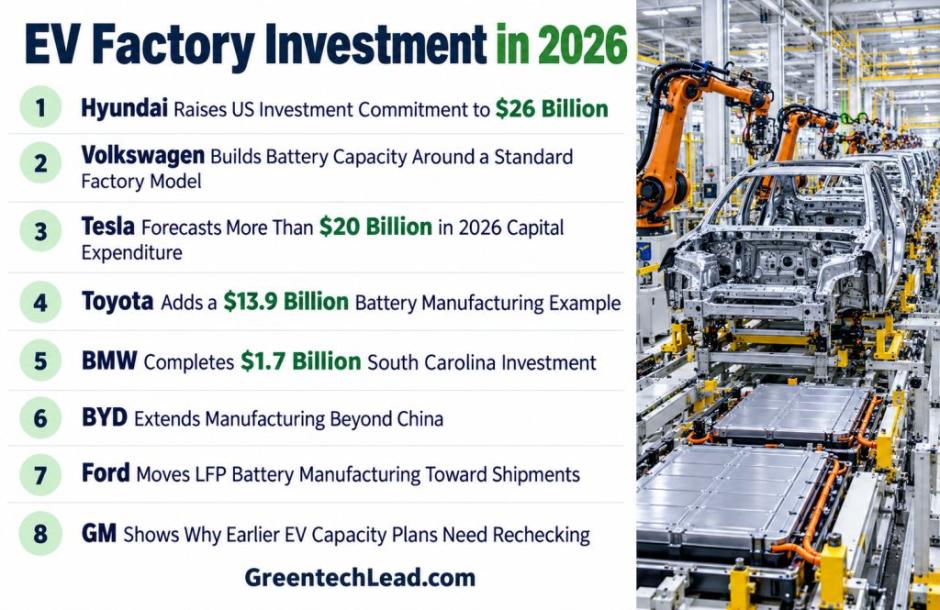
Electric vehicle factory investment is entering a more selective phase in 2026. Automakers are expanding battery production, localizing supply chains and preparing new assembly lines, while adjusting capacity to demand and protecting returns on capital.
Hyundai Motor Group, Volkswagen, Tesla, BYD, BMW, Toyota, Ford and General Motors illustrate different approaches. Some are building dedicated facilities; others are converting existing plants or investing in battery technology that can support several vehicle categories.
Their headline budgets are not directly comparable. A multiyear industrial commitment differs from annual capital expenditure, and battery manufacturing capacity cannot be ranked alongside vehicle assembly capacity without explaining what each figure measures.
Hyundai Raises US Investment Commitment to $26 Billion
Hyundai Motor Group increased its planned US investment from $21 billion to $26 billion for 2025–2028, adding $5 billion to its original commitment.
The Hyundai US investment expansion covers automotive manufacturing, steel, robotics and related activities. The group expects the programme to create approximately 25,000 direct jobs by 2028.
The commitment includes a robotics facility with planned annual capacity of 30,000 units, demonstrating why the full $26 billion should not be described as EV factory spending.
Hyundai’s manufacturing roadmap targets 500,000 vehicles annually at Metaplant America by 2028, covering hybrid and electric vehicles. This is planned capacity rather than actual production.
The strategy combines vehicle assembly with local supply-chain development. Its financial performance will depend on production ramp-up, component localization and sufficient demand to use the expanded facilities.
Volkswagen Builds Battery Capacity Around a Standard Factory Model
Volkswagen’s PowerCo commissioned its Salzgitter battery gigafactory in Germany in December 2025, producing its first unified battery cells.
The PowerCo Salzgitter manufacturing announcement outlines an initial capacity build-up of 20 GWh annually, expandable to 40 GWh.
Volkswagen estimates that 20 GWh could support approximately 250,000 electric vehicles, depending on battery size. This implies roughly 80 kWh per vehicle, although actual requirements vary by model.
Salzgitter serves as the lead plant for subsequent PowerCo facilities in Valencia, Spain, and St. Thomas, Canada, using a standardized factory concept.
Standardization can help transfer manufacturing experience between sites. Nevertheless, commissioning does not mean a plant has reached its rated output. Cell quality, manufacturing yields and production costs must improve during the ramp-up before capacity translates into competitive supply.
Tesla Forecasts More Than $20 Billion in 2026 Capital Expenditure
Tesla reported $8.53 billion in capital expenditure in 2025, compared with $11.34 billion in 2024—a decline of approximately 24.8 percent.
Tesla’s 2025 annual report and capital spending outlook forecast capital expenditure exceeding $20 billion in 2026.
That forecast is more than twice its 2025 spending, but it includes AI computing infrastructure, data centres, manufacturing and research facilities, charging and other assets. It is not an EV assembly investment total.
Tesla’s manufacturing investment should therefore be evaluated separately from its technology ambitions. Expanding output from existing facilities can improve capital efficiency when equipment and floor space are available, while new production lines create additional ramp-up and utilization risks.
Toyota Adds a $13.9 Billion Battery Manufacturing Example
Toyota’s $13.9 billion battery plant in Liberty, North Carolina, is a major addition to the comparison.
In its October 2026 manufacturing update, Toyota said it had announced nearly $20 billion in US facility investment from the start of 2024 through the end of 2025, including the North Carolina project.
The Toyota US manufacturing investment update also described a further multiyear commitment of up to $10 billion tied to future mobility and electrification. These commitments should not be combined into an EV-only factory total.
Toyota’s 2026 product disclosures identify North Carolina and a supplier partner as battery sources for its planned US-assembled electric Highlander.
The example highlights the distinction between battery supply investment and final vehicle assembly. Both are required, but their capacity, ownership and spending timelines differ.
BMW Completes $1.7 Billion South Carolina Investment
BMW confirmed on June 30, 2026, that it had completed a $1.7 billion investment in South Carolina, covering expansion of Plant Spartanburg and construction of Plant Woodruff.
The investment establishes the manufacturing foundation for fully electric vehicles and supporting high-voltage battery operations.
BMW’s iX5 would become its first fully electric vehicle assembled in the United States, with production planned for late 2026. The company aims to assemble at least six fully electric models in the country by 2030.
Spartanburg produced 412,799 BMW X vehicles in 2025, its seventh year above 400,000 units. That figure covers its wider model range rather than EV output.
BMW provides a useful distinction between completed capital investment and future production: the facilities are ready, but electric vehicle output must still ramp up.
BYD Extends Manufacturing Beyond China
BYD’s overseas manufacturing strategy combines its integrated vehicle and battery capabilities with regional production.
Its Thailand plant, inaugurated in July 2024, has stated annual capacity of 150,000 vehicles and was completed in 16 months. The company’s Thailand operations continued to identify that capacity in 2026.
The facility provides a concrete manufacturing benchmark, although its nameplate capacity should not be treated as annual output.
For BYD, overseas factories can shorten distribution routes and support market access. Their competitiveness also depends on local suppliers, workforce development, logistics and sustained regional sales.
Ford Moves LFP Battery Manufacturing Toward Shipments
Ford’s July 2026 update said BlueOval Battery Park Michigan was on track to ship EV batteries during 2026.
The facility’s lithium-iron-phosphate batteries are intended to power Ford’s affordable midsize electric truck, the first vehicle on its Universal EV Platform.
This is a more useful current milestone than relying solely on earlier multibillion-dollar factory announcements. Battery production readiness, shipment timing and vehicle launch schedules help establish whether investment is progressing toward commercial use.
LFP manufacturing also connects factory strategy with affordability: the chemistry and production process influence the battery costs that manufacturers must recover through vehicle pricing.
GM Shows Why Earlier EV Capacity Plans Need Rechecking
General Motors illustrates the risks of treating historical factory announcements as unchanged commitments.
Its $4 billion US manufacturing investment announcement in June 2025 included plans to begin gas-powered full-size SUV and light-duty pickup production at Orion in early 2027.
GM’s Factory ZERO is the dedicated assembly location for its electric pickups and selected electric SUVs. It also projected annual capital spending of $10 billion–$12 billion through 2027, covering the wider business.
The shift means Orion’s earlier electric-truck conversion plan cannot simply be carried forward as current EV capacity. Investment comparisons need to reflect revised product allocations.
Which Automakers Are Investing the Most?
Among these examples, Hyundai stands out for its $26 billion multiyear US industrial commitment, Toyota for its $13.9 billion battery plant, and Tesla for its forecast of more than $20 billion in annual capital expenditure. These figures describe different scopes and periods, so they do not establish an EV-factory spending ranking.
Volkswagen offers a measurable battery-capacity expansion, BMW demonstrates completed investment, and BYD provides an overseas vehicle-production benchmark. Ford and GM show how manufacturing plans evolve with technology and demand.
The strongest comparison tracks EV-specific spending, commissioned capacity, actual output and utilization. Ultimately, factory investment delivers value when it produces competitive vehicles and batteries at sustainable costs — not simply when a large budget is announced.
SHAFANA FAZAL