


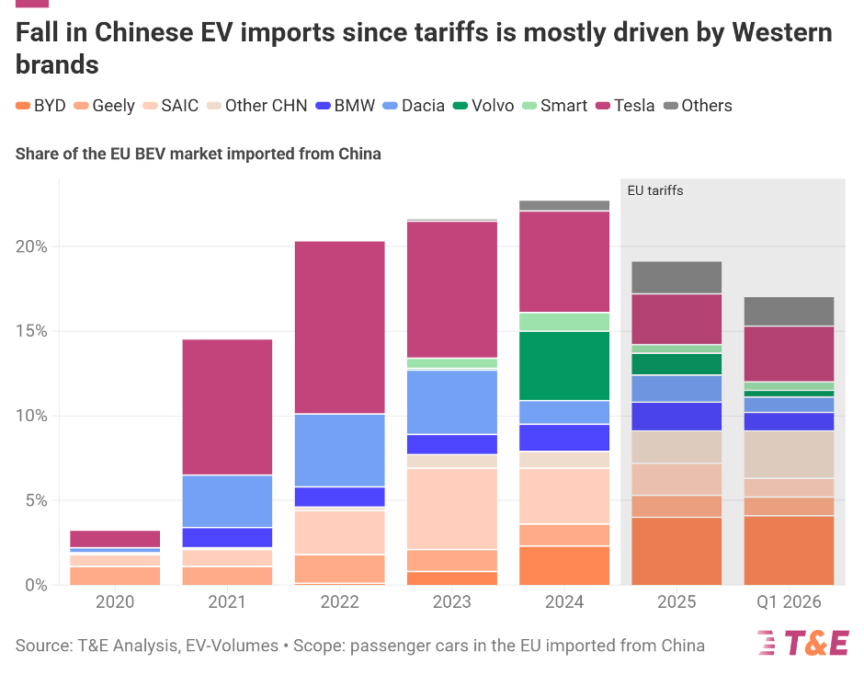
The European Union’s tariffs on Chinese-made electric vehicles have reduced the market share of battery electric vehicles (BEVs) manufactured in China, but Chinese automakers continue to expand their presence in Europe while battery imports from China accelerate, according to new analysis by Transport & Environment (T&E). The report warns that Europe risks becoming a dumping ground for Chinese EVs unless additional trade measures, including tariffs on Chinese batteries, are introduced.
According to T&E report, electric cars produced in China accounted for 17 percent of the EU battery electric vehicle market in the first quarter of 2026, down from a peak of 22 percent in 2024, when the EU introduced tariffs on Chinese EV imports. The decline was driven mainly by Western automakers such as Tesla, BMW, and Volvo, which shifted production from China to European factories.
European manufacturers’ share of Chinese-made BEV imports fell from 38 percent in 2024 to 23 percent in the first quarter of 2026, while Tesla’s share declined from 26 percent to 19 percent. At the same time, Chinese automakers now account for more than half of all Chinese-built BEV imports into the European Union.
The report highlights that tariff levels have produced different outcomes for Chinese manufacturers. SAIC, which faces a 35 percent tariff, saw its BEV imports into Europe almost halve between 2023 and 2025. In contrast, BYD, subject to a 17 percent tariff, more than doubled its battery electric vehicle imports into the EU over the same period. Despite these trade barriers, BEVs from Chinese brands remain 21 percent cheaper than comparable European-made electric vehicles.
Chinese EV manufacturers are also accelerating local production in Europe. Since the European Commission launched its anti-subsidy investigation in September 2023, Chinese companies have announced plans for 10 production facilities across Europe. At the same time, manufacturers have shifted more aggressively into plug-in hybrid electric vehicles (PHEVs), increasing their share of the EU PHEV market to 13 percent, up sharply from 3 percent in 2024.
The battery supply chain remains another major concern for Europe. Chinese battery imports into the EU increased seven-fold between 2020 and 2025, while European manufacturers account for less than one-quarter of battery production within the EU. T&E estimates that imposing a 20 percent tariff on Chinese batteries would raise the average price of EU-manufactured battery electric vehicles by only 2.8 percent, while strengthening the competitiveness of Europe’s domestic battery industry.
The analysis also warns that weaker European Union carbon dioxide targets for passenger cars could strengthen Chinese automakers further. Under proposals to relax the EU’s vehicle emissions targets, Chinese brands could capture 30 percent of the European EV market by 2035, compared with 15 percent under the European Commission’s current proposal.
Transport & Environment said the EU’s tariffs have encouraged Western manufacturers to relocate production to Europe and prompted Chinese companies to establish local manufacturing. However, the organization argues that Europe must combine stronger trade protection with industrial policies, including support for domestic battery production and maintaining the 2030 and 2035 vehicle CO2 targets, to secure the long-term competitiveness of its electric vehicle industry.
Chinese electric vehicle manufacturers are rapidly expanding across Europe by combining competitive pricing, advanced EV technology and local manufacturing investments. The leading players include BYD, Geely, SAIC (MG), Chery and Leapmotor, which together have become major competitors to established European brands.
BYD is the fastest-growing Chinese EV brand in Europe and the world’s largest electric vehicle manufacturer. Between January and April 2026, BYD accounted for 2.2 percent of total new car registrations across the EU, UK and EFTA markets. The company is investing heavily in local production, with its first European factory in Hungary expected to begin production in late 2026 and plans to manufacture all vehicles sold in Europe locally by 2028. BYD serves both retail and fleet customers with models such as the Dolphin, Seal and Atto 3.
Geely is currently the largest Chinese automotive group in Europe, supported by brands including Volvo, Polestar, Lynk & Co and Zeekr. It accounted for 2.5 percent of new vehicle registrations in Europe during the first four months of 2026. Geely has expanded its manufacturing footprint by acquiring part of a former Ford facility in Spain, strengthening local production for European consumers and fleet buyers.
SAIC Motor, primarily through its MG brand, remains one of Europe’s largest Chinese EV suppliers with a 2.4 percent market share. Despite facing the EU’s highest EV tariff of 35 percent, SAIC is planning a manufacturing facility in Galicia, Spain, to localize production. MG has built a broad customer base among value-conscious private buyers and fleet operators across the UK and continental Europe.
Chery has expanded rapidly in Europe through its Omoda and Jaecoo brands, reaching about 2 percent market share in early 2026. The company is investing in local production through a joint venture with Spanish automaker EBRO in Barcelona, enabling assembly of vehicles within Europe. Chery targets mainstream SUV buyers and is expanding its dealer network across key European markets.
Leapmotor has accelerated its European presence through its strategic partnership with Stellantis, which provides manufacturing, distribution and dealership access across the continent. The partnership enables Leapmotor to reach a broad customer base without building a standalone sales network, focusing on affordable battery electric vehicles for mass-market buyers.
SHAFANA FAZAL