


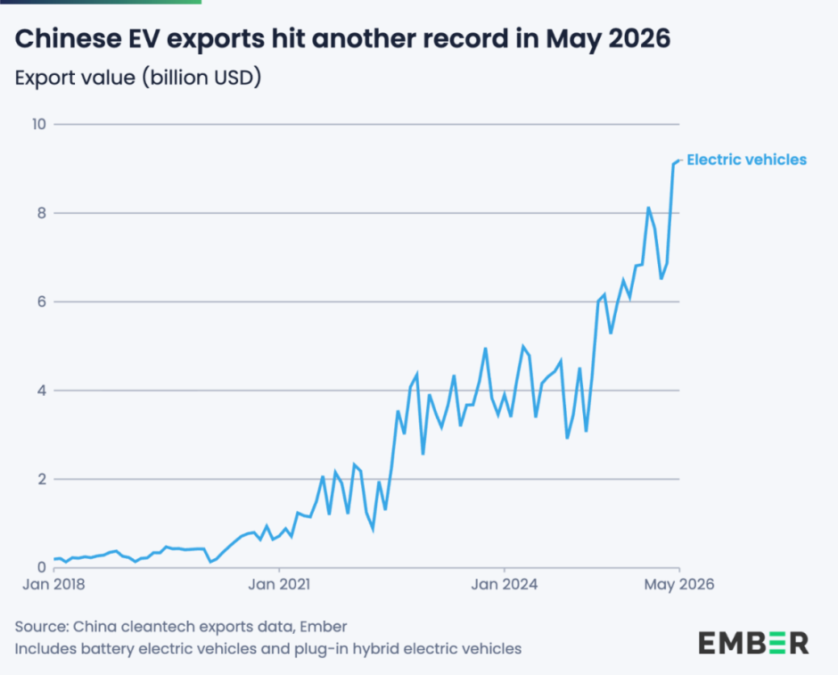
China’s electric vehicle (EV) exports climbed to a record $9.2 billion in May 2026, marking a 49 percent year-on-year increase and surpassing the previous monthly record of $9.1 billion set in April 2026. The latest data from Ember highlights China’s growing dominance in the global EV market and the accelerating adoption of electric mobility across Asia.
China exported approximately 448,000 electric passenger vehicles in May, including 279,000 battery-electric vehicles (BEVs) and 169,000 plug-in hybrid electric vehicles (PHEVs). The growth is particularly notable considering that EV exports generated less than $1 billion per month in 2020, demonstrating the remarkable expansion of China’s automotive export sector.
Southeast Asia emerged as a major growth engine, with Chinese EV exports to the region reaching an all-time high of $1.2 billion in May 2026. Thailand led the surge, importing a record more than 36,000 Chinese electric vehicles, while shipments to the Philippines exceeded 33,000 units.


Smaller ASEAN markets are also accelerating EV adoption. Both Lao PDR and Cambodia achieved record monthly import volumes, supported by government incentives, charging infrastructure investments, and local assembly initiatives. Cambodia significantly boosted EV adoption by cutting customs duties on battery-electric vehicles to zero percent and reducing tariffs on plug-in hybrids to 7 percent from 35 percent in late March, the report said.
Lao PDR has introduced several measures to encourage electrification, including reduced EV registration and service fees and a requirement that transport companies ensure EVs account for 10 percent of their fleets by the end of 2026. In May, the country also imposed a temporary ban on petrol car imports through the end of the year to reduce reliance on imported fossil fuels.
According to Ember analysts, volatility in global fuel markets and rising fuel prices have strengthened the economic case for EV adoption across ASEAN countries. Electrification is increasingly viewed as a strategy to improve energy security, reduce fuel import dependence, and lower long-term transportation costs.
The record-breaking performance underscores a broader regional shift toward clean transportation. As Southeast Asia becomes one of the world’s fastest-growing EV markets, China’s manufacturers are rapidly expanding their presence, supplying growing demand at scale and reinforcing the country’s leadership in global electric vehicle exports.
BABURAJAN KIZHAKEDATH