


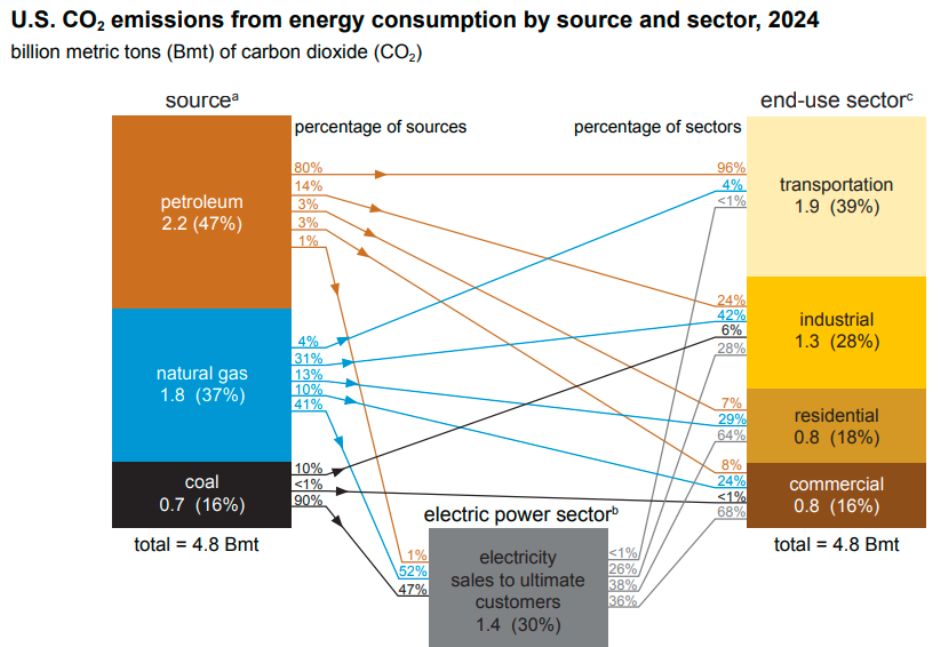
US carbon dioxide emissions from energy consumption totaled about 4.8 billion metric tons in 2024, highlighting the continued dominance of fossil fuels in the country’s energy mix.
Data for 2024 show that petroleum, natural gas, and coal together accounted for nearly all energy related CO2 emissions, with transportation and power generation remaining the largest end use sectors, according to EIA report.
Petroleum Leads US Energy Related CO2 Emissions
Petroleum was the single largest source of CO2 emissions in the United States in 2024, generating around 2.2 billion metric tons, or 47 percent of total emissions from energy consumption. The transportation sector was by far the biggest contributor to petroleum related emissions, accounting for about 96 percent of petroleum use.
Transportation emissions reached approximately 1.9 billion metric tons of CO2, representing 39 percent of total US energy related emissions. This reflects the continued reliance on gasoline, diesel, and jet fuel across road, air, and freight transport, despite growing adoption of electric vehicles.
Natural Gas and Power Generation Play a Major Role
Natural gas was the second largest source of US CO2 emissions, contributing about 1.8 billion metric tons, or 37 percent of the total. Natural gas emissions were spread across multiple sectors, including electric power generation, industrial activity, residential heating, and commercial buildings.
The electric power sector accounted for around 1.4 billion metric tons of CO2 emissions, equivalent to 30 percent of total US energy related emissions in 2024. A large share of these emissions came from natural gas fired power plants, which continue to replace coal but still represent a significant source of carbon emissions.
Coal Use Declines but Remains Significant
Coal contributed approximately 0.7 billion metric tons of CO2 emissions in 2024, or 16 percent of the total. Although coal use in the United States has declined sharply over the past decade, it remains heavily concentrated in the power sector, where it accounted for roughly 90 percent of coal related emissions.
Electricity generation remains the primary channel through which coal contributes to US carbon emissions, even as renewable energy continues to expand its share of the power mix.
Industrial, Residential, and Commercial Emissions
The industrial sector produced about 1.3 billion metric tons of CO2 in 2024, accounting for 28 percent of total energy related emissions. These emissions were driven by a mix of natural gas, petroleum, and electricity use in manufacturing, refining, and heavy industry.
Residential emissions totaled around 0.8 billion metric tons, or 18 percent of the total, largely linked to natural gas and electricity consumption for space heating, cooking, and appliances. The commercial sector contributed a similar level at about 0.8 billion metric tons, or 16 percent, reflecting emissions from offices, retail spaces, and public buildings.
Key Takeaways for US Climate Policy
The 2024 data underline that transportation and power generation remain central to reducing US CO2 emissions from energy consumption. Petroleum dominated emissions through its near total control of the transportation sector, while natural gas played a critical role across electricity, industry, and buildings.
Reducing emissions further will depend on accelerating vehicle electrification, expanding clean electricity generation, improving energy efficiency in buildings, and cutting fossil fuel use across industrial processes. Without deeper structural changes, US energy related CO2 emissions are likely to remain anchored near current levels in the near term.
BABURAJAN KIZHAKEDATH