


The United Nations Environment Programme (UNEP) has warned that the world can no longer avoid exceeding the Paris Agreement’s 1.5°C global warming threshold, making faster greenhouse gas emissions reductions essential to limit climate damage and bring temperatures back down by the end of the century.
The UNEP Emissions Gap Report 2026, titled The Point of Return, highlights a widening challenge between national climate commitments and the emissions reductions needed to control global warming.
The report also identifies progress in renewable energy, electric vehicles and low-carbon technologies. However, fossil fuel dependence, rising electricity demand and insufficient climate policy implementation continue to undermine global decarbonization efforts.
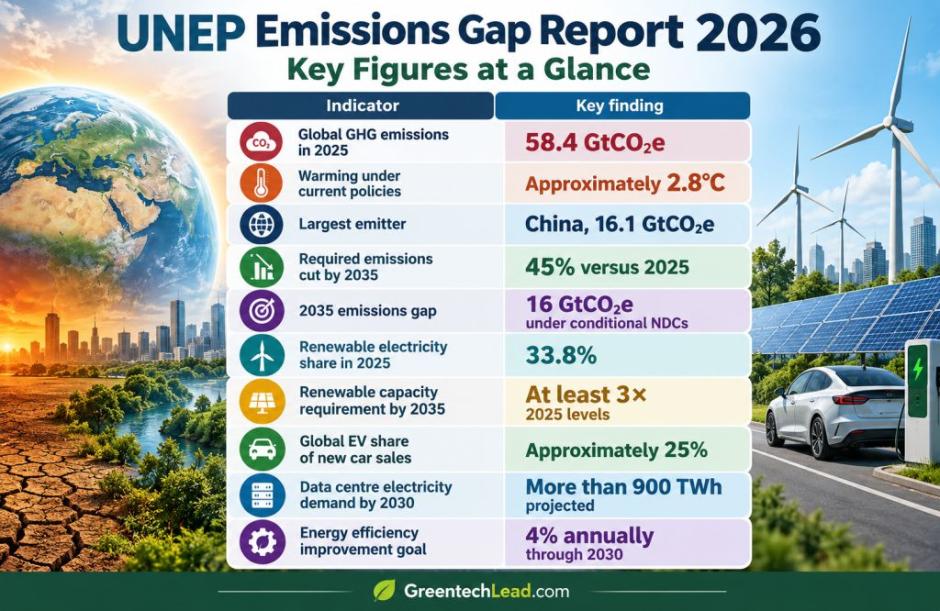
Here are 10 important findings and figures from the report, covering global emissions, major emitting countries, climate commitments, clean energy deployment and future warming risks.
1. Global Greenhouse Gas Emissions Reach 58.4 Billion Tonnes in 2025
Global greenhouse gas emissions were estimated at 58.4 gigatonnes of CO₂ equivalent (GtCO₂e) in 2025, compared with a revised 58.5 GtCO₂e in 2024.
The estimated reduction of approximately 0.16 GtCO₂e was too small, relative to measurement uncertainties, to establish whether global emissions had begun declining.
Key emissions figures for 2025 include:
| Greenhouse gas source | 2025 emissions |
| Total greenhouse gases | 58.4 GtCO₂e |
| Fossil fuel CO₂ | 40.0 GtCO₂ |
| Methane | 9.3 GtCO₂e |
| Land-use change and forestry CO₂ | 4.1 GtCO₂ |
| Nitrous oxide | 3.0 GtCO₂e |
| Fluorinated gases | 2.1 GtCO₂e |
Fossil fuel CO₂ accounted for approximately 68 percent of total emissions. Fluorinated gas emissions increased 8.6 percent, while nitrous oxide emissions rose 1.2 percent.
The findings indicate that global emissions remain near record levels despite increasing investment in clean energy.
2. Global Warming Could Reach 2.8°C Under Current Policies
UNEP estimates that the world’s existing climate policies are consistent with a global warming trajectory of approximately 2.8°C, substantially above the Paris Agreement’s 1.5°C objective.
Before the Paris Agreement, the projected warming trajectory was approximately 4°C. Climate policies and commitments have therefore made a measurable difference, but the remaining gap is substantial.
The report concludes that avoiding any meaningful overshoot of 1.5°C is no longer feasible. It instead examines pathways that could limit peak warming to approximately 1.7–1.8°C and return temperatures to 1.5°C or below by 2100.
This shift makes immediate emissions reductions, rather than reliance on future carbon removal alone, increasingly important.
3. China, United States and India Remain the Largest Emitters
China, the United States and India remain the world’s three largest greenhouse gas emitters.
According to UNEP’s 2025 country-level estimates, excluding land-use change and forestry:
| Country or region | Emissions in 2025 |
| China | 16.1 GtCO₂e |
| United States | 6.0 GtCO₂e |
| India | 4.3 GtCO₂e |
| European Union | 3.1 GtCO₂e |
| Russia | 2.6 GtCO₂e |
| Indonesia | 1.3 GtCO₂e |
The United States recorded the largest absolute annual emissions increase, approximately 133 million tonnes of CO₂ equivalent, driven partly by rising electricity demand and increased coal-fired generation.
India’s emissions growth slowed significantly in 2025. Some datasets indicate a slight decline, although estimates differ.
Per-capita emissions show a different picture. India emitted approximately 3.1 tonnes of CO₂ equivalent per person, compared with 17.6 tonnes in the United States, 11.4 tonnes in China and a global average of 6.6 tonnes.
This distinction is important in international climate negotiations because total emissions, historical responsibility and emissions per person differ substantially.
4. Global Emissions Must Fall 45% by 2035 to Minimize 1.5°C Overshoot
UNEP estimates that limiting the extent and duration of warming above 1.5°C requires rapid emissions reductions relative to 2025 levels.
| Target year | Required emissions reduction |
| 2030 | 18% |
| 2035 | 45% |
| 2040 | 69% |
| Around 2050 | Net-zero CO₂ emissions |
These reductions correspond to UNEP’s lowest feasible 1.5°C overshoot pathways, rather than a scenario that avoids overshoot entirely.
The report estimates that emissions must decline by an average of approximately 5.7 percent annually under these pathways.
Achieving this transition requires faster retirement or decarbonization of fossil fuel infrastructure, greater electrification, renewable electricity deployment and reductions in methane emissions.
5. Global Climate Pledges Leave a 16 Billion Tonne Emissions Gap by 2035
National climate commitments remain insufficient to deliver the reductions needed under the Paris Agreement.
UNEP projects the following global emissions in 2035:
| Climate policy scenario | Projected emissions |
| Existing government policies | 55 GtCO₂e |
| Unconditional national climate pledges | 52 GtCO₂e |
| Conditional national climate pledges | 49 GtCO₂e |
Even full implementation of conditional climate pledges would leave an estimated 16 GtCO₂e gap relative to the lowest 1.5°C overshoot pathway in 2035.
The gap would increase to approximately 22 GtCO₂e if governments continued implementing only existing policies.
As of September 1, 2026, 124 parties had submitted new nationally determined contributions (NDCs), representing approximately 75 percent of global emissions. Nevertheless, the report finds that new pledges have delivered little additional global mitigation ambition.
UNEP’s Emissions Gap Report 2026.pdf
6. Renewable Electricity Overtakes Coal for the First Time
One of the most significant clean energy milestones identified by UNEP is the expansion of renewable electricity generation.
In 2025, renewable power generation surpassed coal-fired electricity globally.
| Electricity source | 2025 generation | Global share |
| Renewable electricity | 10,730 TWh | 33.8% |
| Coal electricity | 10,476 TWh | 33.0% |
Solar and wind power helped avoid approximately 4.1 billion tonnes of CO₂ emissions in 2025, according to estimates cited in the report.
However, the transition remains incomplete. Coal power capacity continues expanding in some markets, with China and India accounting for approximately 95 percent of coal power capacity under construction globally.
UNEP highlights that renewable deployment is increasingly driven by falling technology costs, energy security requirements and industrial competitiveness.
7. Renewable Energy Capacity Must Triple Again by 2035
Despite strong renewable energy growth, UNEP concludes that deployment must accelerate substantially.
Under the lowest 1.5°C overshoot pathways, total renewable electricity capacity must reach at least three times its 2025 level by 2035 and 4.5 times its 2025 level by 2040.
Solar and wind generation must expand even faster.
| Renewable energy indicator | 2035 target | 2040 target |
| Total renewable power capacity versus 2025 | At least 3× | At least 4.5× |
| Solar and wind generation versus 2025 | At least 3× | At least 5.5× |
| Solar and wind share of electricity | Nearly 47% | 63% |
By 2050, solar and wind would need to supply approximately 81 percent of global electricity in these pathways.
These requirements indicate significant opportunities for solar manufacturers, wind turbine suppliers, battery storage developers, transmission infrastructure companies and renewable energy investors.
UNEP’s Emissions Gap Report 2026.pdf
8. Electric Vehicles Account for 25% of Global New Car Sales
Electric vehicle adoption continues expanding, although transport emissions have not yet started declining globally.
UNEP reports that battery-electric and plug-in hybrid vehicles represented approximately one-quarter of worldwide new car sales in 2025.
| Market | EV share of new car sales, 2025 |
| Nepal | 68% |
| China | 55% |
| Vietnam | 41% |
| European Union | 28% |
| Global | Approximately 25% |
Transport accounts for approximately 16 percent of global direct greenhouse gas emissions.
Despite growing EV adoption, transport sector emissions increased by approximately 0.6 GtCO₂e over the decade to 2025.
The findings suggest that accelerating electric car adoption must be accompanied by electrification of buses, trucks, two-wheelers and other transport systems.
9. AI Data Centres Could Consume More Than 900 TWh of Electricity by 2030
The UNEP report identifies growing electricity consumption from artificial intelligence and data centres as an emerging challenge for global decarbonization.
Data centres currently account for less than 1 percent of global greenhouse gas emissions, with their emissions included in the electricity sector.
However, global data centre electricity consumption could more than double to exceed 900 terawatt-hours annually by 2030, depending on infrastructure expansion and mitigation strategies.
The expansion of AI computing creates additional demand for electricity generation, grid infrastructure, cooling technologies and energy-efficient semiconductor systems.
For technology companies and data centre operators, the report highlights the importance of securing low-carbon electricity supplies and improving infrastructure efficiency.
The broader electricity sector remains a major source of greenhouse gas emissions, accounting for approximately one-quarter of the global total.
10. Energy Efficiency Must Improve 4% Annually as Fossil Fuel Dependence Persists
Energy efficiency is another important component of the emissions reduction strategy.
Countries have agreed to double the global average rate of energy efficiency improvement by 2030.
This requires increasing annual energy intensity improvements from approximately 2 percent in 2022 to 4 percent annually through 2030.
UNEP’s lowest 1.5°C overshoot pathways require further reductions in primary energy intensity relative to 2025:
| Year | Required reduction in energy intensity |
| 2035 | At least 30% |
| 2040 | At least 40% |
| 2050 | 55% |
The report identifies electric vehicles, heat pumps, industrial electrification and other efficient technologies as important contributors. Meanwhile, fossil fuels accounted for approximately 71 percent of average global greenhouse gas emissions during 2015–2024, demonstrating the scale of the energy transition still required.
The UNEP Emissions Gap Report 2026 presents two contrasting developments: renewable energy and electric vehicle technologies are expanding rapidly, but global greenhouse gas emissions remain close to historic highs.
For the global energy industry, the findings reinforce the importance of accelerating solar and wind installations, battery storage deployment, grid modernization, industrial electrification and energy efficiency investments.
The report’s central message is that delayed emissions reductions increase the scale, cost and complexity of future climate action, while faster deployment of available clean technologies can still reduce peak warming and shorten the period above 1.5°C.
BABURAJAN KIZHAKEDATH