


Offshore carbon capture and storage (CCS) is emerging as a key technology in global decarbonization strategies, but a new report from the Institute for Energy Economics and Financial Analysis (IEEFA) warns that industry ambitions are advancing far faster than current capabilities. Prepared by Energy Finance Analyst Anika Juhn, the report highlights the significant financial, technical, and environmental challenges facing large-scale offshore CCS projects. While governments and energy companies increasingly view carbon storage as essential for achieving Net Zero emissions, the analysis concludes that today’s operational experience remains insufficient to support the industry’s aggressive expansion plans.
Offshore Carbon Storage Targets Require Nearly 40-Fold Capacity Expansion
Major energy companies, including ExxonMobil, Chevron, and Repsol, have leased nearly 2,400 square miles of subsea acreage across Texas state waters and the Outer Continental Shelf to develop one of the world’s largest offshore carbon transport and storage networks.
These projects are designed to permanently store up to 140 million metric tons of carbon dioxide annually. However, global offshore carbon injection capacity reached only 3.6 million metric tons per year in 2024, meaning the proposed projects would require nearly a 40-fold increase in worldwide operational capacity.
The report also notes that existing CCS facilities generally inject around 1 million metric tons of carbon dioxide annually into individual onshore reservoirs, highlighting the engineering challenge of developing interconnected offshore mega-storage hubs.
Long-Term Carbon Storage Remains a Critical Challenge
According to IEEFA, capturing carbon dioxide is only one part of the CCS process. The long-term effectiveness of offshore storage depends on ensuring that injected carbon remains securely trapped beneath geological formations.
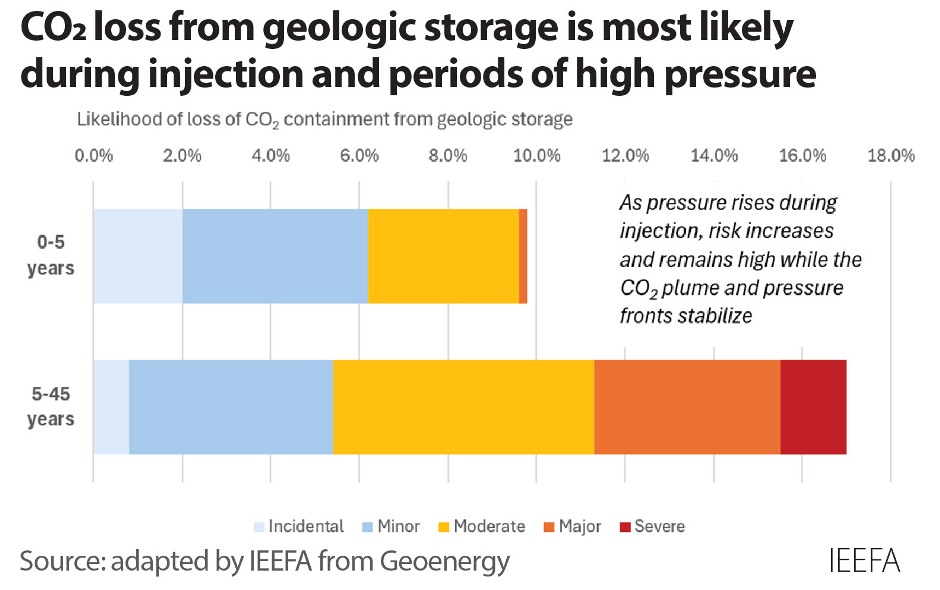
The report states that offshore CCS projects must safely manage carbon injection and reservoir stabilization for at least 50 years, while ensuring stored carbon remains securely contained for hundreds of years after injection. Achieving this will require continuous monitoring, advanced reservoir modeling, and rigorous geological verification throughout the life of every project.
Without permanent containment, the climate benefits of carbon capture could be substantially reduced.
Offshore CCS Depends on Hundreds of Billions in Public Support
IEEFA highlights that current offshore CCS economics remain heavily dependent on government incentives, particularly the U.S. federal 45Q tax credit, which rewards companies for permanently storing captured carbon dioxide.
Based on existing policies, achieving the proposed offshore storage capacity would require approximately $133 billion in cumulative federal support by 2050.
If industry proposals to extend the tax credit period to 30 years are approved, cumulative taxpayer support could increase to around $227 billion by 2050.
Across the full operational life of major offshore storage projects through 2069, government incentives could total approximately $416 billion, raising concerns about the long-term financial sustainability of commercial-scale CCS deployment.
Offshore Storage Carries Higher Environmental Risks
The report emphasizes that offshore carbon storage presents unique environmental and operational risks compared with onshore projects.
According to Anika Juhn, identifying and managing carbon dioxide leaks beneath the seabed is significantly more complex than monitoring onshore reservoirs. Limited operational experience with offshore CCS also creates uncertainty regarding long-term containment performance, potentially increasing future environmental risks and financial liabilities for both project developers and governments.
IEEFA argues that stronger monitoring technologies and broader real-world operating experience will be essential before offshore CCS can be deployed confidently at commercial scale.
Europe Expands Shared Carbon Storage Infrastructure
While the United States is relying heavily on tax-supported storage hubs, Europe is developing shared carbon management infrastructure.
The Northern Lights Consortium, formed by Equinor, Shell, and TotalEnergies, is investing approximately $714 million to expand offshore carbon storage capacity to more than 5 million metric tons annually by 2028.
The project is also creating open-access carbon shipping corridors and certified storage services, enabling industrial companies across Europe to transport captured carbon dioxide for permanent offshore storage.
Meanwhile, BP’s Viking CCS cluster is expected to generate approximately £13 billion ($16.8 billion) in private-sector investment, reinforcing Europe’s leadership in commercial carbon storage infrastructure.
Asia Integrates Carbon Capture With Energy Production
Asian energy companies are pursuing a different strategy by combining carbon storage with hydrocarbon production.
Eni and its partners have approved the $7 billion Tangguh UCC project in Indonesia, which will inject approximately 15 million tonnes of carbon dioxide into active reservoirs for Enhanced Gas Recovery.
The project is expected to unlock approximately 3 trillion cubic feet of additional natural gas while simultaneously storing industrial carbon emissions, creating a commercially driven carbon management model.
India Accelerates Carbon Capture Development
India continues expanding its carbon capture ecosystem as part of its long-term climate strategy.
The country has committed to reducing carbon intensity by 45 percent by 2030 and achieving Net Zero emissions by 2070.
ONGC has committed approximately $12 billion toward its clean energy transition and aims to achieve Net Zero across its Scope 1 and Scope 2 operations by 2038.
Its Gandhar pilot project will inject approximately 100 tonnes of carbon dioxide per day into depleted reservoirs to assess long-term storage performance.
Meanwhile, Carbon Clean is commercializing its CycloneCC modular carbon capture technology, which reduces equipment footprints by approximately 50 percent, making carbon capture systems more practical for industrial facilities and offshore platforms where space is limited.
Offshore CCS Must Demonstrate Commercial and Environmental Viability
The IEEFA report concludes that offshore carbon capture and storage could become a critical component of global decarbonization efforts, but only if the industry overcomes significant technological, financial, and environmental barriers. Expanding offshore storage capacity from 3.6 million metric tons today to projects targeting 140 million metric tons annually, while ensuring secure carbon containment for centuries, represents one of the largest infrastructure challenges facing the clean energy transition. As governments continue committing billions of dollars to carbon management, the long-term success of offshore CCS will depend on proven performance, transparent regulation, robust monitoring systems, and sustained public confidence.
SHAFANA FAZAL