


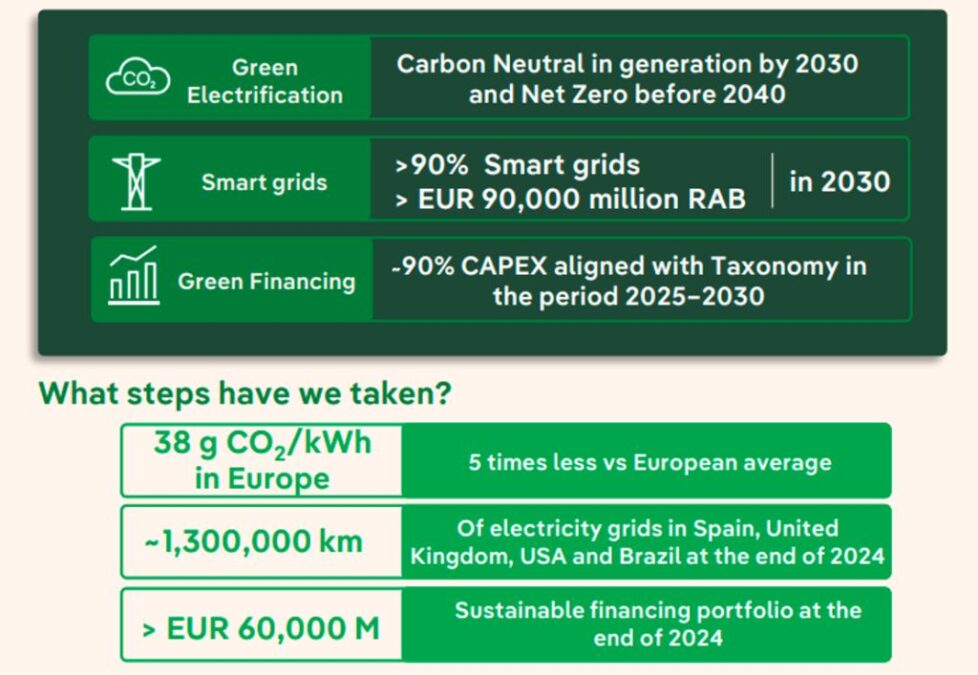
Iberdrola’s Sustainability Targets 2025-2030 has revealed targets that align climate action with long-term business strategy. The plan announced in September 2025 emphasizes decarbonization, electrification, investment, social dividend and governance practices to support a sustainable energy transition.
Strategic Sustainability Goals for 2025-2030
The Sustainability Plan is structured around five core pillars that guide Iberdrola’s environmental and social objectives through 2030:
1. Carbon Neutral and Low-Emission Energy Generation
Achieve carbon neutral electricity generation (<10 g CO2/kWh) by 2030.
Zero pollutant emissions from electricity generation within the same period.
Net zero greenhouse gas emissions across all scopes (1, 2, 3) before 2040.
Expand managed stored energy capacity and smart grid automation to support a flexible, clean energy system.
2. Human and Social Capital Strengthening
Promote equal opportunities, wellbeing and occupational safety programs across all operations.
Extend electrification access programs and contribute meaningfully to society with more than 1,000 verified social initiatives per year.
3. Governance and Ethical Leadership
Maintain a robust governance framework with more than 50 percent independent directors.
Annual compliance system updates and broad stakeholder engagement.
4. Net Positive Environmental Impact
Implement biodiversity plans for around 700 facilities by 2030.
Target 90 percent recycling of wind turbine blades and solar panels by 2030.
Reduce water intensity in energy production by approximately 40 percent.
5. Sustainable Supply Chain and Customer Solutions
Direct more than €50,000 million in sustainable supplier contracts by 2028.
Deploy over 10,000 fast and ultra-fast charging points by 2030.
Improve quality of service and increase digital customer solutions to 75 percent.
Investment Commitments and Achievements
Iberdrola continues to make substantial investments in the energy transition and electrification of the global economy:
The group announced a €58 billion investment plan through 2028, driving grid modernization, electrification and renewable integration.
R&D investment is set at multibillion euros through the period, complementing infrastructure spending and innovation agenda.
Green financing targets aim for over €30,000 million new sustainable financing by 2028 and a portfolio aligned with the European Taxonomy, with roughly 90 percent of organic CAPEX compliant.
Investment to modernize electricity grids not only supports renewable integration but strengthens energy security and customer service performance worldwide. Significant portions of investment are also tied to global electrification trends and grid resilience improvements.
Corporate Recognition and Sustainability Credentials
Iberdrola maintains high rankings in global sustainability indices such as DJSI, MSCI ESG and CDP, reflecting continued progress toward climate and governance targets. The company is regularly recognized for leadership in ethical business practices and sustainable governance.
CO2 Emission Reductions: Targets and Progress
Reducing carbon emissions lies at the core of Iberdrola’s sustainability strategy:
Targets
Net zero greenhouse gas emissions across the value chain by about 2039-2040.
Achieve an absolute reduction of Scope 1, 2 and 3 emissions by 65 percent by 2030 (from 2020 baseline).
Reduce water use intensity in energy production by 40 percent by 2030 (compared with 2025).
Maintain or expand current emission reductions in line with science-based targets.
Achievements
The company’s European operations currently record emission intensities (e.g., 38 to 55 g CO2/kWh) far below regional averages, reflecting successful decarbonization of its generation portfolio.
Strong governance, aligned investment strategies and renewable energy expansion all contribute directly to emission performance that supports global mitigation commitments under the Paris Climate Agreement.
Iberdrola, the global utility major, reported total revenue of €45,547 million for fiscal year, supported by a strategy focused on regulated grid growth and high-value renewable assets.
Net profit reached a record €6,285 million, marking a 12 percent increase. The company maintained a strong procurement ecosystem, with €13,200 million in purchases from global suppliers, supporting more than 500,000 jobs worldwide. Its global workforce expanded to 45,400 employees, reflecting sustained job creation across the clean energy value chain.
Record Capital Expenditure Accelerates Renewable and Grid Expansion
Fiscal 2025 marked the largest investment cycle in Iberdrola’s history, with total capital expenditure reaching €14,460 million. Approximately 62 percent of this investment was directed toward electricity networks, strengthening a regulated asset base that now stands at €51 billion. The integration of Electricity North West in the United Kingdom further reinforced its grid footprint.
In renewables, Iberdrola continued to consolidate its leadership in offshore wind and large-scale clean generation. The successful completion of flagship offshore wind projects, including Saint Brieuc in France and Baltic Eagle in Germany, contributed to installed renewable capacity rising to 44,142 megawatts. Notably, 84 percent of the company’s global generation fleet now consists of emission-free assets.
The company reported emissions intensity of 38 gCO2/kWh in its European operations, approximately five times lower than the sector average, reinforcing its competitive positioning in decarbonized power generation.
Decarbonization Targets and Climate Resilience Strategy
Iberdrola has set one of the sector’s most ambitious climate pathways, targeting a 90 percent reduction in absolute emissions across Scopes 1, 2, and 3 by 2039. In 2025, global emissions intensity stood at 73 gCO2/kWh, continuing its steady decline as legacy fossil assets are phased out.
Beyond emissions reduction, the company is prioritizing climate adaptation and infrastructure resilience. Advanced scenario analysis is being deployed to assess physical risks such as extreme weather events and sea-level rise. Investment in smart grid modernization and digitalization is enabling bidirectional energy flows, improving reliability, and enhancing system stability amid growing renewable penetration.
Water Stewardship and Marine Biodiversity Protection
Water and marine ecosystem protection remain central to Iberdrola’s environmental strategy. In 2025, 98 percent of water used in technical processes was returned to its source. AI-driven predictive models are being deployed for reservoir management to optimize hydroelectric production while safeguarding ecological balance.
As offshore wind capacity expands, Iberdrola has implemented robust marine protection frameworks. Technologies such as double bubble curtains are used during construction to mitigate underwater noise and protect marine mammals, ensuring renewable infrastructure development aligns with biodiversity preservation objectives.
Social Dividend and Customer-Centric Energy Transition
Iberdrola continued to advance its social dividend in 2025, contributing €56.7 million to social initiatives focused on rural development and energy access, benefiting nearly 16 million people globally.
For customers, the rollout of smart grids enhances transparency in energy consumption and supports the integration of heat pumps and electric vehicle charging infrastructure. By strengthening grid stability and maintaining competitive pricing structures, Iberdrola aims to support both residential and industrial customers in lowering their carbon footprints.
Positioning for Long-Term Industrial Green Leadership
Iberdrola’s Sustainability Report 2025 reflects a decisive industrial scale-up strategy anchored in renewable generation, grid modernization, climate resilience, and stakeholder value creation. With record profits, historic capital expenditure, and measurable decarbonization progress, the company is positioning itself as a global benchmark for sustainable industrial growth in the energy transition era.
Conclusion
Iberdrola’s 2025-2030 Sustainability Targets lay out a comprehensive blueprint for transitioning to carbon neutral energy systems, deepening social and governance performance, and scaling investments required to drive a low-carbon future. By integrating sustainable practices across operations, supply chains and communities, the company demonstrates how utility providers can lead in climate action while delivering value for customers, investors and society at large.
FASNA SHABEER