


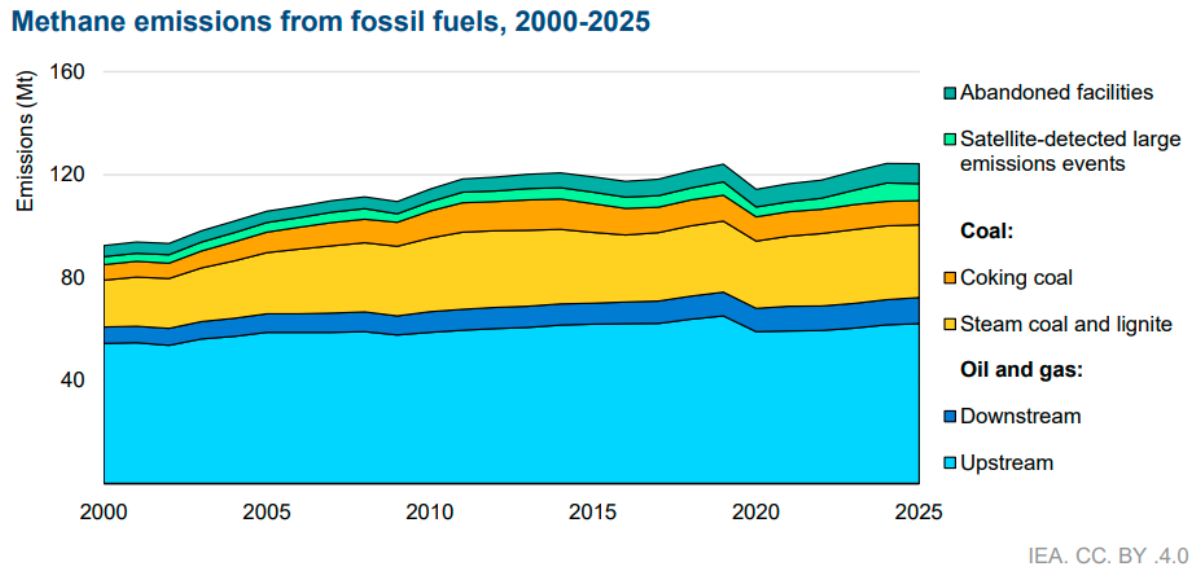
Global methane emissions from fossil fuel operations remained at extremely high levels in 2025 despite growing climate commitments, according to the International Energy Agency’s Global Methane Tracker 2026 report. The IEA report warned that methane remains one of the fastest-growing contributors to global warming, while proven and cost-effective technologies to reduce emissions are still underutilized.
1. Global Fossil Fuel Methane Emissions Reach 124 Million Tonnes
The IEA estimates that methane emissions from fossil fuel operations totaled 124 million tonnes annually in 2025. Oil operations were the largest source at 45 million tonnes, followed by coal at 43 million tonnes and natural gas at 36 million tonnes. Another 20 million tonnes came from bioenergy production and traditional biomass use.
2. Energy Sector Accounts for 40 Percent of Human-Caused Methane
The energy sector, including oil, gas, coal, and bioenergy, accounts for around 40 percent of methane emissions from human activity worldwide. The IEA said reducing methane emissions is critical to limiting near-term global warming and improving air quality.
3. Methane Concentrations Are 2.7 Times Higher Than Pre-Industrial Levels
Atmospheric methane concentrations are now 2.7 times higher than before the Industrial Revolution and are responsible for nearly 30 percent of the rise in global average temperatures since then. The IEA said methane remains the second-most harmful greenhouse gas after carbon dioxide.
4. Top 10 Countries Generate Nearly 70 Percent of Emissions
Around 70 percent of fossil fuel methane emissions come from the world’s 10 largest emitting countries. China is the biggest emitter due to coal mining activities, followed by the United States and Russia. The report also identified Turkmenistan and Venezuela as having among the highest methane intensities globally.
5. Nearly 100 Billion Cubic Metres of Gas Could Be Recovered
The IEA estimates that nearly 100 billion cubic metres of natural gas could be recovered annually through efforts to reduce methane leaks from oil and gas operations. Another 100 billion cubic metres could be unlocked by eliminating non-emergency flaring worldwide.
6. Around 70 Percent of Methane Emissions Can Be Cut with Existing Technology
The report said nearly 85 million tonnes of fossil fuel methane emissions could be reduced using existing technologies. More than 35 million tonnes could be eliminated at no net cost because the value of recovered gas exceeds the cost of mitigation measures.
7. Upstream Oil and Gas Operations Cause 80 Percent of Sector Emissions
About 80 percent of oil and gas methane emissions come from upstream operations such as extraction, gathering systems, and processing facilities. The IEA said leak detection and repair programs, vapor recovery systems, and equipment replacement offer some of the fastest and cheapest solutions.
8. Global Methane Pledge Coverage Continues to Expand
The Global Methane Pledge now includes 159 countries plus the European Union, covering nearly three-quarters of global oil and gas production and about 65 percent of sectoral methane emissions. More than half of global oil and gas production is now covered by company commitments to near-zero methane emissions.
9. Satellite Monitoring Is Improving Methane Detection
Dozens of satellites are now tracking methane leaks globally. The IEA said advanced satellite systems such as TROPOMI, GHGSat, and MethaneSAT are significantly improving methane detection and helping identify large “super-emitting” events from oil and gas facilities.
10. Existing Policies Fall Short of Global Climate Goals
Despite rising climate commitments, the IEA warned that current methane regulations would reduce oil and gas methane emissions by only around 20 percent by 2030 and 26 percent by 2035, far below the Global Methane Pledge target of reducing methane emissions by 30 percent by 2030.
BABURAJAN KIZHAKEDATH