


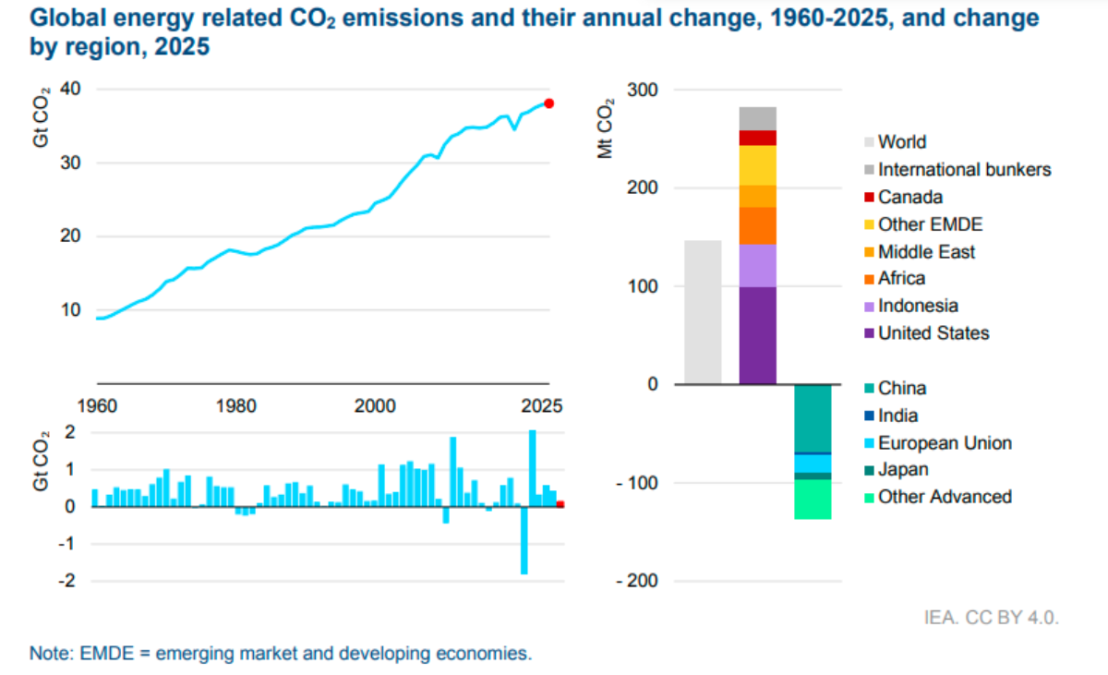
Global energy-related CO2 emissions continued to increase in 2025, rising by around 0.4 percent – the slowest growth rate since 2021 – yet reaching a record high of nearly 38.4 billion tonnes, about 5 percent above 2019 levels. The total increase of approximately 145 million tonnes came as atmospheric CO2 concentrations climbed to about 427 ppm, up 2.4 ppm from 2024 and roughly 50 percent higher than pre-industrial levels.
Emissions from fuel combustion grew by close to 0.5 percent, adding around 185 million tonnes of CO2, while emissions from industrial processes declined by about 2 percent or 40 million tonnes, partially offsetting overall growth. Despite rising emissions, global GDP expanded by around 3.1 percent, indicating continued decoupling between economic growth and emissions, IEA report said.
Regional trends diverged sharply. Emissions in advanced economies increased by 0.5 percent, while growth in emerging market and developing economies slowed to 0.3 percent – the first time in nearly 30 years that advanced economies saw stronger emissions growth. China reduced emissions by around 0.5 percent due to lower coal use and weaker industrial output, while emissions in emerging markets excluding China rose by 1.1 percent, below the 2.2 percent five-year average. India’s emissions declined, supported by a strong monsoon and rapid renewable energy expansion.
Fuel-wise, natural gas was the largest contributor to emissions growth, accounting for about 85 million tonnes of the 185 million tonne increase from fuel combustion, followed by oil at 60 million tonnes. Coal emissions rose by only 25 million tonnes compared to 210 million tonnes in 2024, reflecting slower growth. In the United States, gas-to-coal switching added more than 75 million tonnes of CO2, while China’s coal emissions declined alongside a 1.4 percent drop in coal power generation.
Weather effects significantly influenced emissions patterns. Colder winters in advanced economies boosted natural gas demand, while milder temperatures and an early monsoon in India reduced coal demand by about 8 million tonnes of coal equivalent, cutting over 20 million tonnes of CO2 emissions. Globally, drought-driven hydropower shortfalls added an estimated 40 million tonnes of CO2 emissions. Without favorable weather conditions, coal demand growth would have been about 30 percent higher.
Clean energy deployment continued to limit emissions growth. Since 2019, technologies such as solar PV, wind, nuclear, electric vehicles, and heat pumps have avoided more than 35 EJ of fossil fuel demand in 2025, equivalent to about 7 percent of global fossil fuel use. This includes displacement of over 23 EJ of coal, more than 9 EJ of natural gas, and around 3 EJ of oil, significantly reducing potential emissions despite rising electricity demand.
BABURAJAN KIZHAKEDATH