


The global economy faces a stark financial imbalance: for every US$1 invested in protecting nature, the world pumps US$30 into its destruction, UN Environment Programme (UNEP) said.
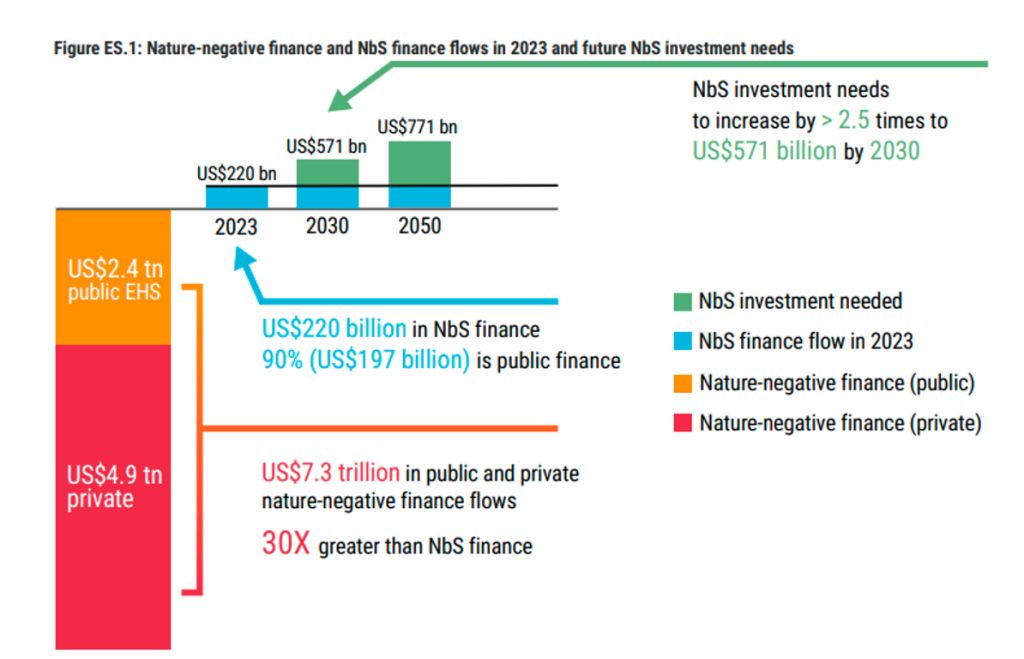
This alarming 30:1 ratio emerges from the State of Finance for Nature 2026 report from UNEP, released today. Drawing on 2023 data, it exposes US$7.3 trillion in nature-negative finance flows while nature-based solutions (NbS) limp along at just US$220 billion.
The report demands an urgent shift: phase out harmful subsidies and investments, then scale NbS to deliver resilience, cut risks, and unlock high returns. With nearly half the global economy reliant on nature, business-as-usual spells disaster for ecosystems, economies, and human well-being.
Shocking Scale of Nature-Negative Finance in 2023
Nature-negative flows hit US$7.3 trillion last year, dwarfing positive efforts. Private sources drove US$4.9 trillion, clustered in high-impact sectors like utilities, industrials, energy, and basic materials. Public harmful subsidies added another US$2.4 trillion across fossil fuels, agriculture, water, transport, and construction.
Governments and businesses continue funding degradation, locking in ecosystem collapse despite growing awareness of nature’s risks and opportunities.
Key breakdowns from the report:
Private finance: US$4.9 trillion – dominated by a few polluting sectors.
Public subsidies: US$2.4 trillion – propping up fossil fuels and resource-intensive industries.
Total harm: US$7.3 trillion, threatening biodiversity and economic stability.
NbS Investments: A Tiny Fraction, But Growing Slowly
In contrast, total NbS finance reached only US$220 billion in 2023 – a mere 5 percent rise from 2022. Public sources supplied nearly 90 percent (about US$196.6 billion), fueled by domestic and international commitments. Private investment? A dismal US$23.4 billion, or just 10 percent of the total.
Despite rising awareness, businesses and finance hesitate to scale up. The report warns NbS must quadruple to US$571 billion annually by 2030 – still only 0.5 percent of global GDP – to meet Rio Conventions goals on biodiversity, climate, and land degradation.
UNEP’s Call to Action: “Follow the Money” for Nature’s Recovery
“If you follow the money, you see the size of the challenge ahead,” said UNEP Executive Director Inger Andersen. “We can either invest in nature’s destruction or power its recovery – there is no middle ground.” She spotlighted surging harmful investments outpacing NbS progress.
German Minister H.E. Reem Alabali-Radovan echoed this: “The world’s financial flows need an urgent shift – from degrading the environment to investments in nature-based solutions. The private sector plays a key role.”
Nature Transition X-Curve: A Roadmap to Repurpose Capital
To flip the script, the report unveils the Nature Transition X-Curve – a groundbreaking framework for policymakers and businesses. It maps a dual path: phasing out destructive subsidies and investments while ramping up high-integrity NbS across supply chains.
This tool sequences reforms for all sectors, turning private and public capital into sustainability engines. By repurposing flows, it promises resilience, equity, and growth – the “Big Nature Turnaround.”
Steps in the Nature Transition X-Curve
Phase out harm: Redirect US$7.3 trillion in nature-negative finance.
Scale NbS: Boost to US$571 billion/year by 2030.
Sector-wide action: Utilities, energy, agriculture, and more adopt nature-positive models.
Public-private synergy: Leverage public funds to crowd in private investment.
Why This Matters for Businesses, Investors, and Policymakers
Redirecting finance isn’t charity – it’s smart economics. Nature underpins half our GDP, yet degradation risks trillions in losses. Scaling NbS offers returns, risk reduction, and compliance with global pacts like the Kunming-Montreal Framework.
BABURAJAN KIZHAKEDATH