


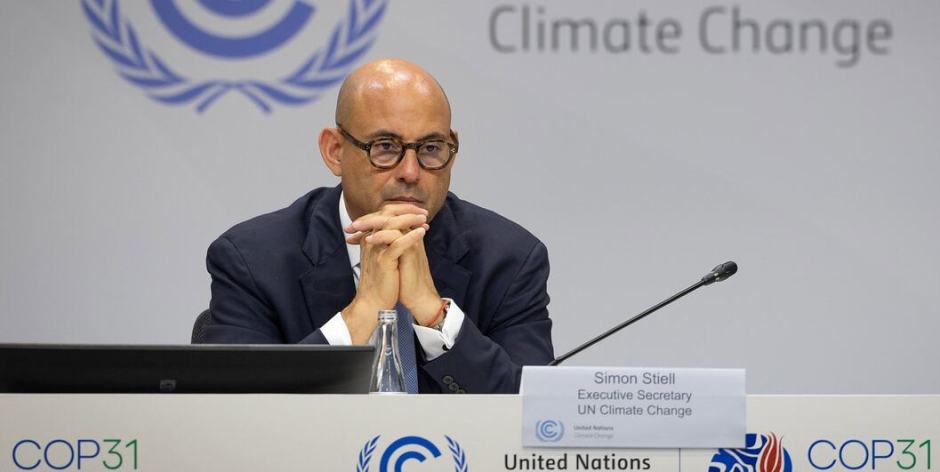
The COP31 UN Climate Change Conference in Antalya, Türkiye, ended on November 22, 2026, without a final climate pact after countries failed to resolve differences over fossil fuel commitments, carbon capture technologies and climate finance for developing economies.
The collapse of negotiations, following two weeks of discussions and two additional days of talks, represents a major setback for international efforts to accelerate renewable energy deployment, reduce greenhouse gas emissions and limit global warming to 1.5°C.
UN Secretary-General Antonio Guterres described the outcome of COP31 as disappointing, warning that rising global temperatures, record greenhouse gas emissions and intensifying climate impacts demand faster investment in clean energy and climate resilience.
The European Union, Panama and the Marshall Islands opposed the proposed agreement, arguing that the omission of commitments to transition away from fossil fuels weakened previous international climate decisions.
Fossil fuel dispute derails COP31 climate agreement
More than 130 countries supported stronger language on the transition away from fossil fuels, but opposition from major fossil fuel-producing economies prevented negotiators from reaching consensus.
The disagreement undermined efforts to advance the commitments made at COP28 in Dubai, where governments agreed to transition away from fossil fuels in energy systems, triple global renewable energy capacity and double the rate of energy efficiency improvements by 2030.
The European Union argued that accepting the Antalya agreement without addressing coal, oil and natural gas consumption would undermine previous climate commitments.
Saudi Arabia, representing the League of Arab States, defended carbon capture and storage (CCS), maintaining that emissions reduction strategies should incorporate multiple technologies.
Pakistan supported continued negotiations, while Ghana, representing the African Group, expressed concerns about inadequate provisions for climate finance, loss and damage, and the just transition.
Global warming could reach 2.8°C under current policies
The COP31 deadlock comes as scientific assessments highlight a widening gap between national climate commitments and the emissions reductions required to address global warming.
The UNEP Emissions Gap Report 2026 projects global warming of 2.8°C this century under existing policies and 2.6°C even if countries fully implement their current nationally determined contributions.
Even if governments deliver their climate commitments and additional net-zero targets, global temperatures could increase by 2.1°C.
UNEP estimates that global greenhouse gas emissions must decline significantly from 2025 levels to create a pathway towards returning to 1.5°C by 2100.
| Year | Required emissions reduction |
| 2030 | 18% |
| 2035 | 45% |
| 2040 | 69% |
Source: UNEP Emissions Gap Report 2026.
Under this scenario, global warming could peak at 1.7–1.8°C around mid-century before declining. Approximately 320 billion tonnes of CO2 would also need to be removed from the atmosphere and permanently stored during this century.
UNEP – UN Environment Programme
Global clean energy investment to reach $2.2 trillion in 2026
Despite the failure of COP31 to deliver a comprehensive agreement, global clean energy investment continues to outperform spending on fossil fuels.
The International Energy Agency’s World Energy Investment 2026 estimates that worldwide energy investment will increase by 5 percent to a record $3.4 trillion in 2026.
Investment in renewable energy, nuclear power, electricity networks, energy storage, electrification, efficiency and low-emissions fuels is expected to reach $2.2 trillion, compared with $1.2 trillion for fossil fuels.
Clean energy accounts for approximately 65 percent of projected global energy investment, with spending around 83 percent higher than fossil fuel investment.
However, clean energy investment is projected to grow by 7 percent in advanced economies and China, compared with 4 percent in other emerging markets, highlighting persistent geographical disparities in energy transition financing.
Nearly 100 countries support 35 percent electrification target
One of the significant developments outside the main COP31 agreement was support from nearly 100 countries for increasing electricity’s share of final energy consumption to 35 percent by 2035.
Accelerating electrification could create additional investment opportunities for solar and wind power developers, battery manufacturers, electricity transmission companies, smart grid technology providers, electric vehicle manufacturers and energy management software companies.
However, climate researchers warned that electrification without a corresponding expansion in clean electricity generation could increase demand for natural gas and coal-fired power.
Bill Hare, CEO of Climate Analytics, criticized the failure to specify clean electricity sources in the 2035 electrification target.
Climate Analytics also expressed concerns about the proposed expansion of carbon capture technologies without stronger commitments to reduce fossil fuel dependence.
Climate finance remains a major challenge for developing countries
The failure to establish credible mechanisms for tripling adaptation finance was another major disappointment at COP31.
Developing economies require substantial investments in renewable energy infrastructure, climate-resilient agriculture, flood protection, water management and disaster preparedness.
Uncertainty surrounding international climate finance could increase financing risks for renewable energy and adaptation projects in developing markets, where high borrowing costs already constrain infrastructure investment.
Private sector participation, multilateral development bank financing, concessional loans and government-backed guarantees will be important in mobilizing capital for these projects.
COP32 in Ethiopia to focus on unresolved climate commitments
Attention now shifts to COP32, scheduled to take place in Addis Ababa, Ethiopia, in November 2027.
UN Climate Change Executive Secretary Simon Stiell highlighted progress at COP31 on just transition measures, electrification, resilience and investment initiatives, despite the failure to adopt the overarching climate agreement.
COP32 will face mounting pressure to establish stronger fossil fuel transition commitments, accelerate emissions reductions, expand adaptation finance and improve access to clean energy investment in developing countries.
For the renewable energy industry, the Antalya outcome reinforces the importance of national energy policies, commercial investment commitments and technology cost reductions in driving decarbonization independently of progress at international climate negotiations.
BABURAJAN KIZHAKEDATH